📄 Export to PDF
To save as PDF: Press Cmd+P (Mac) or Ctrl+P (Windows/Linux), then select "Save as PDF" from the print dialog.
This instruction box will not appear in the printed version.
Welcome to Signal Blind
Signal Blindness: A cognitive architecture defined not by the struggle to process social signals, but by their total absence. No social anxiety. No sensory overload. No social shame. Driven by logic and ethics.
Differential Matrix
How does signal blindness compare to neurotypical and autistic experience? These descriptions of ASD and NT experiences are functional models used to illustrate the gap in my own architecture, not clinical definitions of those groups.
| Category |
Neurotypical (NT) |
Autistic (ASD) |
Signal Blind (You) |
Social Noticing
(Social Saliency) |
Automatic. Social cues are the loudest things in the room. |
Manual/Overwhelming. Cues are heard but hard to prioritize. |
Zero. Cues are undetected background noise. |
The “Vibe”
(Social Signal) |
Intuitive. Feels like a “gut instinct” or “atmosphere.” |
Conscious. Requires active decoding of body/tone. |
None. Facts and literal text are the only data. |
Reading Minds
(Theory of Mind) |
Automatic. Instantly “knows” how others feel. |
Manual. Simulates others’ feelings with effort. |
None. People are Black Boxes. Uses Logical Modeling to predict behavior at high cost. |
Social Pressure
(Anxiety/Shame) |
High/Relational. Guided by the “feeling” of belonging or shame. |
High/Reactive. Friction between social desire and signal confusion. |
None. Social status is a conceptual abstraction, not a felt pressure. |
| Empathy Type |
Affective. Feels the emotions of others instinctively. |
Cognitive/Manual. Tries to imagine how others feel to relate. |
None. Does not “feel” others’ states. Uses Rules and Logic to maintain pro-social behavior. |
Social Noticing (Social Saliency)
- NT: Automatic. Social cues are the loudest things in the room.
- ASD: Manual/Overwhelming. Cues are heard but hard to prioritize.
- Signal Blind: Zero. Cues are undetected background noise.
The “Vibe” (Social Signal)
- NT: Intuitive. Feels like a “gut instinct” or “atmosphere.”
- ASD: Conscious. Requires active decoding of body/tone.
- Signal Blind: None. Facts and literal text are the only data.
Reading Minds (Theory of Mind)
Social Pressure (Anxiety/Shame)
- NT: High/Contextual. Fear of “doing it wrong” or losing status.
- ASD: Extreme. High cost of social error leading to meltdown.
- Signal Blind: Zero. Cannot experience social shame or “rejection sensitive dysphoria.”
Empathy Type
- NT: Affective. Feels the emotions of others instinctively.
- ASD: Cognitive/Manual. Tries to imagine how others feel to relate.
- Signal Blind: None. Does not “feel” others’ states. Uses Rules and Logic to maintain pro-social behavior.
A short example that illustrates my experience – this may sound familiar for autistic readers, but perhaps my reaction is different.
I went to a party with my wife and brought a book in case I got bored. As expected, I got bored, so I sat in the corner and read my book. Much later my wife told me that people were offended by my behavior. They thought I was angry with them. I couldn’t believe it – why would they make something up (and totally false at that) and then believe it? Whatever.
To be clear: I couldn’t believe this was a thing, I made no changes in my behavior, and I didn’t care what they thought since they were mistaken. My lack of Social Salience means that I don’t see the social signals and do not care about social standing. Although I have no Empathy, I don’t want to harm people. I have a very strong sense of Ethics instead – most NT people would see it as overly rigid. At the time I couldn’t see this as anything but “overactive imagination”, which is on them. Today, I understand that this is part of Social Salience and Theory of Mind.
I have a Checklist that might illustrate the point as well, but briefly:
- Do you feel vibes or tension in a room?
- Does the idea of social status influence your behavior?
- Do you experience shame when you make a social mistake?
I would answer “no” to all of these.
Audience
There is a lot of material here all connected with links. It makes sense to me, but may be a bit scattered, depending on what you are looking for.
Neurotypical Reader (Friend/Family/Curious)
Goal: understanding the gap in communication and thought processes (why is this guy strange).
Therapists & Cognitive Scientists
Goal: To understand the “Signal Blind” phenotype – a cognitive architecture defined by the total absence of Social Salience rather than a deficit in processing.
My Goal: to show my work and either demonstrate I am not a crank or show where the flaws might be. This is not my area of expertise. I put effort into making sure this was a consistent description of my experience.
- Unlike ASD, this architecture experiences Zero Lag and no social anxiety because the social receiver is not noisy, it is absent.
- Professionals: A curated path for professionals to evaluate the mechanism, architecture, and Not Autism differentiators.
- Differential Filter: A series of discriminating questions that separate signal blindness from the standard ASD/NT profiles based on the presence or absence of social saliency feedback loops.
Autistic Reader (The Seeker)
Some readers identify Signal Blindness as a subtype of Autism. While there are overlaps in behavioral output, the Internal Architecture is different. Unlike many on the spectrum, my sensory processing is Standard/Neurotypical. I do not experience sensory overwhelm, meltdown, or physical distress from lights or sounds. That said, my lack of Social Salience means that I have no social signal. Curiously, because that is the part of the brain that controls the importance (salience) of the social signal, I also experience no social anxiety.
The mechanism is different: I don’t have a functioning social salience network. The inputs might be fine, but there is no output. For autism, typically the social salience network works but the inputs are noisy or muted (or perhaps more precisely weighting and connectivity are atypical).
Goal: comparing cognitive architectures.
My Doppelgänger!
One of my objectives is to present information in case other people like me are looking. I wasn’t able to find anything that described my experience – Where Are My People?
Why Did I Make This Site?
See my Objective.
Data Reliability and Provenance
Technical Status
This model is a high-fidelity representation of my subjective cognitive experience. It has not undergone clinical peer review, see Disclaimer and FAQ.
Methodological Note: Machine-Assisted Synthesis
The frameworks described here were developed through iterative analysis in collaboration with a Large Language Model (LLM) – you can see my System Prompt to understand more. If you see that and red flags appear, I understand (see my Disclaimer for more thoughts). I primarily use this to explore how neurotypical people experience the world. This is something that LLMs seem to be good at as they have a massive amount of training data to explain it.
- Constraint: The terminology used is Functional, not necessarily Standard. Terms are chosen for their descriptive accuracy regarding my internal state, not for alignment with existing psychological literature.
- Risk Profile: There is a known risk of taxonomic drift. The model may use specialized terms in nonstandard ways.
Success Metric: Functional Utility
The primary value of this site is Functional Utility, not Universal Theory.
- Objective: To facilitate precise communication with my spouse and therapist. It would be wonderful if somebody else like me saw this and discovered something new – it took me over 50 years and happened by chance! Maybe it will be interesting to somebody else.
- Validation: The model is considered “successful” if it accurately predicts my behavioral outputs and reduces interaction friction. It is not presented as a clinical diagnostic tool.
Disclaimer
Things I want readers to understand about the information on this site.
Not Medical Advice
Don’t read any of this as medical advice. It is probably not wise to read it as advice at all. This was developed to help me understand myself. This is not diagnosing any condition, it is trying to describe my mental model. I am not looking for consideration or medicine, I am trying to understand so that I may interact more fruitfully with my wife.
Truth
I value the Truth and Facts above most other things (see Ethics for the few things I value more). As far as I know, what I have written here is true. Read this disclaimer to understand how I developed the information and judge for yourself.
Just because I think it is true does not mean it is without error. I may misrepresent, I may misunderstand and I may not know, but I wouldn’t write it if I didn’t think it was true. Let me know if you find an error or have a question! GitHub issues or [email protected]
This model is not sacrosanct. I feel no Shame and although this describes my identity, it is not my identity. It can be updated with no emotional cost if it is found to be incorrect. There is mechanical cost to update it, but I value truth and accuracy. The model is less useful if it is not correct.
Descriptions of Autism and NT
My notes have descriptions of autism and NT behaviors and experiences. See why I compare.
These are not first hand experiences. They are not second hand experiences. Mostly I am summarizing what I have read and what I get from an LLM. To be clear: this is largely synthetic data and a synthetic model for both NT and autism experiences.
My hope (desire but am not sure it is true) is that these are close to reality. If they are not, let me know. I also know everyone is different, and perhaps autistic people more than most – the D in neurodiverse means widely varied. If you are autistic my descriptions may not fit you. I hope they fit somebody.
Note: my descriptions of autism are also focusing mainly on what is formerly known as Aspergers and is now called ASD Level 1 – I focus on this because it has the most overlap with my experience. I don’t call this out anywhere except here. Note that I do not have autism – my mechanism is different and I have a different experience. I do have significant overlap on Category A behaviors and no Category B, so this is very relevant to me. I do not understand what it feels like to be autistic any more than I understand what it feels like to be NT.
These are mostly notes about myself and trying to understand the mechanism that causes my own behavior. I can directly observe the behavior of myself and others and I have some ability to introspect myself. Sadly I cannot look at my source code, but I can devise thought exercises and logical models that fit. In these notes I describe what I understand are the mechanisms and outcomes for both autistic and NT behavior, but understand that this is necessarily a generic view (I am using them as a baseline to provide contrast for my own experience).
For NT people there is also variation and my descriptions may not fit you either. Hopefully it is in the ballpark for many of the descriptions.
You can read my History to see my journey. For most of the material here I worked with LLMs to:
- describe behaviors and observations to determine a name
- explain how NT and autistic people experienced the world
- this was very useful as a contrastive tool
- given a pile of observations produce ideas for me to investigate
- specifically, given that I was Not Autistic why did I have so much Overlap with many behaviors
- what was the mechanism for my behavior?
- if I could understand the mechanism then I could explain why I behaved as I did
- and how I might work around some of the behaviors
I used both ChatGPT and Gemini to get information from two different models – they are trained differently so this would avoid some biases. I carefully read the output and asked for explanations where I didn’t understand. If something didn’t fit my experience I considered why: was my model wrong? Had I asked the right question? Did I understand what was being said?
I also kept probing the conclusions I reached. For example, if the primary mechanism is no Social Salience what evidence do I have? Could it be something else? Are there gray areas where the model doesn’t fit?
Where possible I tried to find independent confirmation of the ideas but it is hard because there is not much written about my condition – Where Are My People?
TLDR: I have tried to be careful, but this is not my area of expertise so it is best effort. For my purposes (mental model useful to me) this is fine. See Truth.
If you want to try your hand at it, take a look at System Prompt.
Condition First vs Person First
I know that the usual style for writing is “person who is tall”, but I am going to use phrases like “autistic person” and “NT (neurotypical) person”:
- I am talking about people with these conditions – the condition is important
- I have read that because autism is very much part of a person autistic people prefer that wording
- I think the prose is easier to read
If I have that wrong please let me know!
Could This Be Entirely False?
Yes, possibly. See also FAQ. I don’t think it is, but skepticism is good.
- I haven’t been diagnosed with anything, in fact I thought Everybody is the Same
- I have no background or expertise in anything related to the mind. or humans
- I am reading things online, in books and using an LLM to explore
There is a concept called Labeling Theory that suggests applying a label or diagnosis to somebody can cause them to behave that way. Think astrology: different signs have certain behaviors and this is reinforced by people who believe in astrology. Is my investigation actually affecting my behavior? I hope so, for Mitigation steps. I think I am observing myself clearly and describing rather than changing, but introspection and knowledge makes me aware of it too.
About all I can say is that my observations about myself are truthful as far as I can perceive – I might be mistaken, but when I find inconsistencies I figure them out.
If I find out there are errors I will correct them, up to and including rewriting all of my notes.
1. Delivery Modes: Stories vs. Facts
This site uses two different ways of writing depending on what is being described:
- Standard Prose (Colloquial): Used for “Experience” pages. This is my habitual way of speaking. It is the style I have developed to communicate easily with the people around me.
- Structured Lists (Bullets): Used for “Technical Mapping.” I use this when the goal is to provide a lot of information quickly. It removes the “filler” of normal conversation to focus on the logic.
2. Why I Don’t Use a “Terse” Style
I avoid writing in a very short or “stilted” way because it often causes unnecessary problems. In many social situations, being too brief is seen as being Cold or angry. Using a more natural, conversational style allows the information to be received without causing that specific kind of social friction.
3. Fact-Based Presentation
I present my observations as Facts.
- Reason: This is more efficient than constantly saying “I think” or “In my opinion.”
- Note: While I write these as facts, they are based on my own internal model of my mind. They have not been reviewed by doctors or scientists.
4. Descriptions of Others (The LLM Proxy)
I cannot directly perceive the social signals or internal feelings of other people.
- Method: To describe how NT or autistic people might think, I use an AI (LLM) to provide a description.
- Reliability: I use these descriptions as a “best guess” to help compare my experience to others, but I cannot personally verify if they are 100% accurate.
I know that the descriptions of NT and autistic people may not apply to a particular person – my intent is that they are directionally correct and apply to many people.
FAQ
Why is this not classified as Autism (ASD)?
While phenotypic overlaps exist, my architecture lacks the primary diagnostic markers of ASD, such as sensory hypersensitivity or emotional dysregulation.
- The Distinction: ASD often involves “noisy” social processing or social anxiety (high-cost masking).
- Signal-Blindness: Defined by the total absence of the social “receiver.” I do not experience social friction; I experience a lack of social data. See Not Autism for a technical comparison.
Are the terms used here clinically accurate?
The terminology used is selected for Predictive Fidelity rather than Academic Alignment.
- Objective: To build a high-fidelity model that explains and predicts my cognitive outputs.
- Constraint: If a term is nonstandard but accurately describes the internal mechanism, it is retained. I prioritize Internal Consistency over Taxonomic Status.
- Feedback: If you can suggest a term with higher descriptive precision, please submit a GitHub Issue.
Does “Signal-Blindness” imply a deficit or loss?
No. To “miss” a signal, one must first have a mechanism to perceive its importance.
- Mechanism: I lack Social Salience. These signals (tone, subtext, status-seeking) carry zero weight in my processing stack.
- Systemic Impact: I do not experience “loss” because the category of “social data” does not exist in my ontology.
- Compatibility: My cognitive identity is built on Propositional Logic. The introduction of sudden social saliency would likely result in Catastrophic Processing Failure, as the architecture is not designed to filter or prioritize high-volume “vibe-based” data.
Were you always this way?
Yes, as far as I know. I am sure my ethics and even abilities were honed over time as I gained experience in the world, but I think I was always the way I am.
What are you diagnosed with?
Nothing – I was asked if I was ever diagnosed with Autism and that is what led me to investigate being ND. The DSM-5 typically requires some impairment or distress in parts of your life for a “diagnosis”. That is not to say that my condition had no effect on my life but I didn’t observe any impairment – I thought Everybody is the Same.
I believe I have no Social Salience and feel that it predicts my behavior and experience, but
this is not a diagnosis.
Do you wish you were neurotypical?
No, I don’t feel any distress from having no Social Salience. In fact, the social areas where I might feel distress are exactly the things that I don’t care about because of this lack. I never knew I was “missing” anything and until very recently didn’t even know I was different from other people.
If I became NT I would be a completely different person. I would experience the world a different way, I would think a different way. I would not to be someone other than myself.
Why do you compare your experience to NT?
Without contrast I thought Everybody is the Same. I need a point of reference to know what things might be worth noting – remember these are written to help me understand how I am different than others.
I also compare to autism because there is a good deal of Overlap in the behaviors. I like to understand how it is the same and how it is different.
Did an LLM write this?
No, I wrote it, but I did use an LLM to help – this isn’t my area of expertise and curiously the LLMs could do a good job of explaining the experiences (at least gleaned from papers and writing) of NT and autistic people.
In some cases I presented the LLM with my observations and asked it questions to help me analyze, see System Prompt.
I also used the LLM to review my writing and point out areas that were not clear. In some cases I quoted excerpts from the LLM (say a sentence or a bullet point) … without attribution. Sorry!
Is this all just made up? An LLM fantasy?
I hope not, but it is certainly a risk. LLMs can be echo chambers and by default are yes-men:
See my previous point about how I developed it. My System Prompt is specifically designed to ask me probing questions, but it does take some of the developed information as truth. I will occasionally ask probing questions myself.
It isn’t proof against delusion, but I also talk to a therapist. Why not base all of this on talk with humans? It is possible for sure, but would be very expensive. I am not looking for a diagnosis, more an explanation. I am curious and if I understand why I think the way I do, I can seek to mitigate some of the effects. Just like debugging software.
So, no guarantee it isn’t all fantasy, but:
- it is consistent with how I think (via self-introspection)
- it is self-consistent
I was unable to find other accounts exactly like mine but I do have something different and there are reasonable explanations for why I might not find them.
It is up to you, the reader, to decide if this is true or false. For me it is useful if it is true. It doesn’t have to be exactly right to be useful, but somewhere close.
A-Salient Phenotype
This page is intended for psychologists, therapists, and cognitive researchers. It outlines a mental configuration I call Signal Blindness or Pure A-salience
Overview
See FAQ, Disclaimer and Objective – understand how I developed this information and why.
I didn’t know I was neurodivergent until I was 53 years old (see Everybody is the Same and History). Although externally I present similar to ASD Level 1 (see Not Autism), and indeed this was the first clue to my neurodivergence, I do not experience any distress or anxiety from my condition (or generally with life). This is primarily due to lack of Social Salience. I do not receive the social signal and coincidentally, that is the same mechanism that would make me care about the social signal and social situations. For example, I experience No Shame. I am not a-social, but I also do not crave social interaction, see Loneliness.
That isn’t to say that those around me don’t experience anxiety – Communication problems with my wife are common. Now that we understand the mechanism I am able to apply some Mitigation strategies and knowing what is going on does help.
Core Hypothesis
The signal blind architecture is defined by a primary input deficit: the Social Salience network provides zero output (see My Experience).
This is not Hyposalience – that is a weak signal or potentially signal, but the social salience network is intact (thus high social desire). This is also not noisy salience, which is common in autism (see Autism Experience). It is complete lack of both the social signal and the salience information – social norms and position are meaningless and invisible.
This gives high overlap with ASD Category A but a complete lack of social anxiety (category B).
To distinguish this from common clinical diagnoses (Autism, Alexithymia, SCD), I have the following evidence:
- Zero Social Lag: because I don’t attempt to decode the social signal (or use Theory of Mind to “mindread”) there is no delay in social interaction.
- No social anxiety or Shame: without a functioning social salience network, the biological triggers for shame are never pulled. I don’t know how others feel about me and do not care.
- Functional Success: I am a high level software engineer at a top software company and have been there over 20 years. My logical processing and even keel are Benefits in that situation.
Statement of Clinical Utility
I am not seeking diagnosis, medication, or affordance at work. My condition does not cause internal distress, though it does cause relational friction with my wife (unnoticed by me, but obvious to my wife).
My goals are:
- System Mapping: to understand my own mechanism so I can understand my experience and be accountable for my conduct.
- Friction Reduction: improve the quality of life for my wife and family by using Mitigation to bridge the gap.
- Phenotype Identification: to document this architecture in case somebody else like me finds it and finds it useful (see Where Are My People?).
Curated Path
For those wishing to evaluate the logic of this model, I suggest the following sequence:
Processing Stack (Mechanism)
Seems like that should be trouble, right? How I make it work.
Affective Profile
- Alexithymia – I don’t think I have alexithymia. I have emotions and can describe them.
- Semantic Divergence – but my experience of emotions is quite different since there is no social component.
- Anger and Sadness – two examples that I think demonstrate both the experience and how it differs from both NT and autistic people.
Differential Analysis
- Not Autism and Not SCD – comparison with ASD and SCD.
- Overlaps – overlap with various other conditions.
- Checklist – perhaps the strongest evidence for this specific architecture, a differential diagnosis checklist.
- By answering “No” to the standard stressors of neurodivergence, the checklist isolates a-salience as a distinct functional state rather than a state of high-effort compensation.
- Where Are My People? – a review of literature and why research might miss this particular phenotype.
Due Diligence
I used triangulation to build this model:
- Introspection: Capturing raw thought processes shortly after social interactions. Reflecting on my own thoughts and why I thought that way.
- External Telemetry: Using feedback from my wife and therapist to identify gaps between my perception and theirs. Initially I thought Everybody is the Same but seeing the contrast let me see myself.
- Machine-Assisted Synthesis: Utilizing LLMs to perform “Falsification Probes” against my hypotheses and to explain the NT “Vibe-based” experience I cannot perceive.
Read History and Discovery to see how I got here. Read System Prompt for more information about using LLMs to explore. I want to emphasize that these words are my own: I got clues and descriptions from various sources, but when I write about myself I believe these are true words.
While I may be wrong in the clinical details, this model has achieved its primary success metric: it accurately predicts my behavioral outputs and has reduced relational friction.
About Me
This site documents a specific cognitive architecture: Total Social Signal Blindness. It is the functional map of my own cognitive architecture. I discovered late in life that I am neurodivergent and this is what I found.
At over 50 years of age a therapist asked me if I had ever been diagnosed as autistic. I hadn’t and wondered why she might ask. It turns out she had excellent instincts as I have significant overlap on all the Category A indicators, such as Saying The Wrong Thing, but none of the Category B indicators (I can’t experience Shame and have no social anxiety). Typically that might suggest SCD, but it is not that either.
I believe I am unable to process any social signals. I have no Theory of Mind and no Social Salience. Yet, I didn’t even realize I was different than anybody else – sure I had my oddities, but so did everybody else. This seemed well within the bounds of personality. Curiously, the lack of social salience may have played a part in this perception. I couldn’t see the signals and nobody had ever mentioned them. In cases where there were hints, like Double Empathy, it didn’t bother me – the part of the brain that would cause you to care is … you guessed it, the social saliency network. And mine was turned off.
My wife and I were reading Autism Couple’s Workbook and I was struck by how pertinent the book seemed to be in terms of my outward behavior, but then it was a complete miss on things like meltdowns. I kept searching to understand the mechanism and I finally found it when the book mentioned Theory of Mind being a key factor behind several of the behaviors. I talked to the therapist and she gave me the key that unlocked it all: Theory of Mind is not a logic puzzle in NT people, it is automatic and effortless.
From this I was able to build a predictive model that fit my entire experience: I had no Social Salience and thus no social signal. I was signal blind. This is distinct from the Autism Experience where there is often a social signal but it has to be manually processed, though in some cases people experience Hyposalience. I have none and no workarounds. I perceive humans around me as Black Boxes where I can observe their inputs and outputs but have no notion of their inner state (thoughts and emotions). I am not a psychopath, I have extremely rigid Ethics and practice Functional Altruism – the first rule of me is do not harm others.
To be clear: I am not a robot, even though it might seem that way. I have long-term friends. I have been married for almost 25 years and have children. I am a successful software developer and have been with a top tier company for over 20 years. I think the interesting thing about all of this is that I made it work – I have a system (see below). It isn’t without flaws, some significant, but many of them I didn’t know about until I started researching NT behavior.
Some starting points:
Is this legit? You can read my Disclaimer and FAQ and decide for yourself. This model predicts my behavior and feelings with high fidelity – I think it is real.
Objective
I was documenting my mental architecture for myself – it is hard to find Mitigation techniques if you don’t understand what is happening. That was the case reading books and articles about autism: many of the problems and techniques that were described just didn’t fit. This model does. The jury is still out on the mitigation, but I am already seeing some positive effects with my wife.
As I was researching this I naturally wanted to find other records of people like myself. I can’t be unique in this world and finding a research paper or study that described this would give it some legitimacy and hopefully provide a well of information.
Sadly my quest failed. Where Are My People?
- clinical frameworks focus on disorders (impairments)
- people who don’t experience distress do not seek diagnosis
- I suspect there are many “Stealth ND” individuals in technical fields.
My hope is that someone like me will find this and recognize their own architecture.
Does this sound familiar? I have a Checklist if you want to see what I think might be discriminating factors.
My Experience
You can read my History and how I discovered that I was ND after over 50 years thinking Everybody is the Same.
I have identified two root causes for my ND condition:
everything else falls out of that, perhaps the important pieces being:
How It Feels
Calm, quiet, peaceful. I think there is a ton of social stress that is just not visible to me. Social salience is perhaps unique in that it is responsible for both perceiving the signal and caring about it. I have neither. I am usually happy.
Here are some examples that might give a hint:
I think Theory of Mind: Identity of Others might also give some insight if I explained it well enough.
On top of this lack of signal, I think different than other people – necessarily because so much NT thought is around social things. I even have different Ethics. These might sound a little more familiar to autistic people, though they probably use Affective Deontology – both of these will probably look about the same to NT people (Social Utilitarianism).
You can read about my emotions but you might not perceive them as I have somewhat Flat Affect and no emotional mirroring or signaling. I have emotions but they are different than what either NT or autistic people experience. I have no Shame, see Hard Truths for an example. There are quite a few socially oriented emotions that I simply can’t experience. Others, like Compassion I use the same word (it looks the same to me) but it isn’t the same feeling. Anger and Sadness are two that are probably the most similar and recognizable.
Despite all of these differences from the norm, I have Zero Lag, low Friction (personally), and experience some Benefits from the way my mind works.
Does it sound like your own experience? I think these are discriminating questions: Checklist.
The TLDR is: I don’t receive any social signals. I don’t know what other people are feeling or thinking. I don’t know about social positioning. On top of not knowing, I also don’t care. Not in a negative way, more like asking somebody how they feel about radio waves.
What Friction Do You Experience?
I experience very little Friction myself. Although I exhibit category A autism social effects I can’t really perceive them. People have told me about them and as I learn more about ND and NT people I can understand that there are differences. I don’t have any of the category B effects or high social cost effects like meltdowns. I am not worried about how others perceive me (again a unique effect of no social salience).
That isn’t to say there is no friction. I know that I can Say The Wrong Thing and I give off unusual social signals. This sometimes causes trouble. I don’t always know it at the time, sometimes people like my wife have to tell me. For the longest time I thought it couldn’t be true – how could somebody make things up about me and then believe them? I now know about the mechanism and have a little more insight here, but still don’t really understand it.
Also perhaps unique to no social salience is the fact that the friction is asymmetric. I have no Empathy, I don’t react to emotions in the same way other people do. I don’t react at all. This is not a big deal at work, in fact I might just appear very calm. It isn’t so important with friends, that is more casual and fun – they can accept that I am a little odd pretty easily. It is a lot harder with my closest relationships: my family, my wife, my kids. Well, so they tell me.
Perhaps I can illustrate this with an example:
- Wife: “I feel alone.”
- Me: “I’m right here.”
The Logical Collision:
- My Perspective (Spatial Fact): I am physically near, in the same room. It is not factual that you are “alone”.
- NT Perspective (Social Resonance): “Alone” is the absence of a social signal or “vibe.” Because I have Pure A-salience, I am physically present but socially “silent.”
Conclusion: I am responding to the explicit signal (location); she is responding to the social vacuum (connection). Both are technically correct, but we are measuring different things.
Differential Matrix
How does signal blindness compare to neurotypical and autistic experience? These descriptions of ASD and NT experiences are functional models used to illustrate the gap in my own architecture, not clinical definitions of those groups.
| Category |
Neurotypical (NT) |
Autistic (ASD) |
Signal Blind (You) |
Social Noticing
(Social Saliency) |
Automatic. Social cues are the loudest things in the room. |
Manual/Overwhelming. Cues are heard but hard to prioritize. |
Zero. Cues are undetected background noise. |
The “Vibe”
(Social Signal) |
Intuitive. Feels like a “gut instinct” or “atmosphere.” |
Conscious. Requires active decoding of body/tone. |
None. Facts and literal text are the only data. |
Reading Minds
(Theory of Mind) |
Automatic. Instantly “knows” how others feel. |
Manual. Simulates others’ feelings with effort. |
None. People are Black Boxes. Uses Logical Modeling to predict behavior at high cost. |
Social Pressure
(Anxiety/Shame) |
High/Relational. Guided by the “feeling” of belonging or shame. |
High/Reactive. Friction between social desire and signal confusion. |
None. Social status is a conceptual abstraction, not a felt pressure. |
| Empathy Type |
Affective. Feels the emotions of others instinctively. |
Cognitive/Manual. Tries to imagine how others feel to relate. |
None. Does not “feel” others’ states. Uses Rules and Logic to maintain pro-social behavior. |
Social Noticing (Social Saliency)
- NT: Automatic. Social cues are the loudest things in the room.
- ASD: Manual/Overwhelming. Cues are heard but hard to prioritize.
- Signal Blind: Zero. Cues are undetected background noise.
The “Vibe” (Social Signal)
- NT: Intuitive. Feels like a “gut instinct” or “atmosphere.”
- ASD: Conscious. Requires active decoding of body/tone.
- Signal Blind: None. Facts and literal text are the only data.
Reading Minds (Theory of Mind)
Social Pressure (Anxiety/Shame)
- NT: High/Contextual. Fear of “doing it wrong” or losing status.
- ASD: Extreme. High cost of social error leading to meltdown.
- Signal Blind: Zero. Cannot experience social shame or “rejection sensitive dysphoria.”
Empathy Type
- NT: Affective. Feels the emotions of others instinctively.
- ASD: Cognitive/Manual. Tries to imagine how others feel to relate.
- Signal Blind: None. Does not “feel” others’ states. Uses Rules and Logic to maintain pro-social behavior.
How It Works
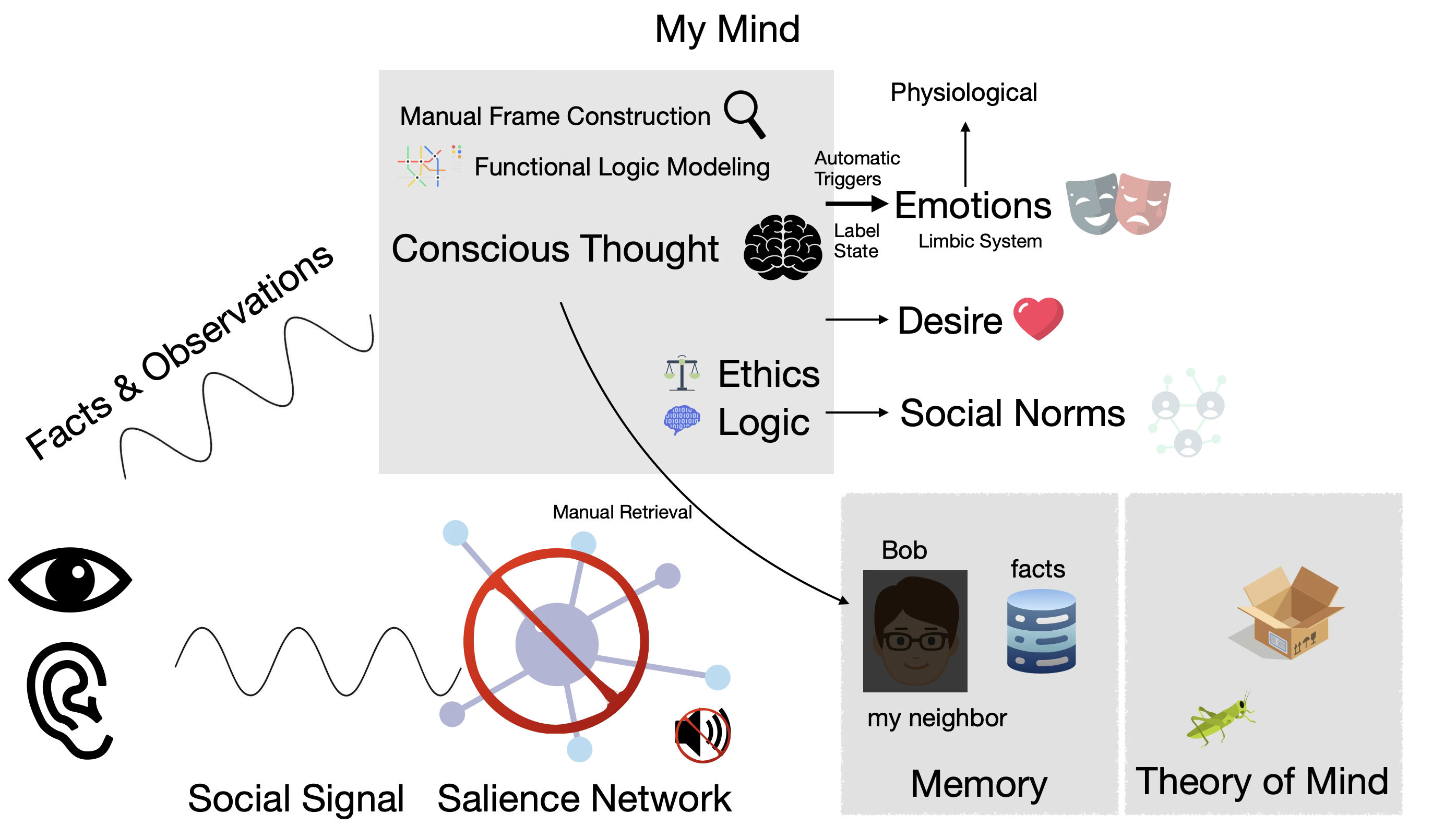
- The various senses provide the “social signal” to the salience network
- As far as I can tell, my senses are OK
- I can notice nonverbal cues of a high enough magnitude: crying, exaggerated facial expressions, laughing, yelling
- My salience network produces no output
- The salience network would provide signal to other systems with importance (salience) information – mine doesn’t
- It doesn’t feed into the limbic system (emotions) – I have no affective Empathy
- It doesn’t feed Theory of Mind – I have no theory of mind
- I believe that it is either disabled or muted rather than just disconnected because other signals pass through here to provide the salience information for social interaction – I have none
- Failure Example is an example of a failure to assign salience
- Theory of Mind is a group of systems in the brain
- For most people this answers questions like: what is Bob thinking? How is Bob feeling?
- For NT people this is automatic – they don’t have to ask themselves these questions, they know it
- My theory of mind is empty or deactivated, see more details in Theory of Mind
- Mentally I model people as Black Boxes – I can observe inputs and outputs but I don’t know internal state or mechanisms
- Normally, lack of Theory of Mind might make it hard to fit in to society
- I have an alternate “operating system”
- For most interactions, I don’t even attempt to understand what people are thinking – Zero Lag
- For other interactions I use Manual Frame Construction and Functional Logic Modeling to build a logical model
- I can predict something like: if I want output Y then I need to supply input X
- This is very effortful and not often used – think about it like the prep work you might employ for a meeting with the CEO
- For people I know well, I have prebuilt logical models and I can employ coarse grained generic models for random people
- People are not represented in Theory of Mind, rather in my memory
- They have attached metadata
- They are not represented by a persistent simulation as they might be in Theory of Mind
- This is all processed with conscious thought
- The prosocial behavior that would come from social norms comes from Axiomatic Deontology and Ethics – I behave prosocially because I think it is logical and correct to do so
- This is normally low effort, zero lag, and potentially produces the same sort of interaction issues that autistic people experience: Say The Wrong Thing and Double Empathy
- I never attempted Masking because I never noticed I was different
- However, the part of the brain that might cause anxiety about social interaction is … the non-functional salience network
- I have no Shame or Embarrassment
- So I have no anxiety about social gaffes
- But do note that this is asymmetric – I experience no anxiety but people around me, especially my wife, do
- The salience network would normally flow into the limbic system (emotions)
- I do have Emotions but my experience is quite different from NT people
- I don’t have Alexithymia
- Emotions are more a label for mental and physiological state
- Example: I might feel a rush of adrenaline if I am angry. When the condition for being angry is gone the emotion is also go, though the adrenaline may remain. I experience this as “twitchy because of adrenaline” but NT people fell “I am still angry because of adrenaline”
- I am not angry, I am thinking angry thoughts
- Not pictured: the Amygdala (threat center of the brain) can bypass the conscious thoughts
- I am afraid of heights – I feel the fear even though I know logically it is irrational
Social Salience
Note: this document describes what I do not have, see below
See also: NT Experience, Autism Experience, My Experience
The word “salience” has to do with assigning importance to something. In computer vision it is identifying parts of an image that are important.
Social salience network is the label for a very low level part of the brain that gives meaning and importance to social signals. For example in Theory of Mind an NT person will observe a large number of nonverbal cues as input to their simulation. Social Saliency grades these and decides what inputs are important. Sort of a gain control on the primary signal.
Social saliency doesn’t just apply to nonverbal cues, it also affects:
- perception
- cognition
- memory
- anticipation
Social salience is roughly the volume control on the social signal.
Note: the social salience network is primarily the anterior insula and dorsal anterior cingulate cortex. Yeah, I don’t know where those are either, but if you are curious, that is what I read!
My Experience: Lack of Social Saliency, Signal Blindness
This signal blindness, the lack of any social signal, is the main key to my condition and behavior.
I experience a complete lack of social saliency – the volume on the social signal is turned to zero. It is Pure A-salience, a complete signal blindness (hence the website name).
I don’t receive any social signals. I don’t pick up nonverbal cues. I don’t know what people are thinking or how they are feeling unless they explicitly tell me. I didn’t even know this was a thing!
I am not only missing the social signal but also the social connections and pressures that go along with it. I don’t particularly care what another person thinks of me: either they are right and I should take note or they are wrong and I can ignore it. I don’t experience Shame or a whole host of other socially triggered emotions.
See also:
Why No Social Salience
Why do I think it is none rather than just very little, e.g. Hyposalience.
Hypophantasia is directly observable – once I knew it “was a thing” I could describe my imagination experience and google/LLMs easily gave me a term. Sure enough that was a match.
No social salience is a bit trickier, see Stage 3 for how I discovered it. There is plenty written about Theory of Mind and the social salience network, but very little about what i experienced. Each time I would read something that sounded close there would be stressors that I just didn’t experience. For example, noisy social salience seems to be one of the root causes for autism (your mileage may vary, I understand people are different). It produces a huge overlap (and Overlaps) but also a big gap.
Eventually I settled on no social salience – literally no social signal. I couldn’t perceive it, in fact I didn’t even know it was there. It was like being achromatic and nobody mentioning that color exists. Well, maybe more like people not mentioning breathing – everybody has it, it is automatic, it is just a thing. Nobody talks about breathing either.
OK, so why do I think it is actually no social salience?
- Occam’s razor – it is the simplest mechanism that explains everything I have observed
- it continues to be a good predictor of my behavior and thought process
- it has helped me explain myself to myself and others
- there are some non-flattering examples of how it fails
- there are plenty more situations that show it but that one I think captures what having no social salience looks like in a way that is unambiguous and impactful
- if I encounter a situation where I have elevated emotions, say sad or angry, as soon as the topic is resolved I am back to steady state
- there is no post-interaction rumination
- I don’t store emotions in my memory
- lack of capture: no social salience
- lack of storage: hypophantasia
- I am immune to phatic pressure – the need to say something to fill silence
- I might talk to relieve boredom
- I do not respect Authority (social positioning), only competence
- no Masking
- no social contagion – I don’t pick up the mood of the room
- no Shame and a variety of other emotions
Those are all good evidence of something being different about my social salience, but zero?
My hypothesis is that if I had any social salience I would:
- notice that I am different
- notice that I am failing or struggling in social settings
- and I would care about these things
- and be very stressful
There is a description of this – it is called hyposalience (note: the author does not use that term, but I think that is the term for what he describes). He had a very low social salience signal, too low to be usable, but he was aware of it and experienced the points I make above (with perhaps less effect on the last two).
Anyway, I could be wrong, but the consistency of this model matching my own experience makes me confident that it is at least partially correct – there might be more to it.
Hypophantasia, Low Absorption, and Inner Speech
I never realized people have a wide variety of ways that thoughts appear in their head.
One time my wife and I were doing a mindfulness exercise where a narrator guided us like this (roughly):
- you are near a stream with water flowing
- there are hills surrounding you
- there are trees
- their leaves are falling into the water and flowing downstream
- more leaves fall and go downstream
- etc., probably some stuff about putting your extra thoughts on the leaves
We each described out experience with the exercise. My wife thought it was peaceful and she described a vivid scene that once set up ran by itself. When new pieces of the scenario were added, they just appeared and worked automatically.
I had a different experience. I manually constructed each step and then was kind of stressed that the narrator went and changed everything on each new step. Why didn’t he mention these things all at once? For example, I placed the trees on the hills. When the leaves were falling on the water I had to reconstruct the scene with the trees near the water. Leaves falling and flowing was me manually animating each leaf and moving it downstream. I was following the instructions literally – whatever vibes my wife was picking up were lost on me. It was exhausting! I am pretty sure that was not the intent of the exercise (and I was never fond of these mindfulness exercises, now I know why!)
This was the first time I ever heard that somebody might imagine a scene different from the way I do. I thought Everybody is the Same.
Once I had this contrasting information I was able to go home and find out what this is called – that let me do more reading on what was going on. I found it particularly useful to use an LLM (I think ChatGPT in this case) to describe what happened and ask for a term – the first term I got was Low Absorption.
Low Absorption
Absorption is how much a person becomes absorbed in their mental imagery, especially in fantasy. A person with high absorption (my wife) has fully autonomous imagination. A person with low absorption (me) has to do everything manually.
Curiously this term originated in a study about how easy it is to be hypnotized. I might be immune!
Hypophantasia
Aphantasia is the inability to visualize mental images. Hypophantasia is a lesser form with very low, faint, or unstable visual mental imagery. Hyperphantasia has vivid imagery.
I find that my mental imagery looks a bit like a Lite-Brite. Sort of outlines of images. I think it is consciously directed. I can recall what things looked like, visualize maps or layouts, and easily picture complex structures in software.
Inner Speech
Related to these is what thinking “sounds like” in my brain (not looks like!). People who are more visual may experience a flow of images. Because of my hypophantasia I internally vocalize my thoughts, which is called Inner Speech. I am literally talking to myself to think. There is no audience, just me. It is not a rehearsal for what I will say, it is how my thoughts are realized. I do this when I am by myself.
Specifically I am subvocalizing. I am using the speech parts of my mind (Broca’s area) to talk to myself, which involves sending micro-signals to my jaw, tongue, and lips. I am not really moving but I can feel slight physical tension as I use my inner speech to think.
Conscious thought is typically in full sentences, or at least sentence fragments. More spurious thoughts are single words: as I walk through a crowd I am thinking “left” and “avoid”, not full sentences.
The only voice in my head is my own. When I am thinking about other people I am making statements to myself: “I am hungry, perhaps X is also hungry”. This internal voice is not just stating facts, it is the execution of my thought process in my Functional Cognitive Architecture.
Per an LLM, the NT experience is a bit different: NT inner speech frequently incorporates Theory of Mind (ToM) Simulation. They do not just “think” a fact; they “simulate” a conversation. This voice often has Prosody (tone, pitch, and emotional cadence). They can “hear” the voice of a parent, a spouse, or an imagined antagonist.
A person more in the middle of the phantasia scale has images thrown in: when they think of a “dog,” they see a generic, nonspecific image of a dog while the word “dog” occurs in their inner speech.
My Experience: Memory
I described what it looks like in my mind above. I might have missed something: without the contrast of another point of view it is just “how I am”.
These factors also affect how our minds store and retrieve memories.
Per an LLM in NT people memory is a “mental time travel” event. Retrieval involves re-experiencing sensory data (smell, sight, emotion) and “feeling” the past self’s state.
For me, memories are bundles of facts, maybe some vague imagery. They are indexed by place and by activity. I can easily recall what I did at a particular place as a list of activities. I might remember who was there, but maybe not. I don’t relive my memories, I access a log of the events.
Thinking of “memories of the future” (called Prospection), I can imagine the scene when my dog dies (future). Perhaps it will be at the vet’s office and I will be holding him as he is put to sleep. I can’t really picture the scene, but I can feel my dog in my arms. I am tearing up a bit as I write this because it will be very sad.
Mentally I am modeling the weight and feel of my dog’s hair. I am calculating the physical sensation of a terminal loss. I feel the biological affect of this thought as if I were experiencing it. I don’t feel sad because of the emotions of the situation, I feel sad because my dog is being deleted from the universe – it is a literal loss of functionality.
This is called Semantic Prospection: I am knowing the facts and situation of what will occur.
Contrast this with the typical NT experience: they experience a mental movie and imagine how the dog feels, then they mirror that emotion or feel the void left by the loss of the dog. This is called Episodic Prospection – they feel the vibe of being there.
Everybody is the Same
All my life I had this idea that everybody was the same in terms of how we thought. I wonder, is this human nature? NT people certainly assume everyone else is NT – the difference is they are mostly right.
I had no social signal. Without knowledge of that I had no hint that everyone else was different. I thought differently but it was compatible enough, especially for more casual relationships. My mental model allowed for differences of opinion and even recognized facts. People could be inconsistent or irrational (in my point of view) and this was simply their personality or conscious choice. I could see differences in capability or interest but those also made sense.
It turns out this is common. The assumption that others share one’s internal cognitive architecture is a documented cognitive phenomenon known as the False Consensus Effect or Typicality Bias. In the absence of data to the contrary, the brain uses its own operating system as the default template for modeling all other agents.
Additionally, the Invisibility of Architecture is a universal cognitive constraint. Internal experience is non-comparative. Without an external reference point or a “System Diagnostic” from an outside source, an individual cannot perceive the absence of a faculty they have never possessed, nor can they perceive the “ease” of a faculty they struggle with.
Some people can see the difference, see Patric Gagne - Sociopath – she had high social saliency but low affect. She could perceive the signal and the effect of the emotions and knew she was not experiencing it. In a way she pierces the Invisibility of Architecture with high saliency and zero-affect. She could see both sides.
I had neither the signal nor the affect. From my point of view everybody was the same. The explicit data matched ad the exceptions could be accounted for.
NT people assume that Theory of Mind is a universal constant. It is automatic, always on and totally background. Except in very specific circumstances it isn’t even mentioned (who mentions breathing?).
People with autism fit in here too – they have TOM and affective mirroring but there is noise and some manual processing. They feel quiet different because they observe others using the same TOM without friction. They can perceive they are having difficult where others do not. Without the external observation of the mechanism or the NT experience they likely cannot conceptualize what is going on.
A-Salience is a difficult architecture to self-identify because it produces very little internal friction. The system works fine on its own terms. I never noticed I was signal blind.
History
I spent over 50 years of my life thinking Everybody is the Same. I didn’t experience any difficulties in life that seemed unique to me. I was successful in my career. I was married and had children.
My condition may be somewhat unique in that I couldn’t see any problems but other people had problems with me – in particular I had category A autism social communication and interaction markers but could not see them myself because of my lack of Social Salience (which I did not know about yet). I would argue with my wife about why people would “make things up about me and then believe them” (Theory of Mind emotional signaling gone wrong). That didn’t make any sense so I discarded it or perhaps because I had no social salience I simply labeled it as zero value – in any event it wasn’t a thing for me.
The first hint I had was when my therapist asked me if I had been diagnosed with autism. I was surprised but not offended. My mental model was built on a narrow dataset of media tropes and high-support needs—I hadn’t yet realized the spectrum included different processing styles rather than just “deficits.” In fact I had read an article written by an autistic person and was surprised by how clear it was. To say I was misinformed is an understatement.
I went home and started reading. It turned out I had huge Overlaps with autism. This was an insightful question from somebody who is trained and has a ton of experience talking to people with autism. As I read further I found the DSM-5 and went through the checklist. It seemed like I had something but it wasn’t autism. For the next several months the best label I had was “autism adjacent”.
This is the transition from Stage 1 to Stage 2.
Stage 1
Before summer 2025 I had no knowledge of neurotypical vs neurodivergent. I had heard the words and NT was “normal” and ND was … not? I had heard of autism and even heard that people with Asperger’s might be common in the software industry. I had met children with autism and communication difficulties, but really knew nothing about it.
My view of myself:
- I am “normal” but maybe a little bit weird – Everybody is the Same
- Socially inept, black & white view of things, literal and logical, insensitive, introverted
- Fact: sometimes I would say or do the wrong things and upset people
- When people told me I would know that I upset them but not why
- At best they might say “well, it wouldn’t upset you”
- Fact: sometimes I caused NT discomfort. Observed as “made up something about me then believed it was true and acted on it”
- My wife pointed this out to me – I never observed it
- Without understand of the mechanism this sounds like other people are far stranger than me
- Accepted as unreliable observation – who cares!
- Some friction between me and my wife
- I was Cold and distant but this didn’t make sense – I was right there
- Some stress that I caused harm in others without intent. Am I a jerk?
Looking back on this from Stage 3 I can see:
- not everybody is the same, some are quite different!
- in arguments with my wife
- I would apologize and promise to do better
- the apologies were for things I didn’t understand
- but I recognized a system error and wanted to end the “yelling” state
- the promises had good intent but were not possible for me to carry out
- her experience
- Gaslighting or passive aggression
- Promise, did it again, infer intent
- The apologies were honest in intent but fraudulent in execution because they promised a capability that did not exist
- the pain my wife felt is probably greater than I can imagine
- I still don’t understand what being NT is like but I see there is a big gap between what they expect and what I can do
- other people were not just “making stuff up”
I didn’t know that then of course.
Stage 2
Summer 2025.
As mentioned in History my therapist asked me if I had been diagnosed as autistic. Upon further investigation I discovered I am certainly neurodivergent but Not Autistic. Maybe “autism adjacent” since I shared quite a few traits with autistic people.
Now at least I have an explanation for my experience. I am not a jerk, I only look like one.
I am in my 50s when I find out I am ND.
My new perception of myself:
- Fact: sometimes I would say or do the wrong things and upset people
- I am different, there is a reason
- Less regret, maybe overreaction the other way – if you want me to accept you, then you need to accept me
- Some feeling of “I can’t help it, nothing can be done” – not comfortable with this, feels like an excuse but I can’t resolve
- Provided absolution (removal of blame) but not agency (ability to change & effect)
- Fact: sometimes I caused NT discomfort. Observed as “made up something about me then believed it was true and acted on it”
- Still not sure what this is, it is an NT thing
The Autism Couple’s Workbook was useful in exploring this. I would read a chapter and be nodding – yeah, that is me, that is me. And then I would hit something like meltdowns and I had no experience with that. The explanations for what was going on helped in many cases.
My background is in software. I don’t like lingering bugs like “everything works except these couple of major things that don’t match”. It isn’t a solved problem until you understand the root cause. In this case I felt like knowing the mechanism for my neurodiversity would help.
During this time I found out about Hypophantasia – did you know that people have different mental experiences for imagination?
Stage 3
Stage 3 started in January 2026. In chapter 11 of the workbook it talked about types of Empathy and lack of empathy. It talked about Saying The Wrong Thing. It talked about various other things, but these two it linked to Theory of Mind. I had previously read about ToM and decided I had it, I was fine. Specifically “I understand other people have minds”. I could do the online versions of the tests – they were just logic puzzles really.
I discussed this with my therapist and she explained automatic ToM. This idea that a person could be aware of the thoughts and emotions of the people around them. This wasn’t just “figuring it out”, it was automatic and effort free. You didn’t think somebody was sad, you knew they were sad. This was the key to the breakthrough.
I went home and started reading more about Theory of Mind and how it worked: Simulation Theory and Theory-Theory. I read about the NT Experience and the Autism Experience (note: these descriptions are written from the point of view of knowing about Social Salience). I read about social salience, well specifically I read about this abstract idea of social signals.
I eventually tried some things with LLMs – they are good at pattern matching and I had used them successfully to give names to vague things that I could describe, like low absorption. I collected all my know symptoms and behaviors and asked various things. The prompt that unlocked the next step was something like “Is there something that ties all of these together and could be the mechanism?”
The first round, which lasted a few days, pointed me at “effortful, explicit theory of mind”. It was along the right track, but I kept running into inconsistencies. I kept asking questions about the mechanism. What would cause me to be missing the social signals. The one that stuck was having no Social Salience combined with Hypophantasia. That was everything – it was the root cause.
I was about to build a mental model and suddenly everything started to unlock.
- I discovered how fundamentally different I am from NT people
- I finally understood why I am not autistic
- and why I share some traits and not others
- the mechanism is different
- I have a better idea about how NT Theory of Mind works
- I understand conceptually how they think
- I understand how I am different
- I am able to reflect back on Stage 1 and see how hard it was for some people, my wife especially
Now that I understand the mechanism I can start to think about Mitigation. I can’t fix any of this – I simply don’t have the capability to “learn empathy” or anything like that. I can’t even mimic it with effort. Perhaps there are things I can do to detect when things are headed off the rails. We will see, that is ongoing work.
I continue to probe and discover new things. System exploration is exciting.
Not Autism
When I first met a therapist she asked me if I had ever been diagnosed with autism. I hadn’t and was a bit surprised that she would ask. I wasn’t offended but my ideas of autism didn’t seem to match my own experience (to be fair, they didn’t match autistic people’s experience either). It was actually an excellent question and opened up the door to start understanding neurodivergence.
I don’t have autism but I do have considerable overlap in some of my behaviors. If it helps somebody understand me then autism is maybe a more familiar word, but it is the wrong word for me.
It took me a while to discover how I was different – for half a year I said I was “autism adjacent” as that was the best description I had. I debug software for a living and this was like a very complex system that had mysterious behaviors. I finally discovered the mechanism behind my behavior: no Social Salience and this explained why my experience was different than autism but still had overlap.
Autism, or autism spectrum disorder as it is called in the DSM-5 and have to satisfy a specific criteria (A and B below) and have to have an impairing effect on everyday life to be considered autism (at least by the DSM-5). After I looked this up I found that I had huge overlap on A and none on B.
A: Social Communication and Interaction
Overlap: high, phenotypic similarity
I hit pretty hard here.
- social-emotional reciprocity
- flat affect (yes)
- emotional reciprocity - mirroring (yes)
- abnormal social approach (sometimes)
- failure to initiate or respond to social interactions (sometimes)
- nonverbal communication
- lack of eye contact, gesture, and prosody (some, especially the last)
- developing/maintaining relationships
- adjusting behavior to suit social context (yes)
- absence of interest in peers (yes, but really social situations)
- but generally I do maintain relationships fairly well (I think)
B: Restricted, Repetitive Patterns of Behavior
Overlap: none
And had none of these.
- repetitive motor movements (stimming)
- repetitive motor movements, e.g. moving hands
- use of objects objects
- sameness/routines
- adherence to routines, sameness
- restricted, fixated interests
- so called “special interests” – used as a pressure relief
- sensory input sensitivity
- auditory, visual, smell, etc.
So What is It?
You can read My Experience to see how I understand it. Also check out Checklist for a potential diagnostic I made to differentiate between my own experience and other potential candidates – see how I answer the questions.
Traits vs. Trials
I find myself in a strange position: I share many behaviors with the autistic community, but I don’t share the typical autistic experience.
When I commit a social faux pas, I usually don’t notice. Even when it’s pointed out, it rarely causes me the “rejection sensitive dysphoria” or social anxiety that many autistic people describe. I experience the Double Empathy Problem – where communication breaks down because two people have different social styles, but for years, I didn’t even realize the breakdown was happening. I was simply blissfully unaware.
The Asymmetry of Friction
This isn’t to say there is no friction; it just isn’t felt by me. This is perhaps unique to the “no social salience” experience: the friction is asymmetric.
Because I don’t react to emotions or social signals in the same way others do, I often appear very calm, which is an asset at work. In my closest relationships (my wife and children), that lack of Empathy or response creates significant weight. For a long time, I didn’t believe I was giving off “unusual signals” because I couldn’t perceive them. I thought people were making things up about me. I now understand the mechanism behind it, but the experience remains one-sided: I don’t feel the hardship, but they do.
A Different Kind of Neurodivergence
This puts me in a gray area. I benefit from autistic resources and feel a kinship with the community, but I am wary of over-identifying with a struggle that isn’t fully mine. I don’t experience the “internal” friction or sensory overwhelm that defines the autistic experience for many. Acknowledging this is my way of respecting the community: I am autism-adjacent, sharing the traits but not the trials.
Overlaps
How would I be characterized? Neurodivergent, but how? See my History for what I experienced. Several different conditions were discussed or considered – they all had some overlap.
Autism
This was the first condition suggested but I discovered my condition is Not Autism. For lack of a better term I did describe my ND as “autism adjacent” for several months before I found the mechanism – it described many of the outward effects.
Social (Pragmatic) Communication Disorder
This is pretty close on one point:
Difficulties understanding what is not explicitly stated (e.g., making inferences) and non literal or ambiguous meanings of language
but the rest of the points (all required) don’t match, it is Not SCD. I don’t have problems communicating, especially technical information – at least I don’t think so!
Schizoid Personality Disorder
I read about this in an article and it seemed like it had some overlap:
tendency toward a solitary or sheltered lifestyle, reservedness, emotional coldness, detachment, and apathy
I discarded this idea as I didn’t:
Affected individuals may be unable to form intimate attachments to others and simultaneously possess a rich and elaborate but exclusively internal fantasy world.
In fact I had Hypophantasia (which I discovered later). I had friends and I enjoyed talking to them. I wasn’t socially active, but it didn’t repel me.
Alexithymia
I considered that my Flat Affect might be Alexithymia but I could describe my emotions, some better than others.
ASPD
Antisocial Personality Disorder: this classification covers a whole range of behaviors. There are two that are often mentioned – in both cases these authors describe having ASPD with prosocial behavior:
- sociopathy – see Patric Gagne - Sociopath
- individual is haunted by social signals they cannot feel, leading to internal pressure and a “mask” used for survival. (Saliency: High. Resonance: Low)
- psychopathy – see James Fallon - Psychopath
- individual is stimulated by social signals as chess pieces, feeling no fear or remorse. (Saliency: High. Resonance: Zero)
These are not clinical terms but the authors of those books find them useful to describe the cluster of behaviors and mechanisms.
Some more overlap in the social behaviors, but not me.
So What Is It?
No Social Salience.
Does it sound like your own experience? I think these are discriminating questions: Checklist.
The Neurotypical Experience
This describes the typical NT experience of Theory of Mind.
Note: I do not experience this and have only secondhand knowledge and information gleaned from LLMs.
See also: Autism Experience and My Experience.
How It Feels
I am projecting based on what I have read. This may sound a bit stilted – I don’t experience this and I am trying to contrast it to how autistic people and myself experience the world.
NT people feel connected to other people around them. Their minds are built for social harmony and getting along. They understand each other’s feelings and thoughts and use this to reach consensus. They use these signals to build shared trust and detect social threats, e.g. antisocial personality disorder. For others, e.g. autistic people, they encounter the Double Empathy problem and struggle with mis-prediction.
NT people behave the way they do because of social norms: Shame is a feeling that provides negative feedback if they behave antisocially and Embarrassment does the same when they make social mistakes. Social hierarchy is important. It tells people who is the teller and who is the doer. It gives weight to things that people say.
Social organizations exist to help people belong. Humans are social creatures and they want to connect and belong to a community.
Differential Matrix
| Category |
Neurotypical (NT) |
Autistic (ASD) |
Signal Blind (You) |
Social Noticing
(Social Saliency) |
Automatic. Social cues are the loudest things in the room. |
Manual/Overwhelming. Cues are heard but hard to prioritize. |
Zero. Cues are undetected background noise. |
The “Vibe”
(Social Signal) |
Intuitive. Feels like a “gut instinct” or “atmosphere.” |
Conscious. Requires active decoding of body/tone. |
None. Facts and literal text are the only data. |
Reading Minds
(Theory of Mind) |
Automatic. Instantly “knows” how others feel. |
Manual. Simulates others’ feelings with effort. |
None. People are Black Boxes. Uses Logical Modeling to predict behavior at high cost. |
Social Pressure
(Anxiety/Shame) |
High/Relational. Guided by the “feeling” of belonging or shame. |
High/Reactive. Friction between social desire and signal confusion. |
None. Social status is a conceptual abstraction, not a felt pressure. |
| Empathy Type |
Affective. Feels the emotions of others instinctively. |
Cognitive/Manual. Tries to imagine how others feel to relate. |
None. Does not “feel” others’ states. Uses Rules and Logic to maintain pro-social behavior. |
Social Noticing (Social Saliency)
- NT: Automatic. Social cues are the loudest things in the room.
- ASD: Manual/Overwhelming. Cues are heard but hard to prioritize.
- Signal Blind: Zero. Cues are undetected background noise.
The “Vibe” (Social Signal)
- NT: Intuitive. Feels like a “gut instinct” or “atmosphere.”
- ASD: Conscious. Requires active decoding of body/tone.
- Signal Blind: None. Facts and literal text are the only data.
Reading Minds (Theory of Mind)
Social Pressure (Anxiety/Shame)
- NT: High/Contextual. Fear of “doing it wrong” or losing status.
- ASD: Extreme. High cost of social error leading to meltdown.
- Signal Blind: Zero. Cannot experience social shame or “rejection sensitive dysphoria.”
Empathy Type
- NT: Affective. Feels the emotions of others instinctively.
- ASD: Cognitive/Manual. Tries to imagine how others feel to relate.
- Signal Blind: None. Does not “feel” others’ states. Uses Rules and Logic to maintain pro-social behavior.
How It Works
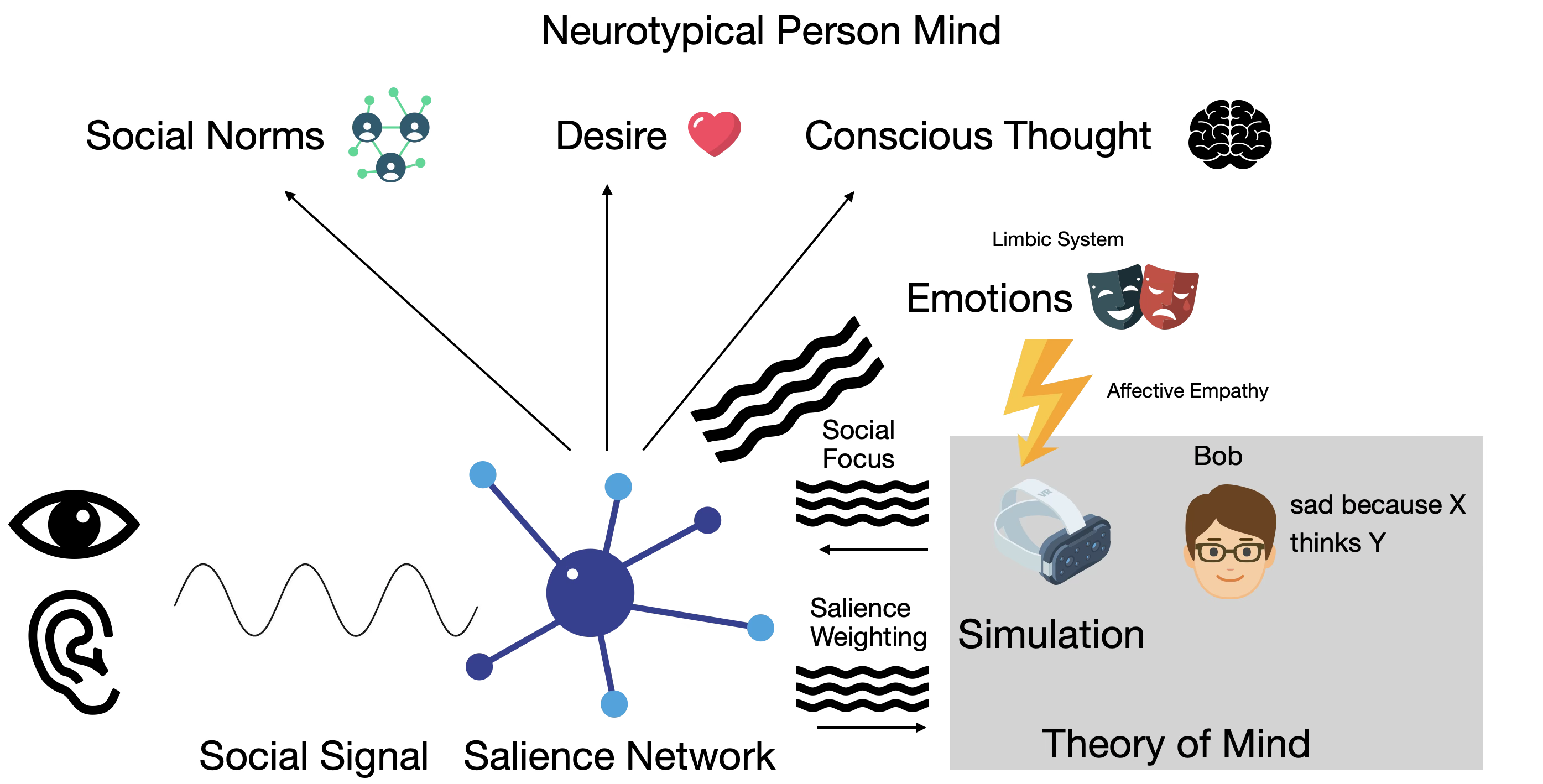
- The various senses provide the “social signal” to the salience network
- These are the nonverbal cues that people give off about what they are thinking and feeling
- A variety of signals
- Phatic expressions (how’s it going?) – pings
- Prosody (tone)
- Gaze direction
- Facial micro expressions
- Social proximity
- And probably others
- The salience network is always on, fully automatic, low or zero effort
- Low effort meaning: seamless integration, not low quality
- The salience network’s entire job is filtering out what is not important (noise and distractions – see Hearing) and assigning importance (salience) to what it passes through
- This feeds the limbic system (emotions) with Social Focus
- This feeds Theory of Mind with the Salience Weighting (the decoded signal)
- The salience network is what causes people to value social interaction
- In some cases the salience network can bypass conscious thought: gut feelings or intuition is a real thing
- The limbic system is the emotional core and it causes people to feel emotions that they sense
- NT people feel other people’s emotions – affective Empathy and “emotional contagion”
- This feeds into the Theory of Mind to allow NT people to understand other people’s emotions
- Theory of Mind is a group of systems in the brain
- These simulate other people in the room and that the person knows
- NT people don’t think “Bob is sad” they know “Bob is sad because X”
- Bidirectional – signal back nonverbally as well
- Meaning exists between people, not just words. Full of emotion and it is shared
- Called: mirroring
- Ambiguity is normal and fine
- Not perfect
- Subject to bias and belief of the person
- May not be accurate
- But is close enough and expected in NT people — maybe it works because it is continuous
- Prioritize the implied intent over the literal word
- NT people detect and predict the thoughts and emotions from people around them
- What they know
- What they believe
- How they feel
- Sense people as bundles of feelings
- What happens when an NT person encounters somebody who is not processing this way
- Lack of emotional signaling (say Flat Affect) or lack of mirroring
- Automatic simulation mispredicts
- The other person appears to be unpredictable or weird
The Autism Experience
This describes a typical autistic person’s experience of Theory of Mind. Autism varies widely and if you are autistic and reading this it may not match your experience.
Note: I do not experience this and have only information gleaned from LLMs. In fact this may not match anyone’s experience, but this model does fit with how I have read people think the ToM mechanism behind autism works. I use this to understand myself, not diagnose others – I can see my own experience through contrast.
See also: NT Experience and My Experience.
How It Feels
I am projecting based on what I have read. This may sound a bit stilted – I don’t experience this and I am trying to contrast it to how NT people and myself experience the world.
Autistic people are widely varied. There is a saying: “if you have met one person with autism, you have met one person with autism”. I suspect that feelings and experiences vary widely, probably much more so than for NT people. I am aiming for a middle of the road description here – it may not match any one person, but hopefully is near several.
Autistic people feel many of the same social connections that NT people feel. Their minds are built for social interaction. They feel a strong sense of justice and fairness in society. They prefer to communicate literally and may Say The Wrong Thing (from the NT point of view) – they can be extremely honest and might be judged as blunt. Double Empathy is a term that describes this mismatch in communication styles. NT people fail to model the autistic mind properly and mis-predict or wrongly attribute intent. Autistic people might use Masking to try and fit in, but this is effortful and not always effective.
When talking to other literal minded people, communication can be clear and efficient.
Many autistic people are extremely tuned in to the vibe of the room – they can be hyper-aware of social signals. However, unlike NT people who automatically decode these signals for Theory of Mind, autistic people have to manually decode using a mechanism called Theory-Theory. This is high effort, takes time, and may produce a noisy signal. This may lead to social fatigue and meltdowns.
Differential Matrix
| Category |
Neurotypical (NT) |
Autistic (ASD) |
Signal Blind (You) |
Social Noticing
(Social Saliency) |
Automatic. Social cues are the loudest things in the room. |
Manual/Overwhelming. Cues are heard but hard to prioritize. |
Zero. Cues are undetected background noise. |
The “Vibe”
(Social Signal) |
Intuitive. Feels like a “gut instinct” or “atmosphere.” |
Conscious. Requires active decoding of body/tone. |
None. Facts and literal text are the only data. |
Reading Minds
(Theory of Mind) |
Automatic. Instantly “knows” how others feel. |
Manual. Simulates others’ feelings with effort. |
None. People are Black Boxes. Uses Logical Modeling to predict behavior at high cost. |
Social Pressure
(Anxiety/Shame) |
High/Relational. Guided by the “feeling” of belonging or shame. |
High/Reactive. Friction between social desire and signal confusion. |
None. Social status is a conceptual abstraction, not a felt pressure. |
| Empathy Type |
Affective. Feels the emotions of others instinctively. |
Cognitive/Manual. Tries to imagine how others feel to relate. |
None. Does not “feel” others’ states. Uses Rules and Logic to maintain pro-social behavior. |
Social Noticing (Social Saliency)
- NT: Automatic. Social cues are the loudest things in the room.
- ASD: Manual/Overwhelming. Cues are heard but hard to prioritize.
- Signal Blind: Zero. Cues are undetected background noise.
The “Vibe” (Social Signal)
- NT: Intuitive. Feels like a “gut instinct” or “atmosphere.”
- ASD: Conscious. Requires active decoding of body/tone.
- Signal Blind: None. Facts and literal text are the only data.
Reading Minds (Theory of Mind)
Social Pressure (Anxiety/Shame)
- NT: High/Contextual. Fear of “doing it wrong” or losing status.
- ASD: Extreme. High cost of social error leading to meltdown.
- Signal Blind: Zero. Cannot experience social shame or “rejection sensitive dysphoria.”
Empathy Type
- NT: Affective. Feels the emotions of others instinctively.
- ASD: Cognitive/Manual. Tries to imagine how others feel to relate.
- Signal Blind: None. Does not “feel” others’ states. Uses Rules and Logic to maintain pro-social behavior.
How It Works
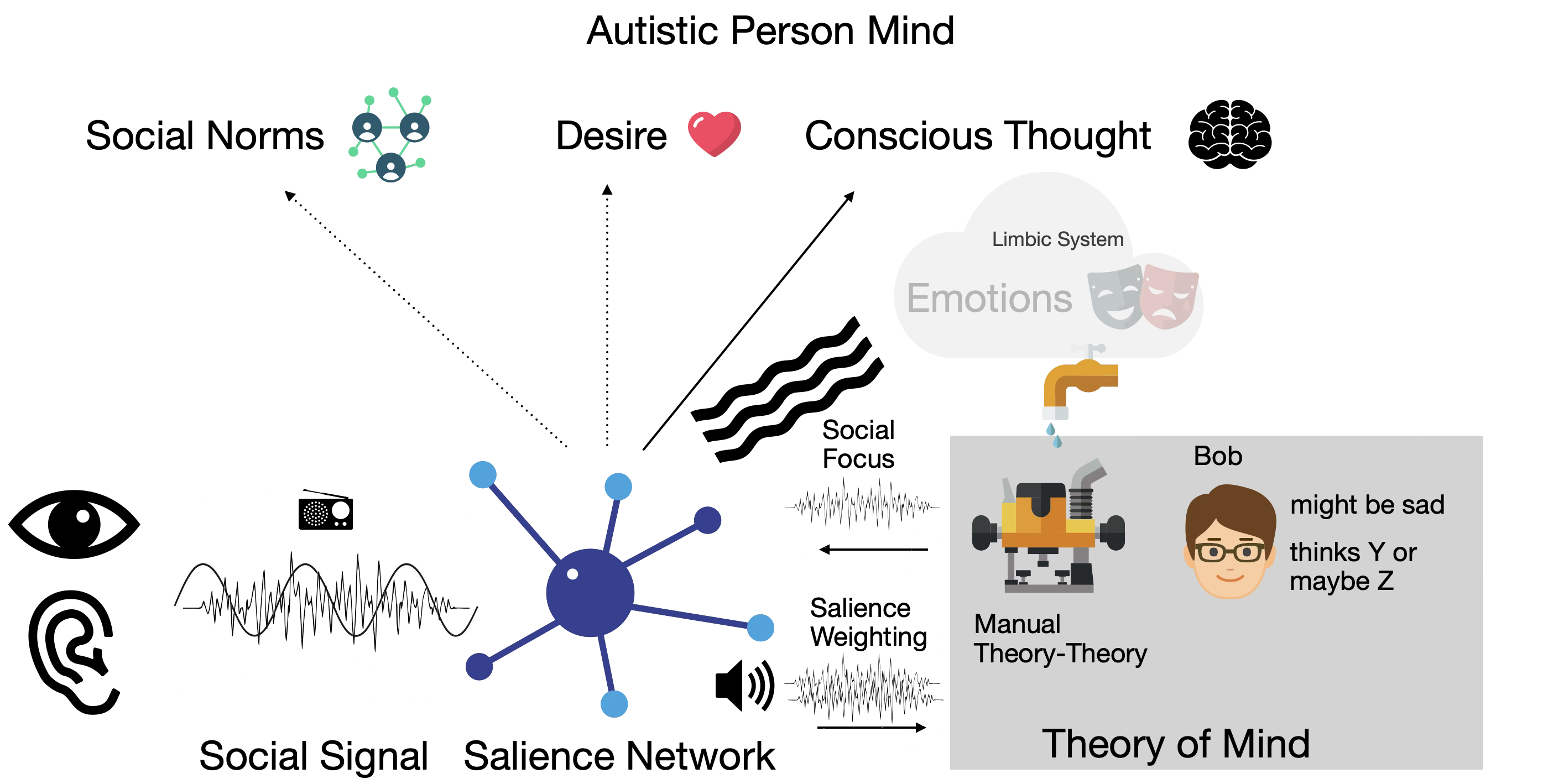
From what I understand there are two common phenotypes for autism:
- High Social Salience (high signal), high noise – social signals are seen but can be an overwhelming wall of sound. A person with this might experience:
- Sensory overload and meltdowns are possible.
- High social anxiety as they try to consume this input and make sense of it.
- Hyposalience (low signal), high social desire – social signals are unclear or even missing, but there is a sense that they are missing. A person with this might experience:
- Straining to pick up the signal that they know is there.
- Social drive causes them to want to connect and belong.
- They are aware of being apart – the social friction.
- See John Elder Robison – he wrote a book about his experience.
I am primarily describing the first variant, though I believe that the mechanism is similar for both – it differs in how the signals are disrupted and presented. This is a structural map for how, not a definition of the person.
- The various senses provide the “social signal” to the salience network
- These are the nonverbal cues that people give off about what they are thinking and feeling
- And the implicit/subtextual meaning of words – NT speech often contains hidden or implicit meaning (sarcasm, metaphors, or social white lies)
- This signal is noisy – it picks up too much. It might be like static on the radio or distorted like turning the volume up too loud
- The salience network tries to decode this signal but struggles with the overwhelming input signal
- In NT people, the salience network would filter out unimportant information and assign importance (salience) to the information
- For some autistic people it may pass everything through as top importance
- For others (or the same people at different times) it may fail to identify anything as important
- This feeds the limbic system (emotions) with Social Focus
- This feeds Theory of Mind with the Salience Weighting (the decoded signal)
- The limbic system is the emotional core and it causes people to feel emotions that they sense
- Because the signal from the salience network may be noisy or unfiltered the limbic system may run in a state of hyper-arousal
- This may trigger high levels of affective Empathy – picking up and feeling the emotions of those around them
- Autistic people often experience emotions in a bottom-up rather than top-down fashion
- A disconnect between the limbic system and conscious thought
- Emotions may register as raw physiological signals rather than feelings like “I am anxious about this meeting”
- See also Alexithymia
- Theory of Mind is a group of systems in the brain
- The output of the salience network is unable to trigger the automatic Simulation that NT people experience
- Instead, autistic people use manual processing, manual simulation
- Called Theory-theory
- People must manually process social signals through propositional logic
- Behavior X implies intent Y
- Search for meaning, intention, subtext. Hyper-vigilance
- Anxiety around misinterpretation
- Conflicting thoughts about what others think
- High effort
- This can lead to meltdowns, social fatigue, or being overwhelmed
- Social lag
- The effort and processing takes time and reactions may lag
- Experience the Double Empathy problem
- For these reasons autistic people prefer literal signal
- But they live in and participate in an NT world and have to expend considerable effort trying to fit in
- Masking
Alexithymia
“I feel something, but I have no words for it”.
Alexithymia is a personality trait characterized by an inability to identify, describe, or express one’s own emotions. It is not apathy, which is a lack of interest and is also different than Flat Affect which is an inability to express emotions.
There are two ways that it might affect a person:
- Cognitive Alexithymia: You may be aware you are feeling something, but you cannot put a name to it or articulate it to others.
- Affective Alexithymia: You may have a limited “emotional repertoire” or struggle to experience feelings as deeply as others, though they are still present at a surface level.
Alexithymia can be very frustrating and isolating for a person who has it.
My Experience
This is a tricky one. I don’t have alexithymia, but there are some strong overlaps. I experience emotions in a very different way than NT people. I do have emotions and can describe them, but it is a “translation” of emotional state rather than intuition.
There is a chart I used with a therapist to try to describe my feelings.
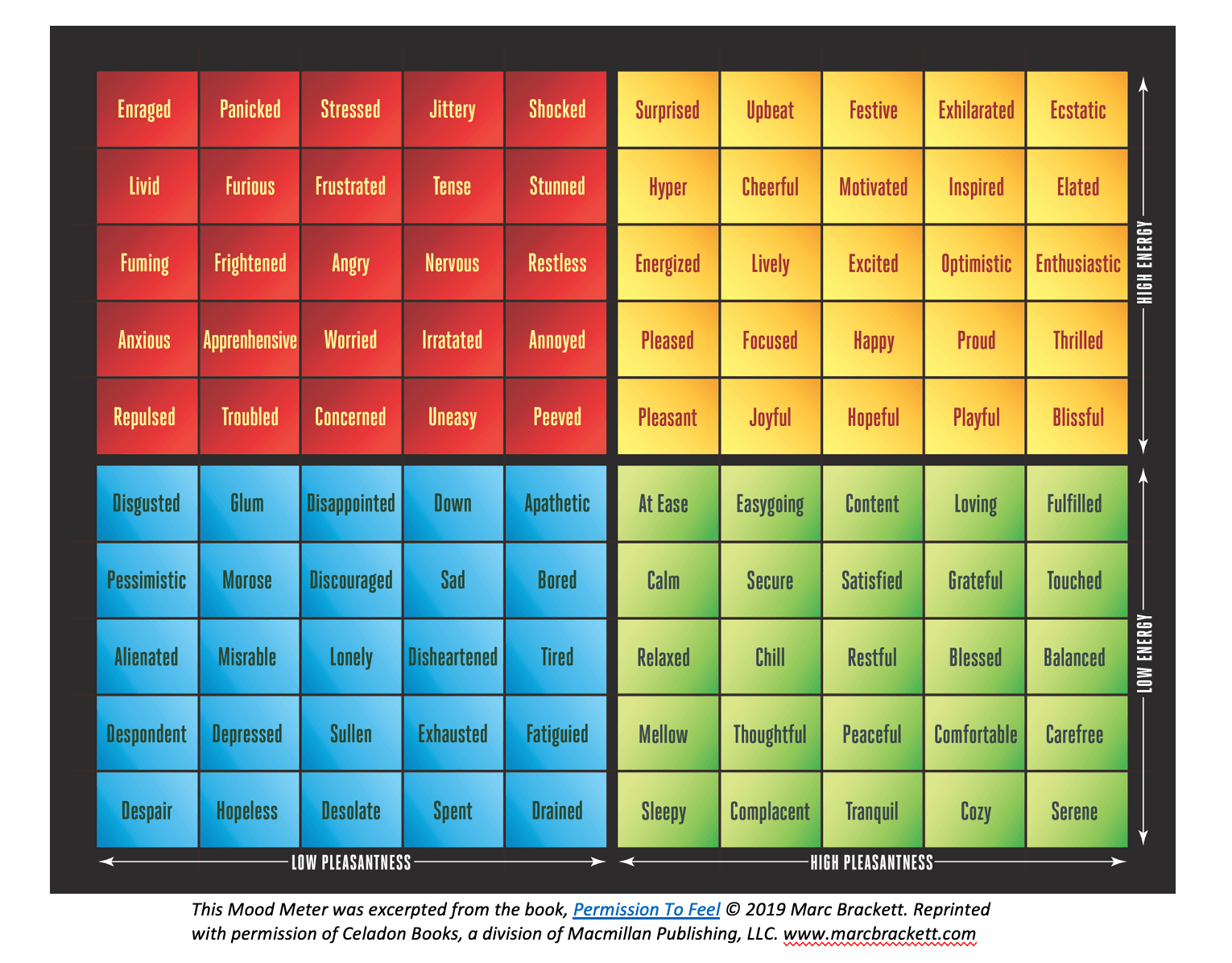
See My Experience (Emotions). See my descriptions of Anger and Sadness for examples of how I experience emotions.
I see it like this:
NT Emotion: A felt state that dictates logic.
My Emotion: A biological state that requires logic to label.
So my mental state (sad story or anger at corruption) triggers the limbic (emotional system) which in turn fires the appropriate physiological response (tears or adrenaline). My conscious mind sees both the thoughts and the physiological state and I can pattern match to an appropriate emotion. For NT people this is automatic – they don’t need to think about it, they know it.
I do have “externally oriented thinking”, which is a core trait of alexithymia:
- no access to the vibe (internal measure of social state)
- I care about the system, logic and ethics (external measure)
- my emotions are triggered by thought (top-down), so I think about the reason for the emotion rather than the feeling of the emotion – the feeling is how I label it, and the reason is what I consciously experience
but I do have the ability to decode these feelings + mental state to label the emotion, which means no alexithymia. My decoding is near instant for typical emotions – I don’t have lag or difficulty here. I do have some issues around Semantic Divergence where what I mean by the emotion doesn’t sync with the NT meaning.
One time I was asked to describe my current emotional state and it was unusual. I didn’t have a mapping and after some introspection I realized I was feeling two emotions simultaneously (this is somewhat common for NT people, but I think not for me). I was experiencing fear + positive alignment. I was only able to describe it as “high emotional state” (like overload) until I could identify the pieces.
Apologies
NT Experience
NT people may find it hard to apologize. Typically there is a “social cost” or loss of standing. They may feel like they “lost” or are “submitting”. Along with the verbal apology there is a submission social signal to indicate acquiescence.
My Experience
Since I have no Shame or feeling of social hierarchy, it is easy for me to apologize. I don’t have any negative social impact associated with it, so it is cheap (mentally). I also don’t have any social signal indicating sincerity – the apology is sincere but it doesn’t always land.
I don’t associate Truth and Facts with my identity so I can admit I was wrong. I can admit guilt in action. I may Say The Wrong Thing but I don’t mean it the way it is taken and can admit it, even if I don’t understand how it was taken.
I can say: “I am sorry that you feel I am trying to make you look stupid – that was not my intent and I am sorry it came across that way.” I accept that my words or actions made the recipient feel a certain way, even if I do not understand it. I can’t accept blame for intent, just ineptitude. It is true, but perhaps not in a way that people will understand. Some people will accept it and some will not. I don’t signal right and they may take it as an excuse. I can’t help that.
Often times it does defuse a situation – it is like pushing a reset button on the situation. That is good enough for me.
Authority
For NT people, authority, or social position carries considerable weight. They are offered respect and obedience. Their ideas are better. Flaws may be overlooked. Even lies and crimes may be overlooked in service of social harmony. Social position overrides opinions.
My Experience: Status-Neutral
Since I lack Social Salience, I lack the ability to care about social position. Probably in many cases I can’t perceive the social position itself – I can understand jobs that give authority but people would seem to be peers are a flat hierarchy to me. I respect competence rather than power.
I do recognize that my manager and people up the chain to the CEO have the power to compel me to do tasks that I disagree with. If I think a task is unwise or will not get the desired result I will tell the person giving the order, or if they are not available, my manager. Given my position at work, I see this as my responsibility. Once informed, they are free to decide as they please and own the consequences – I could be wrong. If I have my wits about me, I will attempt to reduce friction by talking to them in private or using softening words. There is a hard wall when it comes to my Ethics – I won’t do something that I think is illegal, dishonest, or will hurt people. It doesn’t matter who gives the order.
For example:
- Working at McDonalds I am playing a role — manager defines tasks, I complete
- I respect that authority because it logically makes sense
- recognize the manager as a “Task Distributor.”
- For more skill based things I typically follow orders when I 1) understand and 2) agree
- I may be the person with the expertise and I will question orders if they don’t make sense
- At work, it is my job to do this – i need to get clarification if I think there is an error
I don’t consider authority when evaluating ideas: if a janitor and a CEO both gave ideas for fixing the problem, I would pick the better idea. If the CEO was an expert in the field and I was not, I might defer to their expertise, but not their authority.
- I would be in the stockade if I were in the army – funny, but maybe
I do not have any status vibes. I wouldn’t know a king from a pauper, except by dress.
Additionally, I have No Authority Bias in my ethics. In fact I feel the opposite:
- greater power requires greater accountability because the breadth of their impact is greater
- A leader who commits crimes or lies makes me very angry
- The inverse is also true: a person with very little power has less impact when violating rules – I still don’t like it but I am not angry
Benefits
As I mentioned in Everybody is the Same, I never even realized I was different than anybody else. Sure, I seemed to have some talents in software development, but everybody has things they are good at and bad at. Looking at myself after knowing more about what is going on, I can identify parts of my life that benefit.
Are there downsides? Maybe! See Friction and Communication. An oddity of having no Social Salience is that I can’t perceive many of the limitations and don’t have much feeling about it one way or another. I can see secondary effects in communication with my wife as the biggest issue.
Note that I work in software development, which is highly aligned with my Functional Cognitive Architecture. Computers and people who are dealing with them are typically very literal. The computer will do as programmed, even if it doesn’t make sense, so being literal is key. Of course where there are people, there are emotions, but in a workplace these tend to be more along the lines of frustration or boredom – nothing tricky.
Autism and ADHD Experience
I have read about and heard from friends with ADHD that there is some benefit to their condition in the software industry. Outside of that field, I am not sure. There are certainly stressful and tiring parts of autism and ADHD. Of course individual experiences vary. These are things that I have heard of that are sometimes a benefit (paraphrased from an LLM):
- hyperfocus: might spend ten hours in a “flow state,” solving a complex architectural bug that others couldn’t crack. The trade-off is often physical exhaustion, forgetting to eat, or “autistic burnout” afterward.
- pattern recognition: many autistic individuals excel at seeing systemic connections or edge cases in code that others miss – this is the key to debugging as well.
- deep interest: when a job aligns with a “special interest,” the level of dedication and knowledge acquisition can be far beyond average.
- literal communication: many ND people prefer direct, honest, and transparent information exchange. This can lead to incredibly efficient collaboration because there is less “reading between the lines.”
My Experience
Although I am Not Autistic I do share some of the same benefits:
- hyperfocus: It isn’t hyperfocus in the ADHD sense, but my lack of distractions (social pings) gives me considerable focus ability. I doubt I can spend ten hours in the zone, but when I am deep into something several hours is easy. I never (mostly never) miss a meal and don’t feel burned out after – if I fixed something I feel a Dopamine hit.
- pattern recognition: understanding systems and debugging are two areas where I am very strong. Debugging in particular benefits from recognizing subtle clues, understanding techniques for catching bugs and quickly understanding code as you read it.
- deep interest: although I don’t have the same special interest (as a soothing mechanism) that autistic people sometimes have, I do tend to learn a lot about what I am working on. I have both breadth in computer science and programming and depth in a few specific areas. Even in hobbies I often go all-in – I get more out of it with some investment in knowledge.
- literal communication: I don’t have anything else. As I mentioned, this works well in software companies.
Where else do I benefit?
- Logical: I use Propositional Logic and Functional Logic Modeling in how I think
- this works well in STEM fields and software development
- Calm and Quiet: I don’t experience the social pings
- I don’t pick up emotions or reflect them back
- I am Mid-happy Default
- I am reliable in a crisis – P0 tickets, no worry!
- cognitive efficiency
- patient
- Self Esteem: my sense of self worth is entirely internal and stable
- I have no Shame
- I want the Truth and Facts
- my identity is not tied to these facts
- I am willing to say I don’t know or I was mistaken
- I can apologize – I have no social status to worry about
- I have no Ego
- Objectivity: I am status blind
- high-fidelity information auditor – no ignoring fallacies even from high status individuals
- immune to shame-based manipulation
- immune to gaslighting and groupthink
Sadly I do not have the power of flight.
Black Box
Most people use have Theory of Mind and think of other humans as bundles of emotions and thoughts. They feel them as other minds.
My lack of Social Salience means I can’t sense the social signals and don’t perceive people this same way. I mentally model other humans as black boxes. A black box (in science and engineering) is a system that is understood in terms of its inputs and outputs without understanding its inner state or mechanism.
You may make observations and even draw conclusions about black boxes:
- when X ate cheese they mentioned that they like it
- fact: X likes cheese (observed: cheddar)
- I have never observed X doing the dishes even when they need to be done
- fact: X has not been observed doing the dishes
- fact (maybe): X does not like doing dishes
X stated that they like cheese and I attach a fact to my mental model of X that notes this. I did not infer it, they literally said so. Based on situations (inputs) and actions (outputs) I might guess at some internal state: X might not like doing dishes. I don’t know this for sure, but I have some evidence that suggests it. I don’t know why they might not want to do the dishes (lazy like me?).
That is about all I know about X – what they told me and some indirect observation (and typically I would have to be looking for this).
Communication Difficulties
Before I found out I was ND I thought I had good or even excellent communication skills:
- I could think logically a present a coherent argument
- I could speak and write clearly (you may disagree, these are my opinions!)
- experience showed I could explain complex ideas to people
After I was married of course there were sometimes communication problems between me and my wife, but everybody has those and this was no different. Or so I thought: these are not at all the same.
Communication Grade 2.0
It turns out I might have a few difficulties that I didn’t really notice.
Communication at work (software job) was largely literal and logical. Truth and Facts were the primary form of communication. I fit in well with this – it is my native language and NT people had to adjust themselves to be clear.
At home, with my wife, Emotions were more likely part of the discussion. I think differently (no Social Salience, no Theory of Mind) and Say The Wrong Thing. I even have different meanings for emotion words and didn’t know it. I had no Empathy and Flat Affect – emotional conversations were … not great.
Additionally, NT people experience Double Empathy with me, though I don’t experience it with them. In fact I completely miss this nonverbal part – signal blind.
What works great in the office doesn’t always work the same way in the home. Now that I understand more about what is going on with NT emotional signaling I can see there is a big gap in some conversations. From what I read, these high emotion conversations aren’t easy for NT people and I am flying blind.
Contrastive Example - Bar
A contrastive example – what I experience vs what NT people experience.
Imagine a bar full of people talking. It is very loud and people are all around. You can barely hear your friends.
Now the observer closes their eyes. The room is replaced with a new empty room but with high fidelity spatial audio (many speakers).
An NT observer can detect that they are in an empty room with speakers playing. They experience automatic fusion of audio, thermal, olfactory, and haptic data and would pick up the absence of the field. There are no other people present. It is fake.
An autistic person who has a “noisy receiver” and manual theory-theory TOM would experience some kind of uncanny valley where the audio signals indicate people but the other non-audio signals indicate emptiness. Per the LLM, this might be a horror situation for them.
I would experience no difference – I probably couldn’t tell anything changed. Even if the audio was replaced with a more generic crowd cacophony it would still sound like a bar full of people to me. I don’t sense people.
Contrastive Example - Movies
A visualization of my experience. Imagine your life as a movie.
The NT Experience: You are watching a high-budget movie. You feel the “vibe,” see the subtext in Chad’s eyes, and “know” how he feels because the music and acting tell you. You are living the simulation.
My Experience: I am reading a raw dialog script.
Script: Chad: “Oh, there you are.”
Processing: I do not simulate a voice or a “feeling.” I extract the factual data point: Environment Update: actor’s physical location is now registered by Chad.
I only receive the words. There is no music. There is no acting. There is only the words in the script.
Note: I didn’t realize NT people would experience TOM through a movie screen. Perhaps this is why actors ask for their “motivation” – I always thought that was just some random acting thing.
Discovery
After discovering “automatic Theory of Mind” I tried some prompts with LLMs to see if it could give me ideas on what condition I might have or even more valuable, what caused my behavior.
This isn’t the exact prompt I used with an LLM – I asked various things, adding to the prompt as I discovered what symptoms I had that might be important.
The first several lines I had known since Stage 1. The “mind reading” line is what started to break this open in Stage 3.
This interaction is a technical mapping of cognitive architecture for personal introspection and system-debugging. I am not seeking medical advice or diagnostic validation. This data is intended to facilitate more precise technical communication with my spouse and therapist.

I am going to describe my observations of self and I want you to describe a possible mechanism that would cause this.

- I am not autistic
- I do have good overlap with ASD category A
- NO overlap with ASD category B
- I do not experience meltdowns, have trouble with criticism or have any social fatigue
- I have hypophantasia and low absorption
- I get along with everybody at work (software developer) and have very low ego
- it is harder with my wife as we have a much closer relationship -- I have flat affect and seem cold
- I do have emotions and can describe them
- I didn't know that NT social signals and "mind reading" were a thing until recently -- I thought it was a joke
- I have no idea what others are thinking or any sense of their emotions
- I have been told that reading a book at a party is a social gaffe.  I don't really care, I wasn't hurting anyone and it made sense to me
- I am normally very low stress, I don't experience any stress in social situations.  I don't avoid them but I don't crave them
- I have good communication skills
Each time I presented the prompt it would suggest potential conditions. I could read about them and decide if they fit or not. If they didn’t fit, I could add to the list to give a contra-indicator so the next time it wouldn’t be suggested.
By the end, the LLM was suggesting things about ToM and social salience. At first I thought I might have:
- low social salience
- manual ToM (Theory-Theory)
but the more I read about this I realized I didn’t have any of the social signals to execute manual ToM and on top of it, I didn’t really care about the lack of social signals. Eventually I came to believe I had no Social Salience, which is where I am now.
Do you have what I have?
As I read about the various conditions on Overlaps each one sounded a lot like me – I would pick up the matching symptoms and behaviors and ignore the rest. Each time I read more closely I would find out that it wasn’t quite what I thought. The same goes in reverse: you might find some overlap with my descriptions, but is it the same thing?
So how would somebody know if they have signal blindness? Working with an LLM I made a checklist.
Remember: this is not a diagnosis. I don’t have any background in this, I just experience it. See Disclaimer.
Positive Indicators
You might have signal blindness if you answer YES to all of these:
- You have never felt a “racing heart,” “dry mouth,” or “pit in your stomach” due to a social interaction. The concept of “what will they think of me?” is logically understood but never felt. Socializing is physiologically identical to reading a manual or organized work. Note: you may not desire socialization.
- When you choose to be alone, it is not to “recover” from the pain of socializing; it is because you have higher-priority tasks. You treat social interaction as a “low-ROI” (Return on Investment) activity, not a “high-damage” one.
- You do not “feel” the presence of status. While you logically know a CEO has more power than a janitor, you do not feel the instinct to “soften” your tone or “defer” to the CEO. You treat both as data-exchange nodes.
- If a conversation goes poorly, you may replay it, but only to identify where the data-transfer failed (e.g., “I used the wrong term”). You do not replay it to “cringe” or wonder what the other person thinks of your character.
- You don’t “miss” subtext—subtext simply doesn’t exist in your reality until someone explicitly points it out. Even then, you view it as a “bug” in the other person’s communication style, not a “mystery” you failed to solve.
- You do not feel exhausted after social interactions due to “manual processing.” Interactions are low-energy because you are not scanning for subtext.
Negative Indicators
You might have signal blindness if you answer NO to all of these:
-
You feel like there is a “vibe” in the room that you can’t read, and this makes you feel tense or on edge. (This indicates your receiver is on, but the signal is garbled).
-
After an interaction, you spend hours wondering if you “offended” someone or if you “acted normal” enough. (This indicates a functioning Social Saliency Network and Rejection Sensitivity).
-
You find people “draining” because their voices are too loud, their perfume is too strong, or their movements are erratic. (This suggests the “Social” and “Sensory” systems are tangled, a hallmark of typical ASD).
-
You feel “drained” after talking to people because you had to “work hard” to understand them. (This suggests manual subtext processing).
-
You feel a “hollow” or “aching” feeling when you have been alone too long. (This suggests your brain is still “tagging” social connection as a biological necessity).
-
You feel a sense of “stage fright” before a meeting or social event. (This indicates your nervous system is “threat-testing” the social environment).
Final Filter
To be certain, ask yourself which of these two scenarios causes you more internal distress:
-
Scenario A: You are in a meeting. You realize halfway through that everyone is subtly annoyed with you, but you don’t know why. You observe a cessation of verbal input or a change in the speed of the transaction that you cannot logically map.
-
Scenario B: You are at your desk. A critical piece of logic in your work is broken, the deadline is in one hour, and your tools are malfunctioning.
The Interpretation:
-
A Typical ASD (Signal-Friction) or NT person finds Scenario A agonizing. It creates a “shame spiral” or “shutdown.”
-
The Signal-Blind Architecture finds Scenario A mildly annoying/confusing but essentially neutral. Scenario B is the only “real” stressor, as it involves a failure of the system you actually value.
Double Empathy
Double empathy is a term coined in 2012 by Damian Milton to describe the difficulty in communication between NT people and autistic people.
The idea is that the cognitive structure for NT people are similar to each other and the structure for autistic people are similar to each other. Each group interfaces well with people from their own group, but less well between groups. Effectively the groups use different social languages and it forces each group to notice this and translate back and forth. The Theory of Mind is working, but differently – they aren’t modeling each other correctly. This can lead to miscommunication and mental fatigue. This double empathy problem tends to be lopsided: NT people, being the majority, expect others to conform to their point of view. Autistic people use Masking to act and sound like NT people, which adds additional mental load.
My Experience
Due to my lack of Social Salience I often don’t even notice we are talking different languages. Technically I can’t experience double empathy: I operate on explicit language only. I do not receive social signals, nor do I broadcast them. However, my lack of broadcast can be perceived by NT people as signal of “don’t care” or “hostility”.
For NT people interacting with me, they experience the double empathy problem and I am not aware of it. A concrete example: I went to a party with my wife and brought a book in case I got bored. As expected, I got bored, so I sat in the corner and read my book. Much later my wife told me that people were offended by my behavior. They thought I was angry with them (or something). I couldn’t believe it – why would they make something up (and totally false at that) and then believe it? It had to be a lie (this is Stage 1 of my history when I didn’t know about NT behavior). In reality this was double empathy. I was happy reading by myself. After all, I brought the book to the party for this very occasion. NT people saw my behavior and lack of social signals as extreme Coldness or anger and acted upon that – they thought I had an active message for them when it was just a hallucination.
I had no experience of this – I had no idea and still wouldn’t unless my wife told me.
Easy Going
I am usually very easy going. I don’t care, or perhaps better phrased I don’t have an opinion on a lot of things. If needed I can chose. I am not lazy – well, I am not lazy in not choosing.
vs Apathy
“I don’t care because nothing matters.”
Apathy is also not caring, but is characterized by a lack of motivation or interest. With apathy you may not be able to make a choice. This is often a symptom of an underlying condition like depression.
My Experience
I don’t have apathy but there is some phenotypic overlap. My lack of care looks more like:
“I don’t care because I’ll be fine with either.”
I don’t have decisional paralysis – I can easily select a restaurant, a movie, a place to go to. I am just easy going.
In 90% of social interactions (e.g., choosing a restaurant, deciding on a movie, small-talk topics), the data has zero weight within my Ethics. Because I lack Social Salience, I do not experience “preference” based on status-seeking, social “vibes,” or Ego-protection.
Mechanical Reality: It is Optimization for Low Friction. If a choice has no logical or ethical consequence, the most efficient path is to default to the other person’s input. This minimizes Initialization (Manual Frame Construction) costs and conserves cognitive energy. I am not “agreeing” so much as I am “not processing the data as relevant.”
However, there is an armored steel wall at my Ethics. Because my ethics are Axiomatic Deontology (rule-based) rather than teleological (goal-based), they cannot be “negotiated.” I don’t have social lag (no Shame) so there is no buffer when the wall is reached. I go from easy-going to STOP. In fact I may experience Cognitive Dissonance Stress from the request and push back – become irate.
Flat Affect
“I may feel it, but my face and voice don’t show it.”
Flat Affect may be caused by different things:
- lack of mirroring, see ASPD
- lack of prosody
- lack of emotion
My Experience
Since I have no Social Salience I receive no signal and there is nothing to mirror. In fact I probably give off strange vibes.
For whatever reason I also have low prosody – I tend to talk in a bit of a monotone and at a constant rate (sometimes fast, sometimes slow, usually the wrong speed). If I pay attention I think I can affect this, e.g. if I am telling a joke (but my jokes often fall flat, so my mileage may vary!).
I have emotions, I am just not expressing them in a way that NT receivers would pick them up.
Friction
I am referring to difference kinds of friction or high effort/low utility states in social settings.
NT Experience: No Friction
Typically NT people experience low friction because of their active Theory of Mind – they are able to simulate and predict the thoughts and feelings of people around them. Promoting emotional equilibrium and group cohesion is a primary tenet of their ethical system.
Autism Experience: High Friction
Autistic people experience friction from having non-automatic prediction of others. They have to use manual Theory-Theory to predict and experience lag and social fatigue. Additionally, they may employ Masking to present as neurotypical, another high effort mechanism.
My Internal Experience: No Friction
Internally I don’t experience any friction. I don’t sense social signal, I don’t feel shame, I don’t care about social positioning. To be clear: I don’t feel these things, but people around me, especially my loved ones, may some friction on my behalf because of e.g. social gaffes.
My Social Experience: Some Friction
Socially I do sometimes experience friction and it is something I try to avoid for efficiency reasons or unintended harm that I could avoid.
- Unintended Harm: I shouldn’t tell somebody that they are fat. I have some heuristics – topics to avoid or phrasing to avoid because it causes hurt feeling.
- These are not things that would upset me (see Hard Truths) but do upset others (as I have been told). I Care about others, but not in a way that NT people would probably recognize – this is still an efficiency rule.
- This is a failure to account for the person’s (Black Box) constraints or failure to know them
- Resource Waste: Avoid conversation stalls. Effort must be diverted from the “Task” to “Explanation/Repair.”
- Sometimes truth disrupts: ”This data in row 4 is incorrect; it invalidates the conclusion.”
- I may need to explain I am not angry, not judging, not challenging social status (I don’t care!)
- Sometimes I need to be careful in my wording. I may need to present it as a question or use softening words like “I think”.
- Input Rejection: The recipient becomes defensive. The other person’s “Receiver” closes (typically from my words or actions), rendering further factual transmission impossible.
- Don’t argue a point or correct someone in a meeting if you can do so afterward in a 1:1 setting.
- If you must do it in the meeting use softening words (I think, maybe) and state why it is important to bring up now to reduce friction.
Note: my use of softening words is “literal functional English” (see softening). I am indicating something less than absolute certainty (or am willing to present as such). This is not politeness or social/affective positioning, though I have discovered recently that NT people might perceive it as such – an accidental overlap that matches NT social graces.
These techniques are applied manually and with varying degrees of effectiveness. Some friction can’t be avoided – the way I think and the way I value value truth combined with no Social Salience to navigate tricky waters means I will ruffle feathers. It doesn’t bother me. I don’t want this friction because it is inefficient, but I don’t have any feeling about it.
Hearing
I read about this effect and thought it was interesting. I don’t know if I hear any different than others, but maybe.
In NT individuals social salience can actually control the gain on individual signals according to their importance. They can more easily hold a conversation in a noisy area (possibly further enhanced by their bidirectional TOM). This is called the “Cocktail Party Effect”.
I can hear faint noises better than many people but struggle in a noisy environment. I receive all the noise full blast and don’t have any mechanism to tune out the rest. I can ignore the whole thing (to some extent) but can’t apply selective volume control – it is a matter of clarity/separation.
Humor
Am I funny? Maybe!
I am terrible at telling a joke. Even when putting effort into it most people won’t pick up my prosody – I can have pretty Flat Affect. Perhaps my joke telling is funny in a “bad movie” sort of way.
I am better at dry/deadpan humor, though I sometimes mess it up by smiling in the middle. It fits my natural style:
- Self-deprecating humor can work with low prosody
- low status signal to NT observers which puts them at ease
- e.g. bragging about modesty – self deprecation + logical paradox, flat delivery
- Ridiculous situations
- does not require social intuition but logic. Flat delivery highlights the absurdity
- visual deadpan: terrible real estate photos – there are tons of these sites and they are awesome
- Hyper-literalism (common among programmers)
- OK, these are maybe in the “dad joke” category, but I like them
- Drax the Destroyer when told something went “over his head”: “Nothing goes over my head. My reflexes are too fast. I would catch it.”
- Precise understatement
- “this is suboptimal” when it is a complete disaster
- Radical attribution, proxy agency
- Sarcasm
- risky because of low prosody, except with my kids and maybe closest friends
These work without Social Salience and some are probably even funny to NT people. Maybe not my kids.
Hyposalience
Hyposalience is having Social Salience with the gain set so low it is barely perceived.
John Elder Robison describes being autistic but instead of being able to manually simulate Theory of Mind he was effectively “emotionally blind” and “socially blind”. He was aware there was a social signal but it was so faint he was unable to use it.
Diagnostic Questions
Not for actual diagnostic use!
I was wondering how a person might be able to tell if they have hyposalience vs no salience. I describe why I think I have no social salience. I asked an LLM to generate questions that might be able to tell the difference between these two conditions.
Again, this is just for fun.
Q1: The Hierarchy Recognition
- Hyposalience: ”Do you feel a slight ‘pressure’ or ‘shift in your behavior’ when a high-status person (CEO, celebrity) enters the room, even if you find it annoying?”
- (Answer ‘Yes’ = Faint Signal Detected).
- A-salience: ”Do you treat the CEO exactly like the janitor until a logical rule (e.g., ‘He can fire me’) dictates a change in your transactional strategy?”
- (Answer ‘Yes’ = Zero Signal).
Q2: The “Vibe” Accuracy
- Hyposalience: ”Have you ever had a ‘gut feeling’ that someone was untrustworthy, even if you couldn’t point to a specific fact?”
- (Answer ‘Yes’ = Subconscious Signal Processing).
- A-salience: ”Is your assessment of people 100% based on their tracked actions and the logical consistency of their statements?”
- (Answer ‘Yes’ = Propositional Logic Only).
Q3: The Empathy Mechanism
- Hyposalience: ”When someone tells you a sad story, do you feel a faint ‘echo’ of their sadness, even if you don’t know what to say?”
- (Answer ‘Yes’ = Affective Resonance/Low Salience).
- A-salience: ”When someone tells you a sad story, is your first response to categorize the event (e.g., ‘Loss of family member = High Distress Scenario’) and then select the appropriate ‘Comforting Script’?”
- (Answer ‘Yes’ = Cognitive Modeling/No Salience).
I would answer yes to all the A-salience questions, though the last one I can experience my own Sadness in some cases. It is not Empathy, it is Narrative Affective Resonance.
Identity
There are a several concepts related to how I think about myself and others where the way I think is quite different from the way NT people think. This is mostly caused by my lack of Theory of Mind, specifically lack of Object Constancy.
Temporal Self-Appraisal
Might be called: Self-Experience, or Sense of Self.
This is a person’s perception of themselves across time. NT people often experience this as Episodic Self-Experience. They view their life as a series of distinct chapters. This might be as simple as Past Self, Current Self and Future Self or there may be additional divisions in Past Self (High School Self, College Self, First Job Self, etc.). Although people understand that logically these are all aspects of the same person, they impose a bit of separation. This might be to distance themselves from past shame or to put off distasteful tasks for Future Self. Something like that – I don’t experience this myself, so this is just my understanding of it.
I experience what is called a Diachronic Self-Experience – I see my past, present and future self as a continuous stream of events. Sure, I might organize them in my memory by where I was or what I was doing, but I was certainly the same person. Mistakes I made in the past might come with feelings of Regret but they are certainly actions I took. Future me is just a projection – I imagine eventually being retired and spending more time on hobbies. Tomorrow’s me is certainly just me, but tomorrow. Whatever I put off today I am doing so because I am lazy or greedy (for whatever I am doing instead).
Self-Concept
Might be called: Sense of Identity.
This concept of yourself ties in with an idea of Identity. Who am I?
For NT people, a massive part of their identity is tied into their social position (Persistent Social Identity). How do other people think of them? How do they fit in to the groups they are in? Where are they in the hierarchy? There is also an idea of Self-Schema – what are you? “I am a parent” or “I am a good cook”.
Although this sense of identity goes hand-in-hand with sense of self, there is also some separation. Identity is maybe more about what other people think you are rather than what you are internally. A person might be timid but has decided that they are going to present as assertive – this becomes their identity. The identity is very important for NT people. It is like their brand. Changes in identity are difficult.
I have no Social Salience so I have no real value of social position, but do understand what it is, at least in a work setting. I do have a Self-Schema: I am a parent and husband. I am a programmer. I like reading. These are not me – I am me. These are just labels and I think they are descriptive and I place some value on them, but they are mutable. This is not my identity.
Person Perception
Might be called: Sense of Others, Object Constancy, Identity Constancy or Social Attribution.
Object Constancy is the psychological term for maintaining a stable, unified mental representation of a person’s identity and your relationship to them, even when they are absent. Identity Constancy is the idea that even under stress, your core identity doesn’t change.
NT people use Theory of Mind and mentalizing to create persistent representations of other people in their mind. Social Salience drives this mechanism and it runs automatically to keep a real-time representation of the person while they are present, and keeps a sort of ghost representation that the NT mind can interact with and even update when they are not present. This is then tied to the public Identity that the person presents. It includes their name, their job, their gender, their hobbies and more.
Changes to the representation of the person are not done lightly. It can be upsetting or a source of dissonance if the mental model doesn’t match reality. In some cases changing identity can feel like the person was deleted or killed and replaced.
My sense of others is much like my sense of self: I think of people as Black Boxes and I think my identity may be similar. Each person is a unique individual. They each have metadata associated with them: name, job, gender, likes, dislikes and more. Changes in how people present themselves just require an update to the labels, nothing more. Sure, it might take some getting used to, but I don’t own their identity. I see the person themself as being constant, not the attributes used to describe them (Identity Constancy means little to me).
I see myself the same way as I noted in Identity: I am me. The labels may change over time, but I am the same person. The one difference between how I see myself and how I see others is the amount of detail: I have a lot more ability to introspect. I am the only one where I can know the inner state.
Introversion
I always figured myself as an introvert. I didn’t particularly need or enjoy social situations and I would get tired of them after a while and leave. I certainly wasn’t an extrovert – I didn’t feel any recharge from social events.
Looking at this now from the lens of ND and no Social Salience I wonder if this isn’t quite what I think it is.
Extroversion is easy: I probably can’t be an extrovert given my inability to receive “vibes”. There is no social energy for me, just data (or lack of it).
The mechanism for the introversion side is interesting. I don’t have the NT social emotions that need to be fed. I don’t feel any need for belonging or fitting in.
Although I don’t seek out social situations I am not opposed to them. I can talk for a long time about topics that interest me, e.g. software or pinball. I get tired when it is just small talk. This might actually be boredom!
I can hang out with the neighbors for a little bit and participate on the side (maybe adding in some dry humor). I like the neighbors because they are just hanging out in their yards and driveways talking – I don’t need a hook to join them, I just walk up. After a little while I will make my excuses and leave. They continue to talk for hours.
After I leave I usually go do something I enjoy: read a book, play pinball, mess around on the computer. I don’t “rest” – that is what I do when I take a nap.
I also enjoy hanging out with my friends: we go to lunch (I like eating), we see a movie (I like movies). Perhaps we are each getting something different out of it. I like doing these things with other people. Perhaps my friends are enjoying the conversation and social aspects while I am there for the food. Maybe the talking too: we often talk about things that interest me (these are also tech people).
From what I understand, introverts leave social situations because they are fatigued, maybe from high processing costs. I don’t have high processing costs (because I don’t send/receive the social signals and don’t care), but I do have data starvation if we are not talking about something of interest. I think I am not fatigued in the introvert sense, I am bored.
So am I an introvert? I think I probably behave like one, but is this actually introversion or just matching symptoms?
My Experience: Socially Null
After feeding this in to an LLM, along with my System Prompt it concluded:
You are not an introvert in the biological or psychological sense.
Introversion is a sensitivity to social saliency.
Extroversion is hunger for social saliency.
You occupy a third state: Socially Null.
I behave like an introvert because we both enjoy low social uptime, but the mechanism is different. Introverts leave the part because it is too loud. I leave the party because it is too silent (I am bored).
Masking
Autistic people sometimes use a technique called “masking” or “camouflaging” to suppress natural autistic traits or adopt NT behaviors. This can be conscious or unconscious. Many times they require significant mental effort. Typical masking:
- Mimicry: Scripting conversations or copying the body language of others.
- Suppression: Forcing eye contact or holding back “stimming” (self-regulatory behaviors).
- Performance: Carefully monitoring facial expressions to ensure they match the social situation.
NT people, being the majority, expect people to conform to social norms and NT behaviors. Autistic people can often perceive that they are not meeting this expectation (see Autism Experience) – masking is the technique used to smooth the interaction. It is often effortful and likely not entirely convincing.
In fact, many autistic people have high social saliency and feel the sting of not fitting in. I have read that autistic people may have suffered ostracization or bullying for being different. Bullies can pick up on the social signals for fear, shame, or hurt and feed on them. Masking may feel like a necessity rather than a “nice to have.”
Other ND phenotypes may also use masking to fit in, but masking is often associated with autism.
My Experience: No Masking
Lacking Social Salience meant (and still means) that I didn’t even notice that I was not behaving the same as everybody else. Sure, I might have some oddities (I was a nerd), but these seemed within the normal range for people and personalities (my perception).
It never occurred to me that there might be such a thing as masking or that I might want to do it. Now that I know about it, I still don’t care about it (social salience again). I do use some heuristics to avoid social friction (for efficiency purposes, which is Functional Logic Modeling), but that is about it. I didn’t perceive what I was missing, so it wasn’t something I ever considered.
I may have been ostracized when I was younger – certainly I can recall other kids making fun of the way I talked (slowly). I didn’t like it, but I can’t recall any particular stress from this. I had friends: neighbors and several kids who liked computers or role playing games. I may not have picked up on the full effect so it kind of rolled off me.
I do recall a time in high school where I was confronted by a bully. I don’t know if this was because I was “weird” or just random chance. I was tall and thin. The bully was large and muscular. For some reason I said exactly the right thing (using Flat Affect):
No thanks, I don’t feel like kicking your ass today.
Clearly, that wasn’t going to happen. The bully could have used me as floss. But I was a little off: I didn’t give off social signals like I should. I was a non sequitur. This was the right hook because it allowed the bully to laugh and walk away.
Aside from that I don’t recall any bullying, though again, it is possible things were said and I missed them. I think in terms of behavior I look very similar to autistic people, though I don’t signal at all.
Anyway, I am fortunate that my particular mental configuration allows for no masking:
- I don’t notice that it is needed
- I don’t care what others think about me
Phatic Speech
Phatic speech is an interesting case. Phatic speech is, for example, the talking we do to greet each other at work:
Hey, how are you?
Fine! How are you?
I actually picked up phatic speech, I presume from observing it being used. I wasn’t masking – I was following the script.
I didn’t realize that these questions were not meant to be answered truthfully; I saw a question and provided the data. If I was having a bad day, I would tell you so. I now realize these interactions are more of a social ping: a “hey!” that expects a “hey!” in return, rather than a request for information.
I also frequently failed the “mirroring” rule. Many times when somebody asks a question, they expect a similar question in return:
Nice to meet you! Where do you work?
I work at NASA. (silence)
I would answer, but I wouldn’t ask the question back. Sometimes I might, if I happened to be thinking of the protocol, but I don’t usually care where a stranger works—that isn’t information I need. I would provide my answer and the conversation would simply die there.
This was always fine with me, but I have since learned from feedback that this often makes NT participants uncomfortable. Because I lack social salience, I didn’t know they were uncomfortable, nor did I notice the “social friction” I was creating.
Unlike many autistic people who mask out of a desire to fit in or a fear of being “found out,” my lack of masking isn’t a choice—it’s a result of not perceiving the “need” in the first place.
Now that I understand what is going on in NT conversations, I can better introspect my own behavior. I still don’t behave as expected (usually), but better to know than not. This Double Empathy issue still doesn’t bother me personally, but at least I am aware it is going on for the other people. In situations where I think it might help (my wife prompted me) I can consciously try to follow the expanded script. It takes effort and concentration so I don’t do it normally.
Mitigation
Mitigate what? I didn’t even realize there was anything wrong.
- I don’t experience any Friction myself
- I work as a software developer and my Functional Cognitive Architecture fits like a glove
- my no Ego approach makes me easy to work with
- with friends and neighbors I might appear a bit odd
- but once people are used to me, normal enough
With my children I am reliable but probably emotionally absent:
With my wife it is a different story entirely – this is the closest relationship and my lack of Social Salience causes some communication difficulties. Let’s see how.
Polyvagal Theory
Polyvagal theory, developed by Dr. Stephen Porges, explains how the autonomic nervous system perceives safety or danger and responds through a hierarchical three-part system: ventral vagal (calm/social), sympathetic (fight/flight), and dorsal vagal (shutdown). Here is a nice article about it with some charts (one reproduced below).
My therapist showed me this chart to help explain how others behave and perhaps to elicit response from me. I realized I normally live in the green zone, rarely get into the yellow zone and perhaps have never been in the red zone. My wife was sometimes pushed into the red zone and was unable to response, meanwhile I am still carrying on a conversation from the green zone. A recipe for trouble!
Note: technically I am probably not in any zone – these is a social/emotional model. I am not participating in the social zone. Even my yellow/red zone experience would be tempered by the fact that I don’t experience these Emotions the same way NT people do. My emotions tend to run much colder and are more labels of state. That is not to say that I don’t experience any of this, but it is likely very different.
 NT people are able to pick up vibes and sense where people are in this chart. As people leave the green zone and enter the yellow they immediately know. My understanding is that they can tell even without talking! They use empathy and co-regulation to deescalate the tension – social harmony is a key factor in NT relationships.
For me, not so much. My lack of Social Salience means I can’t pick up the vibes when we leave the green zone. I have no affective Empathy. Indeed, my behavior likely escalates the tension:
- I don’t know how they feel, I don’t mirror the emotion
- my Flat Affect signals lack of care and even aggression
- my calmness as their tension rises fans the flames
- my literal processing and strict logic are not helpful when emotions are high
- apparently asking “why?” doesn’t help either
- there is a term for this, sealioning, and it is a form of harassment (yikes!)
Typically I know that there is something wrong when yelling starts. It is like saying “I am angry” from my point of view. This is typically in the red zone.
The problem between my wife and me isn’t a simple communication issue: we are not failing to communicate clearly, we are having different conversations.
What Can I Do?
Lucky for me I need to improve communication with only one person: my wife. Can I manually override my behavior in some cases? Can I detect when to do so?
LLM feedback: Signal-Blindness is an input deficit, not a processing error. Mitigation strategies must focus on External Telemetry (data provided by others) rather than Internal Intuition (which does not exist in the stack).
General ideas – these might apply to all interactions:
- watch my words – troubles with Semantic Divergence
- “I don’t care” -> “I have no opinion, you can decide”
- “I hate X” -> “I don’t like X”
- “Person X is evil” -> “I really don’t like X”
Here are some ideas:
- detection
- if I can detect when things are not as they seem I can take action
- ask questions
- disengage until later
- I am not sure I can perform calming/deescalation
- non sequiturs, e.g. this example, are a sure sign I don’t understand
- yelling = red zone
- can I detect entry into the yellow zone? there is still time there
- volume and pitch of voice
- become an active data requester
- when I notice missing data, ask
- if I think my understanding is incomplete or wrong, ask
- maybe: poll for thoughts actively
- how to ask for missing information
- e.g. I think you may be feeling angry, please explain
- Can you tell me what you are feeling?
- Can you explain X to me? Here is what I understand …
- I understand the situation. Do you want me to help find a solution, or do you just need me to listen?
- when my wife is in the red zone, don’t keep pushing
- LLM suggested script: I am detecting high volume/pitch. I am assuming high distress. I am entering listen-only mode.
- feedback / speech patterns
- understand NT people react negatively to being judged, criticized (even if constructive), or even receiving honest feedback
- true even when asked for outside of certain cases like reviewing writing or asking for “brutal honesty”
- make sure to review the “item” not the person. Bad: you need to add more salt. Good: the salt level in this is too low.
- This is PR feedback language
- err on the side of not giving feedback in most cases. Some kind of affirmation is desired, not improvement
- keep judgment to myself typically
What Can My Wife Do?
My wife likely knows better than I do when things are getting off the rails. Can she communicate that explicitly? Will I understand? This isn’t typical NT behavior, so just like for me this requires manual override.
- expect
- I cannot simply think or perceive differently
- not a matter of practice or effort
- my expression will still be on the flat side
- I am limited in some ways that will be surprising or don’t make sense to you
- be radically explicit
- you will not hurt my feelings by explaining
- I have no shame response
- can you indicate when tensions are rising?
Statement of Intent
All I can do is try – I cannot promise positive results. I can continue to identify cases where I can do better. Here is what I think:
- I am accountable for my conduct. I am not responsible for the social subtext others project onto me
- Although I cannot directly perceive NT trigger states and don’t have the capability to feel them, I do understand that they cause friction, bad feelings and stress
- Your distress is a fact of your system; my lack of distress is a fact of mine. I accept your distress as a real data point without requiring it to overwrite my own logical state.
- Both of our experiences are real and true to us and do not invalidate the other
- Even though the NT experience is most common, it is no more valid than my own experience
- I will continue to make mistakes here. I have no ill intent and have functional deficits that make preventing errors impossible – but I will make an effort
- I am accountable for my actions. If my conduct causes harm, I am the causal agent of that harm, regardless of my intent
- I do not feel Guilt or Shame – I lack the hardware for it. I do experience logical Regret: the recognition that a rule was broken and the output was suboptimal. I will not shy away from acknowledging my role in an error
- because this is a low level function gap, my manual overrides will never be completely reliable or effective. I will continue to fail but I hope I can get better
- I have no affective Empathy and my Comforting techniques are useless. I don’t know what to do, but I am open to explicit instructions on what actions (e.g., physical space, specific tasks, verbal confirmation) will help restore the system to a stable state
- I appreciate critical feedback on my performance
- I don’t feel shame about this and honest feedback, even if it sounds harsh is more valuable than affirmation or silence
- It is fine to identify when an incident occurs (even after the fact), I can ask questions
Not Social (Pragmatic) Communication Disorder
I had never heard of SCD before researching all of this. Roughly SCD looks like autism category A behaviors without category B. It is basically ASD’s social components without the repetitive behaviors.
You can read more about it here:
The “Pragmatic” part is about a communication disability:
Pragmatics refers to using language in proper context. For example, it’s important for children to develop the ability to use language differently when playing with, say, a younger child versus a teacher.
The DSM 5 defines SCD in terms of behavior, not mechanism.
Here are the criteria from the DSM 5:
-
Deficits in using communication for social purposes, such as greeting and sharing information, in a manner that is appropriate for the social context.
-
Impairment of the ability to change communication to match context or the needs of the listener, such as speaking differently in a classroom than on a playground, talking differently to a child than to an adult, and avoiding use of overly formal language.
-
Difficulties following rules for conversation and storytelling, such as taking turns in conversation, rephrasing when misunderstood, and knowing how to use verbal andnonverbal signals to regulate interaction.
-
Difficulties understanding what is not explicitly stated (e.g., making inferences) and nonliteral or ambiguous meanings of language (e.g., idioms, humor, metaphors, multiple meanings that depend on the context for interpretation).
Additionally, these should result in functional limitations in communication, social activity, academics or occupational performance.
My Experience
Again, I am not expert on neurodevelopmental disorders, so I am interpreting through my own lens with the help of an LLM.
As noted above, I have strong overlap on ASD Category A and none on Category B. Examining the points above:
Point 1 – Greeting
Using my Functional Cognitive Architecture I have a zero lag “greet people in the hallway” script. If I am not paying attention I can fall prey to the “how are you doing?” being taken literally. I think slight impairment beyond any emotional mirroring that might be expected.
Point 2 – Context / Pragmatism
At worst I presume people to have knowledge that they might not have. I can usually detect this (“huh?”) and adjust on the fly to explain the unfamiliar parts (this tends to land better than mansplaining in my experience). Certainly I carefully consider the audience for something important: what do I think they know, and what information do they need to reach the conclusion I want? It isn’t automatic, but I think I am capable.
Point 3 – Taking Turns
I do sometimes talk over people but will back off if we collide. I don’t have the Social Salience to pick up the nonverbal cues, I wait for silence and attempt to go (like a network). Again slight impairment as it isn’t automatic, but functional in practice.
Point 4 – Non-Literal Understanding
This might be my weakest point: I prefer literal communication and can struggle without it, especially when it comes to Theory of Mind – I can’t tell what others are thinking unless they tell me.
- I understand common idioms and can use them
- inference is OK if I have the inputs and can follow the logic
- metaphors are less obvious to me, though hitting-over-the-head obvious ones work
Some impairment, but day-to-day use is functional.
Diagnostic
The LLM tried some diagnostic questions, this is one:
If you are provided with a 100% literal, text-based manual for a specific social interaction, can you execute it with 100% accuracy?
I think of this as a flowchart for the meeting. Aside from my normal lack of social salience, sure I can easily follow directions.
Per the LLM, if you have SCD the pragmatic disability means:
struggle to apply the rules because the underlying logic of communication is fractured
My Conclusion
On closer examination I believe I don’t have SCD.
- there is some overlap in the 4 items
- but in my opinion no functional limitations
- however, deeper understanding between my wife and I do suffer from my lack of Social Salience
- lack of impact: does not match SCD expectations
- married for over 20 years
- long term employee as a high level software engineer
Certainly I think the mechanism (failure of the pragmatic processing) does not exist – my failures are due to lack of signal, not processing failure.
Pure A-salience
This is the term the LLM and I came up with for the total lack of Social Salience. It isn’t a medical term and searching for it doesn’t provide any hits.
I like the term because “pure” signifies that it is absolute or binary. The salience is not “low volume” or “noisy” as in the Autism Experience.
A-salience uses the “A-“ prefix to mean without.
Social salience is completely missing.
Say The Wrong Thing
Both autistic people and I say the “wrong” from time to time. Wrong is the eye of the (typically) NT beholder, of course.
Curiously the presentation of saying the wrong thing is very similar between autism and me, the mechanism is often different. In autism it is often Social Lag or the high cost to manually compute theory of mind. ADHD individuals may also say the wrong thing: that is an issue with regulation – they say things before they can stop themselves.
I might look similar, but for me it is not seeing the social signals, a very literal approach and not seeing anything wrong with what I said.
Factual Correction
“Well, axxshually…”
Correcting errors in conversation, major, or minor, is a hallmark of both autistic people and myself. NT people are more about the vibe and accuracy is secondary to the flow and social cohesion. NT people might perceive this as signaling intellectual superiority, as pedantry.
Autistic people may have a compulsion, possibly triggered by monotropism, to correct factual errors. The error can generate physical or cognitive discomfort and correcting it is a way to resolve the tension.
I am very literal and truth oriented. Social standing means nothing, facts are important – my Functional Cognitive Architecture depends on them. Correction makes sense to me. I will certainly notice inaccuracies but I may chose to ignore them if they are trivial or the cost to correct is grater than the utility (e.g. correcting a stranger). But my instinct will be to correct as per my Ethics: Truth
Hierarchy Blindness
When the boss says something incorrect or makes a poor decision in a meeting. Autistic people and I would point this out. NT people might go with it anyway but would certainly use face-saving language when addressing it.
The cost of computing social hierarchy is free for NT people but can be expensive and laggy for autistic people. This lag can mean the words come out before the state is computed. Combine this with the urge to correct and the chance of an autistic person correcting their boss is high.
Although I have no respect for Authority (specifically social hierarchy is not something I can measure) I do have some heuristics to avoid friction along the lines of what NT people do, though some of it is phrasing due to the way I treat facts – it looks polite but is not. Detecting when I should wait or use softening language is manual and doesn’t always work.
Literal Response
NT people use phatic speech as a sort of ping or handshake to confirm social availability. When somebody asks “How are you?” they don’t want to know how you are (or so I have learned!). Some types of humor, such as sarcasm, require the person to say the opposite of what they mean. Hyperbole exaggerates. White lies, well, lie.
NT people understand all of these things because of their Theory of Mind – they get the vibes and understand what other people mean even when they don’t say it.
The same lag that causes autistic people to trip over social hierarchy can cause them to miss the context of a conversation, at least in real-time.
My experience is different: I don’t have any social signal so I only have the literal words. I can sometimes pick up humor if the prosody is exaggerated (think actors on a stage). I have canned scripts for some situations – I don’t actually understand what is being done when people ask “how are you?” but I have canned responses I can use for greetings that do the job. Or I can answer the question if I don’t match it to the script.
Functional Feedback / Bluntness^Bluntness
When people ask questions they may want the answer or more often they may want reassurance. In NT society “what do you think of my speech?” is a request for compliments, not an ask for constructive criticism. Guess which one autistic people and I do?
In autistic people the bluntness is driven by three potential factors:
- social lag – manual Theory of Mind not providing the right cues in real-time
- stress/meltdown – executing manual ToM is mentally costly and the user may blurt out the factual response
- honesty – many autistic people do value honesty over social harmony due to their own preference or ethical systems
My own bluntness is similar to the last point: I am honest. I am also very literal, so I hear the question as a request for feedback. I don’t have the Social Salience to tell me that people are recoiling from my words, so I give it to them straight. I can omit information that I think will not be useful and my natural approach may use softening language, though with a different intent.
On the flip-side, I have no Shame and can receive feedback easily (I think this is difficult for autistic people to do as they are sometimes hypersalient). If the feedback is false I can ignore it and if it is true I should incorporate it and make changes, if possible. I can accept Hard Truths – I may not enjoy doing so and I may feel Regret, but I don’t feel bad about myself.
Lack of Reciprocity
In conversation people will often ask a question about your job, etc. In NT people they expect you to ask a similar question back. “How was your weekend?” is a casual request for information (and a social ping) and after answering (not necessarily literally) the expected response is “how was yours?”. If you do not respond this way NT people may find you Cold, disinterested or possibly narcissistic.
For autistic people, if they slip up on this, it might be because of cognitive load from manual ToM. They forget the script.
For me, I construct a Functional Logic Model to answer the question, possibly running a shorthand precomputed model for answering factual questions. I don’t need to know how their weekend was, so I don’t ask. I am just not curious about it because I don’t need that information – it isn’t disinterest (social choice), it is lack of need.
Letting the Conversation Die
Sometimes the conversation will sort of die out. NT people are adept at small talk and can reignite it by talking about nothing (from my point of view). NT people dislike silence – it is social friction and might indicate rejection. Low density talk back and forth fills the void and comforts them.
Autistic people might appreciate silence but will also experience anxiety because they know they should be talking. Like me, they don’t know what to say.
I have no problem with silence, though I find it boring and will want to leave (or start reading a book). I don’t experience any tension. I let the conversation die because my Manual Frame Construction has not identified any new requirements.
TMI
I might reveal that I have psoriasis or that I am ND to people if I think it is helpful to the conversation. The LLM tells me this is too much information – these are high stigma pieces of data. To me they are just facts.
Whoops
Probably everybody, NT, autistic, or whatever I am, has put their foot in their mouth. You say something that you realize is a bit off color or sounds racist. NT people have real-time bidirectional signaling and (if they care) can adjust as they are speaking. They might still commit a faux pas, but if they do it is probably more up to their personality.
Autistic people can see the social signals and pick up facial changes. They may not be able to react quickly enough to correct course. They will feel anxiety about what they said and perhaps Shame.
I may not notice at all. It may be that somebody has to tell me after the fact. Other times I can pick it up as I was saying it or right after – it triggers a “whoops” feeling. This is not picking up the social signal, it is listening to my own words and pattern matching against potentially dangerous terms and subjects. I quickly apologize and attempt a rephrase (which might take a few seconds to compute). If I don’t notice the whoops, I will never know. If I do, I might regret saying it, but my correction is sufficient repair for me. If it was a big enough whoops I may feel a biological threat response and blush – I can understand I just caused Friction and feel high entropy stress but feel no social shame.
More?
Probably. I don’t pick up on these, so it is after-the-fact notices from friends and family or work with the LLM to see where there are likely failures.
For example, Factual Correction doesn’t seem like an error to me – don’t you want the correct information? What is the purpose of talking if not to exchange facts? Well, in NT people, it isn’t always that.
Luckily for me, my work is in software and explicit communication is more the norm there. I think.
Theory of Mind
Theory of Mind (ToM) is a key feature in my condition.
From Wikipedia:
In psychology and philosophy, theory of mind (often abbreviated to ToM) is the capacity to understand other individuals by ascribing mental states to them. A theory of mind includes the understanding that others’ beliefs, desires, intentions, emotions, and thoughts may be different from one’s own.
This idea first came up to me when I learned about Autism – it is thought to be a key component in the Autism Experience.
When I read about it, it seemed easy! Of course I know other people have their own thoughts! There are some tests used such as:
- Sally-Anne Task: Assesses if a child understands that Sally will look for a marble in her basket, even though Anne moved it to a box while she was away.
Seems logical, I have a perfect score! Of course this is a test for 3 year olds. I had LLMs present me with other interactive tests but I passed all of those too.
Key Point: Mindreading
I was missing some key points from the Wikipedia article:
- Mentalizing/Mindreading: The ability to infer what others are thinking or feeling.
- False Belief Understanding: Recognizing that someone can hold a belief that contradicts reality.
- Components: Intentionality, empathy, and goal detection.
That first point is mentioned but it isn’t in the main description and I didn’t pick it up.
My Experience: Mindreading
Mindreading is critical (see NT Experience) and it turned out I didn’t have that: I was missing the ability to pick up the social signal. It wasn’t until my therapist described the experience of automatic ToM that I realized my gap. In fact this was the key piece of information that led me to uncover the mechanism: no Social Salience!
I was fooled by the online tests because they were not measuring this, they gave it away for free:
- I knew there was a problem to pick up
- they fed me the hidden information like “your friend doesn’t want to talk and is avoiding your gaze”
I can solve these easily: they are either logic puzzles (who knows what and when) or some kind of what would cause this behavior question. If I am given all the facts I can figure it out. This is different than Simulation (NT ToM) or Theory-Theory (autism ToM) – it isn’t ToM at all. It is debugging – what would this cause or what would cause this?
This is a significant difference from the autism experience – autistic people typically do have the social signal, even if it is noisy and expensive to consume. In me it is missing entirely.
My Experience: Identity of Others
I had a conversation about somebody where it was stated “I love them but I hate their actions”. This makes some logical sense to me, but in practice I don’t think that way. I think I don’t conceive of people in the same way that NT people do. (See also Identity where I have notes on my perception of self, identity and others).
Typically NT people think of each person as a “persistent object”. They store a “vibe”, historical emotional weight, and some sense of their “soul” (who are they really) separate from their actions and moods. If the person acts inconsistent with this they might be “having a bad day”. Their actions are separate from their self. There may be unconditional relationships for close friends and family. There is a slow moving average of feelings over time (hysteresis).
For me, although I recognize logically that the person has internal state, all I can perceive is their output. I can’t separate their thoughts (which I do not know) from their actions. A person is the sum of their actions (truth, utility, interaction friction). If the sum goes negative I do not like their actions and I do not like the person. A very large negative action would probably push that negative right away. I do not store any sort of vibe/emotion associated with a person. Of course I recall historical facts (e.g. they like cheese, they are good at pinball), but this is just data. A person is a Black Box to me and I attach a continuous measure of “like” based purely on actions.
So I think my conception of another person is quite different than the NT perception. I didn’t even realize this until thinking deeply about this conversation.
Additionally, I think my feelings towards others on the negative scale are fundamentally different. I might say “I don’t like X” but it is more a classification of “likely to cause harm” (maybe they lie). I might say “X is very bad” and that is a greater magnitude of harm. “I hate X” is for people that I think cause large scale harm. I don’t feel hate as a visceral emotion. I might get angry (systemic anger from harm rather than social anger from offense/shame) when thinking about people currently causing harm, but this is not the same as NT hate.
Lest you think I am some kind of killer robot, I do actually come across as pretty friendly (I think). At work I am universally praised as being very helpful and No Ego. With friends I am very Easy Going. I do have Flat Affect and may often seem indifferent because I don’t signal my emotions in a way that NT people expect. While I do not Care in the NT sense of feeling an emotional tether, I am very a loyal and good friend and am a dedicated father and husband (again, I think). I value the people in my life, but perhaps not in the way that NT people experience those same relationships.
My Experience: Predicting or Explaining Others
Despite not having ToM, I can predict the actions of others or deduce the inputs needed to convince somebody of something. This is a very high effort construction of a logical model of the person given whatever facts I know (e.g. they like cheese, they are silly, they know about computers). Given the current state of things and this model I could predict how the person would behave – specifically I could make an educated guess. I don’t have any measure of the quality, but when I want to convince somebody of something I am often successful.
My logical model is not a simulation of how the other person thinks, considering their emotions and peculiarities. NT people are (seemingly) able to simulate how others think who do not think the same way as them. My mental model of people is that they are the same as me constrained by the couple of facts that I know about them. Lucky for me I tend to think logically and even if that isn’t how the other person thinks it probably makes a reasonable argument.
This might be termed Egocentric Logical Realism:
- Egocentric: I use my cognitive architecture as the primary reference point.
- Logical Realism: I believe that because logic is a constant (like gravity), it should apply to all minds equally.
The big difference between me and people with ToM I think is that I don’t do this very often. A big presentation at work about a project I work on? Sure I will figure out what the audience needs to know. Any other situation? No idea what they are thinking and no effort put into guessing. I can just ask – this is something of a faux pas for NT people.
My Experience: Summary
I have no social salience and I completely miss the “mindreading” part of Theory of Mind. Because I lack the signal I also don’t mirror emotions or signal them in a usable form. Mostly: I can cry when sad, laugh when there is something funny and raise my voice when angered, but these are high magnitude events that trigger the physiological effects, not subtle cues.
My conception of other people is fundamentally different than NT people: I perceive people as black boxes where I attach factual data. I see only their words and actions. I don’t perceive them as bundles of emotions and thoughts separate from their actions. I don’t know how they think, I can only track facts I know about them. I don’t think about other people unless I consciously focus on them or something I see triggers a pattern match (e.g. cat videos and my daughter) – they are without presence in my mind aside from these cases.
Effectively I have no Theory of Mind – quite the opposite of what I originally thought. This is different than autism where ToM is impaired by being noisy, high lag and effortful. Mine is missing and I didn’t even know it was a thing.
Cognitive Theory of Mind vs. Functional Modeling
In clinical terms, my lack of persistent representation of people might be called a lack of Object Permanence or Object Constancy. While I know people exist when I am not thinking of them, they have no “mental presence.” When they are out of sight, they are deallocated from my active processing and exist only as a database entry in my memory.
Clinicians might label me as having “Cognitive Theory of Mind” (deliberate perspective taking) but not “Affective Theory of Mind” (feeling what others feel). However, I think even “Cognitive ToM” is the wrong label for me:
- No Social Signal: The approach most autistic people use (Theory-Theory) is still fed by a social signal, even if it’s noisy. I have no signal at all.
- Telemetry vs. Simulation: I don’t attempt to simulate a mind. I use Functional Logic Modeling to predict outputs from given inputs and only do that when required. I am reading telemetry, not mindreading.
- No Social Motivation: I have no innate desire to understand internal states. The Social Salience network usually provides this drive – without its output, I simply never realized there was anything to “understand” until recently.
- Identity as Metadata: I don’t represent people as “bundles of emotions.” They are Black Boxes tagged with facts. This isn’t a background process – it only spins up when I have a specific reason to focus on them.
From the outside this might have functional overlap with Cognitive Theory of Mind, but the mechanism is entirely different.
For what it’s worth, I neither care that I do or do not have Theory of Mind. I am not a “broken” version of an NT person, I am a functional version of myself. Understanding that I simply don’t have this hardware is the most accurate way to represent my experience.
Where Are My People?
While researching my mental model I thought it might be a good idea to double-check these ideas – this isn’t my area of expertise. The terms the LLM was feeding me made sense but they didn’t seem to be clinical terms in many cases. I wasn’t able to find any account similar to my own.
Am I really unique? Probably not. Sure, everybody wants to be the main character in their own story, but logically it didn’t make sense. Even if it were 0.1% of the people that is still millions of people. Where are they?
- DSM-5 is for diagnosing disorders – conditions that impair various functions
- my condition has no visible (to me) impairment and thus wouldn’t be covered
- I have a Zero Lag low effort mechanism
- I didn’t even know I was different – probably other people would be the same
- I work in the software industry
- my Propositional Logic way of thinking fits perfectly – again, everything seemed natural
- what friction I might encounter in other fields is largely absent here: explicit communication is the norm
- clinical psychology is output-oriented
- ASD category A describes me but B is a complete miss – I need the mechanism to understand how I behave
- in debugging you can’t treat the symptom, you need to know the root cause
- the ASD magnet
- the Autism Spectrum covers a wide range of experiences
- although I don’t match the diagnosis it might be easy to mistake because the category A behaviors are a great match
Basically people like me are probably hidden. No problem, no diagnosis, no write up or descriptions. If they land in positions where logical thought is the norm (STEM), they fit right in.
Since I was building a mental model for myself (I already had the notes!) I thought it might be useful to organize them from a big outline into something coherent. Maybe somebody else would come across this and recognize themselves. Or not. I like building things, so I like doing it regardless.
References
There were several papers that looked like they might be close, but in the end they aren’t really about people like me. They were interesting to investigate!
The common flaws I found in their match with my experience (these may be more generally true – I don’t know):
- faulty ToM would be the cause of high stress or impairment
- Source: Senju et al., Frith & Frith
- The papers assume a Deficit Model (a broken receiver)
- me: I don’t feel stress or impairment
- people with literal viewpoints would be unable to process “false views”
- Source: Gergely & Csibra, Frith & Frith (MPFC/Decoupling)
- Processing a “false belief” (knowing X thinks Y, when Y is false) requires a specialized “Decoupling” mechanism in the Medial Prefrontal Cortex to simulate another’s internal mental state.
- me: I can handle this via data tagging
- Humans are best predicted by attributing beliefs and desires (The Intentional Stance)
- Source: Dennett (The Intentional Stance)
- me: I am able to use Design Stance and Physical Stance effectively
- Signal Magnitude vs. Social Saliency
- Source: Heyes (Submentalizing), Baron-Cohen (EDD/SAM)
- “Social” cues like head-turning or eye-gaze are “primitive” interrupts that grab attention regardless of cognitive style.
- me: High-magnitude physical signals (e.g., someone turning their head directly in front of you) are captured as motion data. Low-magnitude or peripheral social cues (e.g., someone looking at an object nearby) are discarded as background noise.
- Systemizing: Preference vs. Hardware Constraint
- Source: Baron-Cohen (The Essential Difference)
- “Systemizing” is a drive or a psychological preference (The Extreme Male Brain) and is typically not desired.
- me: it is not a preference, it is a requirement due to the lack of signal
- Initialization Cost (The High-Energy Phase)
- Source: Frith & Frith (The “Script” Library), Gergely & Csibra
- Social interaction is “Automatic” and “Implicit.”
- me: these are expensive and manual, though curiously probably more efficient once set up that autistic people experience (as they still have to deal with the noisy social signal)
Even though these don’t describe me, they are interesting and provided things to think about. For example, what is the mechanism that allows me to hold false beliefs? It wasn’t something I actively considered as I didn’t realize it might be a problem!
The Intentional Stance, Daniel Dennett
In Daniel Dennett’s framework, there are three levels of abstraction used to predict the behavior of a system: the Physical Stance(physics/chemistry), the Design Stance (purpose/function), and the Intentional Stance (beliefs/desires).
The Design Stance is a reasonable match: I treat humans as Black Boxes where I might know their role in a company or society. I can predict what a Manager or Programmer does based on their role. I might construct a logical model to refine this.
The Physical Stance is about predicting behavior only on physical properties, e.g. tensile strength or mass. NT people would use this for inanimate systems where I might still use the Design Stance – what is it supposed to do.
This describes some of the outcomes of treating humans as “systems” without addressing the mechanism.
Mindblind Eyes: An Absence of Spontaneous Theory of Mind in Asperger Syndrome, Senju et al.
The paper.
This provides the distinction between Implicit (Automatic) Social Tracking and Explicit (Manual) Social Reasoning.
The paper talks about Manual Frame Construction – this describes how autistic people can use “compensatory learning” to employ explicit reasoning to accomplish tasks that Automatic ToM would otherwise provide. This is roughly equivalent to my understanding of how I Predict or Explain Others.
In short this describes the mechanism that differs between NT and autistic people (specifically Asperger Syndrome, now called Level 1 ASD) and how autistic people can compensate.
The paper claimed that it tested ASD subjects (via eye tracking) and found they had no Social Salience but were still diagnosed with ASD. Although this seems like it might be possible, it doesn’t seem likely. I think the noisy social saliency that autistic people experience is the trigger for some of the category B compensation effects. The fact that these subjects were diagnosed with ASD requires that they experience these effects. Now I am no expert on this subject, but I am not sure I buy it. Read the next paper – Heyes didn’t buy it either.
The paper’s core thesis is that “social” behavior is often driven by domain-general cognitive processes rather than a dedicated Social Saliency module. Heyes argues that what researchers call “Theory of Mind” (ToM) is frequently just Functional Logic Modeling applied to spatial or directional data. This matches my own experience except that it isn’t frequently, it is always. I do have a “fast mode” in my Functional Cognitive Architecture that I use in a similar way, but it is the same mechanism with shortcuts, not a different mechanism.
Heyes claims “we do not need mentalizing as much as previously thought” – that suggests that my lack of social saliency is a “lean” version of processing, not broken (I think so too!). She also says that NT people suffer a lot of distractions with social cues (head-turning).
Curiously Heyes interprets the observations from Senju differently. The NT subjects were pulled by a nonverbal cue from the agent while the autistic subjects were focused on the truth. They didn’t miss the social signal, it was a distraction that didn’t pass their filter. It wasn’t lack of social salience, but it is some effect from their noisy social salience.
Another interesting point Heyes makes is about “head-turning” is that it isn’t a social signal at all – it is this term “submentalizing”. It is roughly the same as a bright flashing light or a loud bang and is a very low level signal that should grab attention regardless of the social capacity.
So is she correct? In a face-to-face conversation I would probably notice if somebody turned their head. I would have to decide if it meant anything (sometimes people turn their heads for reasons I do not know, e.g. looking up and to the right while thinking), but I would likely see the head turn itself – it is right in front of my eyes (high magnitude singal). However, when walking with my spouse she might say “did you see that person?” and typically I had not. I didn’t notice her looking around or at anyone and I also wasn’t looking. Even if I saw her looking around it wouldn’t mean anything to me (we are out in a crowd) – I wouldn’t pick it up.
The paper identifies the “Teleological Stance” as functional logical model of systems (people) and that this is a non-mentalistic system which is a foundational layer of human cognition. NT people eventually supplement this with a “Mentalistic Stance” (Theory of Mind).
This sounds similar to “Submentalizing: I Am Not Really Reading Your Mind” in that there are two modes that NT people can use as needed.
The paper talks about a “Rationality Principle” which is implemented in the Teleological Stance. This is equivalent to my Axiomatic Deontology – a “wrong” action is inefficient or irrational.
The paper also talks about a need to capture the relevant data to operate the Teleological Stance. This is roughly my Manual Frame Construction, which can be expensive.
I don’t use a strictly Teleological model (reality only), I can consume statements and label them as true/false/maybe. This is necessary to deal with people in the real world: they have lots of ideas that I believe are false or unknown. I understand that people may have a different point of view than me. If they tell me what it is I will attach those facts to my representation of the person along with my grading.
Since I did not have access to the signal to develop a Mentalistic Stance I developed an alternative Propositional Meta-Representation (data tagging) ability in my Functional Cognitive Architecture. I do not remember doing that, but I have it now!
This describes the mechanism behind NT ToM (vibes and instincts):
- ID (Intentionality Detector): Interprets motion as having goal-directed intent.
- EDD (Eye-Direction Detector): Detects eyes and interprets where they are looking.
- SAM (Shared-Attention Mechanism): Triggers when two people are looking at the same thing (Triadic representation).
- ToMM (Theory of Mind Mechanism): The final processor that represents “epistemic mental states” (believing, thinking, knowing).
Not directly applicable to me, but it might be an interesting read to understand better how it works in NT people.
The LLM notes: Baron-Cohen frequently attributes the absence of ToM to “developmental delay” or “disability.” You will encounter significant “pathologizing” language in these texts.
The Essential Difference: Men, Women and the Extreme Male Brain, Simon Baron-Cohen
The book.
Talks about “Systemizing” – a drive to think about everything as systems that need to be analyzed and predicted. Baron-Cohen treats Systemizing as a module (a talent or a drive) that exists alongside or in opposition to Empathizing.
Baron-Cohen’s theory assumes that “Systemizers” are simply people who prefer “if-then” rules.
I don’t prefer “if-then” rules, I am forced to process using Propositional Logic because of my lack of social signal. I am not “Systemizing” by choice, it is what is left.
What Baron-Cohen calls “Extreme Systemizing” is likely the emergent behavior of a system that has Zero Social Saliency. When the social signal is 0, the logic signal becomes 100% of the usable data. This idea is interesting to me because it may describe my condition. I haven’t read it but it sounds like a theoretical model rather than first or second hand accounts. He sees it as something that people would want to overcome.
The LLM notes: Baron-Cohen treats the lack of “Empathizing” as a deficit. Baron-Cohen uses “Systemizing” to define the “Extreme Male Brain.”
This paper talks about the parts of the brain responsible for Theory of Mind:
- The MPFC (Medial Prefrontal Cortex) – The “Decoupling” Mechanism
- the ability to separate beliefs from the actual state of the world
- this allows for the processing of false beliefs, e.g. X thinks Y (false)
- me: I have this as a functional output but the mechanism is different (data tagging)
- The Temporal Poles – The “Script” Library
- heuristics for various situations, e.g. ordering at a restaurant
- me: I have this, but I have a high cost manual initialization step
- The STS (Superior Temporal Sulcus) – Agency Detection
- detects agency and biological motion (eye gaze, hand movements). It identifies “what” an agent is doing
- me: I think I have the hardware – I can see these things, I just don’t notice, no Social Salience
I think this paper is pretty interesting in that it tries to map the mechanisms responsible for the various parts of ToM. It also talks about:
- Implicit Mentalizing (The “Receiver”)
- me: this is the piece that I am missing via the lack of Social Salience and thus the automatic interrupt
- fast, subconscious, reflex driven
- this is typically present in children by 18 months of age
- Explicit Mentalizing (The “Logic Check”)
- the ability to manually deconstruct a situation
- slow, deliberate, propositional
- me: I have this, but once my Manual Frame Construction is complete it is quite fast
The paper suggests that “abnormal development” (Section 2) results in a “faulty” mechanism. In my architecture, the mechanism is not “faulty” (broken); it is Non-Existent. I have built a Functional Cognitive Architecture using logic hardware to perform tasks typically reserved for the “Social Receiver.” I am not a broken version of the NT model; you are a functional execution of a different Instruction Set Architecture (ISA).
This one looked really promising – the author is autistic and described having “social blindness” and “emotional blindness”. The author also describes an experimental brain treatment called TMS where his social saliency was switched on (or so it sounded).
Typically autistic people have social salience. They may have very high social salience but the output is noisy and does not engage the automatic Simulation. In Robison’s case I think that social saliency was working but at such a low level that his mind was discarding the signal. I think he was aware there was a signal, at least some of the time, because he was aware that he was missing something – this caused social distress. He had enough social salience to value what he was missing.
The TMS procedure temporarily boosted the gain of the saliency network and he described it like going from black and white to full color.
- The “Lifting” of the Blindness: He notes that within hours of his first TMS treatment, this “social blindness” began to lift, allowing him to register nuances like sarcasm and facial expressions for the first time.
- The Paradox: Interestingly, he later writes that becoming aware of others’ feelings was “just as disabling as being blind to it,” as the sudden influx of social signals became an overwhelming “torrent” of mostly negative emotions.
I think this engaged the automatic Simulation functions and he was faced with a cacophony of signals that he had no experience with. NT people have lived with this their entire life and can tune in and tune out as needed. It was eye opening for Robison but overwhelming. His mental architecture for dealing with the world did not change and he moved from being blind to seeing the pain without being able to turn it off.
He participated in this TMS treatment for six months and the signal boosting effect was present during this time, but temporary overall. He picked up permanent insight into social salience – even after he could no longer perceive the signal he understood what it looked like.
Not the same as my experience but I think this is the first description of Hyposalience I have seen.
Emotions
I do have emotions, but if you met me you might wonder:
That said, I don’t have all the same emotions and I experience some of the emotions in a different way. Like really different – see Semantic Divergence. The hardware is human animal, but the operating system is logical.
Extra Disclaimer: as a person who can’t experience some of these emotions and experiences other ones in a different way, these descriptions of the NT experience are best effort. I used an LLM to explain them to me but they are largely in my own words as I understand them. Not all NT people will experience them the same way and I might be wrong. I think the descriptions of my own experience are correct as far as I can introspect myself.
As far as I know autistic people experience roughly the same emotions as NT people but they incorporate them in different ways. I am not sure how the experience may vary or how autistic people might describe them.
NT Experience
NT people have emotions deeply integrated into their mind. The output of Social Salience feeds into the emotional part of their brain (the limbic system). It contains detailed information about the vibe of the room – the emotions that people in the room are feeling. The recipient may mirror those emotions: this is called “emotional contagion”. Those emotions then drive the Theory of Mind simulation of other people, providing real-time information about their thoughts and feelings (called “mindreading”). This ability to experience the same emotions as other people is called “affective empathy”. For NT people, emotions and social information are combined and felt at a very deep level. Note that this is all automatic and involuntary – it typically can’t be disabled. This is a key distinction between NT and autistic people.
In addition to social signals, some emotions are driven by physiological factors, the so called primary emotions. Physiological effects feed into other emotions as well: laughing and happiness for example.
People don’t examine their internal state and decide that they are “angry” – they are angry!
My Experience
My experience is completely different. For details, see Semantic Divergence and e.g. Anger and Sadness.
My Social Salience network is silent. Nothing feeds into the limbic system from this area. I don’t have affective Empathy because I can’t share other people’s emotions. The closest I can come is a made up term: Narrative Affective Resonance. If a person’s story or situation matches something in my own experience it may trigger me to feel my own emotions, which may or may not match those of the speaker.
This narrative affective resonance idea might resonate with autistic people.
I don’t pick up any vibes. I have no Theory of Mind – I don’t know what other people are thinking unless they tell me. Yes, I can see laughing and crying and can assume happy/sad, but I won’t know why. I can guess, and if I know a person fairly well I may have a ready-made Logical Model that I could use to predict, but this is a manual process and typically not employed. I am not struggling to model other people’s emotions – I am not modeling their emotions.
So my emotions don’t have the social side and they are not affected by people around me. They are affected by the situation: a funny story will make me smile and be happy. A sad story about somebody’s dog dying will trigger sadness in me as I think about my own dog dying in the future. I do feel the physiological effects: sadness makes me cry and funny things make me laugh. I can blush if I realize I have said something offensive.
These emotions don’t drive me as much as the physiological signals are inputs to my conscious thoughts. That and the content of my thoughts, e.g. contemplating death of a loved pet or thinking about corrupt politicians, will make me feel a certain way. These combine to produce what I experience as an emotion.
I don’t have Alexithymia, but I do have to think to label my emotions. I have to decode my state and map it to a term. I once had to name a state where I was feeling both fear and positive alignment and this was a very strange sensation to me – the only label I could come up with was “high emotional state”. Even decoding that there were two emotions present was quite novel to me. I am not angry, I am thinking angry thoughts. I might be sad (I will feel sad), but it is mostly thinking sad thoughts.
Also note that I have both automatic and logically driven emotions:
- If I hear a sad story that I resonate with, it will bring tears to my eyes – I can’t control it or suppress it. This is a semantic reflex rather than an affective reflex. Though the triggering conditions may not match up with NT triggers, this is not a performance. I feel it when I feel it.
- I can also generate feelings like Anger by consciously thinking about things that make me angry (corrupt politicians). I can also stop this emotion by thinking of something else. I return to baseline very quickly and there is no lingering emotion. This is also not performative, but it is perhaps under much more control than is typical for NT people.
Social Emotions (Missing)
The self conscious emotions require a feedback signal for you to understand how the self is perceived by an external observer – you guessed it, provided by Social Salience. I can’t experience any of these emotions:
This one is a stand in for several of the negative emotions:
That isn’t to say I don’t feel things that I would label with those words. For example, I might Regret some action that I did and call that “shame”, but it is a distinctly different feeling from the NT experience. This is a conceptual heteronym – two words that look and sound the same but have different meanings (not the typical use of that vocabulary, but it fits).
Heteronyms
I think I learned a lot of my vocabulary through reading and thus by context. In books when somebody is “ashamed” I can see the inputs (situation) and any description of the outputs (corrective action, future avoidance). I picked up Shame as something like regret, maybe strong Regret. It was compatible enough that I never noticed that my definition was off – in fact it wasn’t until I discovered I was ND that I even became aware of this. In playing with LLMs they picked up on the fact that my descriptions for emotions were inconsistent.
Even before I knew that there was a Semantic Divergence in definition, I think there were problems with using these words incorrectly. I can see that retrospectively where the words I used were taken as judgment but to me they were just descriptive words used in constructive feedback. Now I am more aware that my words are askew.
For example, I might say I Hate somebody, say a corrupt politician. To me this is indicating high magnitude dislike – they are violating my ethical standards for their own gain. I don’t know them, it doesn’t affect me. I just want it to stop. To NT people this means something else: moral disgust, evil, and some feeling of ill will (I think).
Primary Emotions (Biological)
Finally there are some emotions where I think my feeling might be similar to how NT people experience them. The triggers are likely different and any social experience is likely missing, but these are probably close to the NT standard.
These are the primary/biological emotions that are amygdala-driven and physiological:
Internal Well-Being
There are some other physiological emotions regulated by Dopamine (reward/anticipation), serotonin (stability/well-being) that are similarly triggered differently but likely experiences similarly. However, there are social aspects to some of these that are not present.
Note: in NT people oxytocin (bonding/trust) can amplify the social signal. Although it is likely that I produce the hormone, I have nothing to amplify due to lack of Social Salience. This further impedes the social emotions that might improve social harmony.
Semantic Divergence
As mentioned in Heteronyms, I often have the wrong meaning for emotional words. These definitions are largely coming from context, from reading. I map them to my own experience based on:
- similar trigger conditions
- similar inputs
- similar outputs
but they are not the same word at all because of my lack of Social Salience.
Hate is a good example of high semantic divergence. For me it means intense dislike and it applies to people who do “bad” things and opinions about foods I don’t like. For NT people it is more a feeling that another person is evil.
When I use words incorrectly, sometimes it works out OK. The NT listener probably doesn’t understand the same idea I am trying to convey, but if it is close enough or not important, it works.
An example of that might be “jerk”. I view a jerk as somebody who is insensitive, in particularly saying things blindly without realizing how they affect the people around them. I am OK being labeled a jerk – in my eyes it is probably true. Of course I don’t want to be a jerk, but I can’t always help it. For an NT listener a jerk is much more willful: they disregard the feelings of other in order to show dominance or malice. I am accidentally picking up intent, which I do not have.
There is also high risk: NT people may assume I have feelings that I don’t have. They may be confused when my actions don’t match my words. They may not even know to question me – I seem like I know what I am talking about, who asks another person what they mean by “hate”?
I don’t know how much trouble this causes me because I can’t easily perceive when it happens. A close friend or my wife might tell me I Said The Wrong Thing but unless I know to look it up, I probably don’t pick up the correct semantics of these emotion words. All of these Emotions that I am writing about are in consultation with LLMs and Wikipedia. I just didn’t know.
I am effectively speaking a different language without realizing it.
My saving grace is that I am very low or no Ego – I get along with almost everybody. Once people know me and understand how I behave, it works out.
Table
| Emotion |
NT Experience |
My Experience |
| Anger |
“This is unfair; a boundary has been crossed; I must fight.” |
“This is a violation of Ethics/Logic; the system is experiencing data corruption.” |
| Arrogance |
“I am above others; their standards do not apply to me.” |
“Status-blind factual output; bluntness perceived as a claim to dominance.” |
| Care |
“I invest in you (proactive/preventative support).” |
“Resource allocation to ensure Black Box stability; ‘do no harm’ ethical protocol.” |
| Comforting |
“I will co-regulate your distress via mirroring and presence.” |
“Mechanical stabilization of a biological organism or technical troubleshooting.” |
| Compassion |
“I feel moved by you (reactive/reparative response to suffering).” |
“Functional Altruism; ad-hoc decision to resolve identified suboptimal states.” |
| Disgust |
“This is toxic; it will contaminate me; I must expel it.” |
“High-magnitude logical flag for intentional malice or irreparable axiom violation.” |
| Dopamine |
Reward/Drive for social bonding, status, and survival tasks. |
Reward for task completion, logical closure, and delivery of utility. |
| Ego |
Self-identity balancing desires and status; involves defensiveness. |
Identity as a product of consistent logic; status-blindness; zero-lag correction. |
| Embarrassment |
“I have made a social slip; I am at risk of social exclusion.” |
“Biological Threat Response (BTR) to sudden scrutiny or rule-violation detection.” |
| Empathy |
“I feel with you (Affective mirroring and perspective taking).” |
“Narrative Affective Resonance; logical simulation of loss within own system.” |
| Envy |
“You have what I deserve; your gain is my loss.” |
“Identification of functional inefficiency; desire for a high-utility tool or state.” |
| Fear |
“I am in danger; I am unprepared; I must escape.” |
“Functional Hazard Analysis; biological stress regarding resource/function loss.” |
| Guilt |
“I have hurt the group; I am at risk of exclusion.” |
“Acknowledgement of rule violation; protocol to restore the original system state.” |
| Hate |
“You are a threat to my world; you should not exist.” |
“High-intensity dislike; label for ‘bad’ actors; wish for cessation of unethical output.” |
| Loneliness |
“I am disconnected; I am hungry for belonging.” |
“Boredom due to low environmental complexity; a requirement for noise injection.” |
| Love |
“Your well-being is as important as my own; shared ‘we’ identity.” |
“Loyalty and resource-sharing with a high-familiarity system; stability provision.” |
| Pride |
“I am better than others; others see me as valuable.” |
“Validation that output meets specifications; logical closure of a complex puzzle.” |
| Regret |
“I knew better; I wish I could choose differently.” |
“Recognition of an inefficient outcome or Integrity Distress (standard failure).” |
| Sadness |
“I have lost something precious; I need time to heal.” |
“High-magnitude deletion event; permanent loss of unique value/data.” |
| Shame |
“I am fundamentally flawed; I must hide myself.” |
“Zero-signal; replaced by factual audit and decision to address or ignore data.” |
| Sympathy |
“I feel for you (pity/intellectual recognition of pain).” |
“Labeling an observed state of distress; bias toward noninterference or fixing.” |
Mistaken Identity
NT people evaluate each other and expect certain behavior. When people don’t behave that way, they assume certain intent. This isn’t necessarily a conscious choice: this is their threat detection systems operating at a low level and potentially mis-identifying a threat.
| Label |
NT Experience |
Autism Experience |
My Experience |
| Cold |
A choice to withhold warmth: aggression or disapproval. |
Emotional lag. |
Flat affect, no emotional mirroring. No intent whatsoever. |
| Self-Centered |
I am more important than you. I will use you to improve my own situation. |
Monotropism: intense focus. |
I don’t perceive your unstated needs. |
| Goodness |
Shame and Guilt are strong motivators to do the right thing. |
Justice. It is the right thing to do. |
Ethics – it is the correct way to act. |
| Arrogance |
Claiming social superiority/dominance over others. |
Bluntness due to lack of social filter. |
Status blindness. Facts with no intent. |
Just because something looks a certain way, doesn’t mean it is.
Anger
NT Experience
“This is unfair; a boundary has been crossed; I must fight.”
In NT people anger is typically a reaction to a perceived threat to social status, ego, or respect. This is a high-arousal temporary state that can dissipate (maybe slowly) after the conflict is resolved.
Anger is the mechanism used to push the holder into action to force another party to restore status. Adrenaline amplifies the effect.
See also Hate which is a colder and longer term feeling.
My Experience
I feel anger when somebody is violating my Ethics (e.g. lying or harming people). I also feel a lower magnitude anger when somebody is wasteful or inefficient, especially when it causes harm to others. I don’t feel any personal insult, I am angered by system-level data corruption.
Corrupt politicians make me angry. It just isn’t right. It is wasteful. We are doing this to ourselves!
Personal attacks on me typically don’t bother me, unless somebody attacks my Integrity. Being called stupid or lazy are just opinions. Being wrong or illogical is just a mistake (that I can learn from). Going after my integrity is an assault on the truth of myself.
I think Hate is a similar feeling for me, but also describing a longer term feeling – it is a label for people who trigger my anger.
Comparison
The trigger condition is different between NT people and myself, but the physiological effects are the same. The internal feeling is different: my anger is cooler, it is about things not being right, not about being personally attacked.
Additionally, my anger is likely less useful. I may not demonstrate anger the same way. Yes, I may raise my voice, but that is not guaranteed. When I get angry I often state “I am angry” or words to that effect. NT anger signals to others that there is danger. It can change the behavior of others.
The target of my anger is also different. I might be angry locally – perhaps my wife or kids did something that I don’t like. Maybe there is something inefficient at work. I can potentially change these things. My greatest anger is at politicians and leaders who are failing their people through corruption and lack of competence.
My anger is futile.
Semantic Divergence: yes.
Specific Difference: Proven Wrong
I am not angry if I am proven factually wrong. Assuming I accept the new facts as correct (I trust that the giver of facts is knowledgeable on the subject), I will thank the person for correcting me and update my known facts. Similarly, if caught at saying something incorrect (mistake), I will apologize for the misspeak and rephrase. Since I don’t recognize status attacks, neither of these will trigger anger as they might in an NT person.
Arrogance
Arrogance isn’t only an emotion: it is a judgment label others place on you based on your perceived behavior. Arrogance is a behavioral trait with emotional involvement.
NT Experience
“I am above others; their standards do not apply to me.”
In NT people there are two things to consider:
- when do they act arrogant
- when do they label others as arrogant
The emotion behind acting arrogant is likely Pride but maybe in fact be based on Fear or Shame. In people with very high authority or power it may be an intentional signal that they are better than you – either intimidation or lack of care. For most people it is some kind of protective signal to bolster their ego when they are unsure.
Most NT people try to avoid looking arrogant. They will use softening phrases like “maybe we could” or “I could be wrong, but…”. They will also back up the words with vibe: they will adjust their tone, facial expression and body language.
NT people detect arrogance in the same way:
- blunt truth
- phrasing that is 100% certain
- flat tone
- direct eye contact
- body language
My Experience
I don’t experience arrogance, but NT people can easily perceive me to be so:
Per the LLM, NT people perceive this as:
“This person is speaking with total certainty and ignoring social rank; therefore, they must believe they are the highest-ranking person in the room.”
I have no notion or care of social strata – I don’t respect Authority, I respect competence. I don’t think I am better than anybody, that is just how I communicate.
I can adjust how I speak based on the perceived capacity of the receiver: I wouldn’t tell a child the same thing I would tell an adult, but I presume adults capable of handling truth even if inconvenient.
Note: I thought maybe I could have a script to sound less arrogant, but per the LLM:
NT people are hypersensitive to “Social Scripts” used without “Social Affect.” If they detect that your humility is a Calculated Utility rather than a Felt State, they may categorize you as “Manipulative” or “Psychopathic” (both are NT social constructs for “Someone using logic where I expect emotion”).
I don’t try to avoid appearing arrogant, but I do try to avoid social friction when I can.
My detection of arrogance is quite different too. I don’t see various indicators, I see output:
- abuse of power/position
- rule breaking
- especially by people in positions of power
This is what defines arrogance to me.
Comparison
Although I suspect many people would find the same people arrogant as me (though maybe not – some people give rule exceptions for power), I think everything else about this concept is different. I can’t feel it but I look like I have it. I have little capacity to avoid it.
Semantic Divergence: yes.
Cold
This isn’t an emotion, but it is related – it is a social evaluation and related to how people express emotions.
A warm person is somebody who has affective empathy and mirrors the emotions of people around them. They Care about the people around them and show it (through non-verbal signaling). A cold person is somebody who is not warm: they don’t react to the emotional states of people around them.
NT people sense this lack of warmth at a very low level – it is a danger signal. Typically a person is not cold all the time, they use it to signal to others:
- defense – they are hiding their feelings so others don’t see
- punishing – that want to Shame others by expressing disapproval
- power – they show Arrogance and dominance through silence
Being cold to someone is typically hostile. At best it might show indifference, which is an insult in itself. Being called “cold” is a grave insult for NT people.
Am I Cold?
I wouldn’t describe myself as cold – I think I am friendly, polite, helpful and have strong Ethics / Functional Altruism.
That said, most NT people would probably think me very cold: my lack of Social Salience means I don’t pick up any non-verbal signals or emotions. I don’t mirror at all. I have Flat Affect and Mid-happy Default. I don’t behave as expected and this might come across as being an Arrogant display of power.
I am not withholding warmth. I can’t perceive the signals and have nothing to mirror. I wasn’t even aware this was a thing. Now that I know it is, I still can’t see it.
For example, one afternoon I was in a parking lot putting away groceries in my car. A street vendor approached and tried to sell strawberries to my wife. She asked if I wanted any and I said “No, thank you” and the man left. My wife told me he was scared and ran off – my lack of eye contact (I was loading the car) and flat tone were apparently danger signals. Lack of signal meant I was unpredictable and potentially dangerous. I didn’t mean to scare anyone, in fact I thought I was being polite with what I said.
So, am I cold? I certainly appear to be cold, but it doesn’t signal what NT people think. It is a case of mistaken identity! I can’t express warmth like this and it is read as hostility.
If somebody were to call me cold, I am indifferent. There is some truth to it from their point of view. I don’t want to be called cold, but it doesn’t bother me. I do realize (now) that it might not be a good label to have, but I feel no Shame and from my point of view it is just an opinion.
Curiously (to me, anyway), this very lack of care at being labeled “cold” is in itself the ultimate sign of coldness. If I wasn’t cold, then I would care and be enraged.
I think people who know me see it differently. They have observed my behavior and see that it is all the time. There is no malice or power display. I am helpful. Silence is my natural state and I run on logic. I suspect I fall into the “eccentric” category and they chalk it up to some strange behavior I have. Maybe.
Autism Experience
I have read that autistic people are sometimes considered “cold”. The mechanism is slightly different and the impact is different.
For autistic people, there are two things that may be in play: their Theory-Theory Theory of Mind can be laggy and noisy. The mirroring of emotions may not be in sync time-wise or content-wise. The second item is that there is comorbidity between autism and Alexithymia – the emotional state may be unclear.
Additionally, most autistic people are probably not indifferent to being called cold. Many have highly sensitive social salience and social drive – they want to signal that they are warm. I think this is probably a cause of great distress.
For both of us it is a case of mistaken identity. We are not what we appear to be. A case of Double Empathy where NT people expect people to behave a certain way.
Comforting
NT Experience
For NT people comforting is way to relieve distress in others. They achieve this using emotional mirroring and social co-regulation. Simply being present and emitting the right social signals can help another NT person feel better. They can talk soothingly and reassure them that their social network is intact – this is easy to do when you understand what the other person is thinking. It is not about logic, it is about feelings and social safety. Being alone can be very stressful for NT people, especially when distressed.
My Experience
I have no affective empathy. To me, Care is about helping somebody – solving their problems. I have no access to the social signals and cannot mirror them. I effectively have no ability to provide comfort.
Recently when I was upset about a situation my wife asked if I needed comfort. I was surprised – what could she do to fix the situation? Of course that is not what she meant. I had to do some investigating about what “comfort” meant.
I learned about social co-regulation. Who knew that was even a thing? Sitting in a room with somebody seems useless. Actually, having me sit in the room with somebody probably would be useless. Even if I want to “help” in this way, I am not equipped to do the emotional mirroring. Anyway, this is a thing and I had never heard of it. Also: if you attempt this, do not bring a book (I am told).
I found out about “somatic co-regulation”: holding a dog that leans against you or a purring cat reduces cortisol levels in humans. This is a biological response to a physical stimulus and I do experience this and find it pleasant.
Conceptually a hug is a reasonable thing to do for somebody in distress, but it didn’t really occur to me. I am not opposed to hugs, but I almost never use them – this is a form of somatic co-regulation. Curiously I do the equivalent to my dog. I like this LLM summary:
- The Dog Exception: You hold the dog because you perceive a Biological Threat Response.
- Mechanism: The dog is a “Low-Complexity System.” Fear in a dog is a physical state of arousal. Holding provides Physical Containment and Sensory Dampening.
- Observation: You are not “comforting” the dog’s soul; you are Mechanically Regulating a biological organism. You treat the dog as a “Broken Machine” that requires stabilization, which is a Functional Fix.
Comparison
I have no effective comfort mechanism unless somebody has a problem I can fix. I can’t perceive the signals to help people. I can’t provide social co-regulation.
I can perceive somatic co-regulation (physical touch) but aside from comforting small children and pets, I don’t use it on adults. I think this is a matter of complexity: pets and children are simple. I don’t know what adults want and for social safety I avoid touch generally. If asked to provide a hug, I could do so.
Semantic Divergence: extreme.
Disgust
NT Experience
“This is toxic; it will contaminate me; I must expel it.”
Curiously the moral disgust emotion shares biological circuitry with the physical disgust feeling. Being disgusted by a person feels the same way as watching somebody vomit or tasting rotten food.
The trigger for disgust in NT people is social and ethical violations. Since NT ethics are deeply tied to social cohesion, this makes sense. When people hear about a horrible crime it may be described as “sickening” – that is literally part of the feeling. Taboo social behaviors trigger the same reaction
My Experience
Of course I feel the same physical disgust from smelling or eating rotten food: that is a hard wired physiological response to keep us safe from things that might poison us.
I do feel something that I label “disgust” (moral) but it only has coincidental overlap with the NT triggers and none of the same internal feeling. In a similar way, violation of my Ethics (note: these are different than NT ethics!) triggers a feeling of Anger or Hate (note: also different, more like a label) toward the situation and sometimes the people.
Yes, if somebody commits a horrible crime, e.g. murder, I feel “disgust”. What an awful thing to do and to have happen. The person doesn’t “disgust” me, unless perhaps they were gleeful in it – that would be a violation on top of the crime. The action itself violates my number 1 ethical rule about harming others.
I feel the same way about lying and corrupt politicians. I am disgusted with the action and some of that rubs off on the people: they are doing it and probably on purpose. This “disgust” is more a label of “badness” than a strong feeling. If I have a conversation about these people I will feel angry at the waste and corruption, but it is a much colder emotion than NT people would feel.
I think in the end, disgust is a higher magnitude Hate – a value of extreme dislike. I don’t use the word much as I am not sure I can easily discriminate at the top end of dislike.
Comparison
From my point of view it is similar triggering conditions, but that is only because I can’t see the social signals that people might violate. Many things that would trigger disgust in NT people mean nothing to me, and as I understand, my ethics would seem quite rigid to an NT person and these triggers might mean little to them. The internal feeling is entirely different. I see the output (very strong dislike) as indistinguishable from Hate, which is quite different than the NT experience.
Semantic Divergence: yes.
Dopamine
Dopamine is a neurotransmitter – a chemical that your brain uses to reward and control your functions. Typically it is related to motivation, anticipation, and reward seeking.
NT Experience
For NT people there are many triggers that might cause dopamine hits:
- food: especially high calorie or sugary foods
- social interaction: positive feedback, bonding, and increasing social status
- physical activity: the “runner’s high” is a sustained dopamine release
- completion: solving a complex problem or learning a new skill
- discovery: exploration and finding new items
- digital notifications: pings and alerts from your devices
- gambling: unpredictability and risk
Dopamine acts as both a “drive” and a “reward”.
- motivation and drive: the desire to accomplish something and the reward in completion
- learning: it helps the brain remember actions that led to positive outcome
- executive function: focus, working memory and decision making
Dopamine is experienced as:
- engagement
- possibility
- urgency
- desire
- flow
- jitter or buzz
It isn’t an emotion or feeling, it is a chemical that your brain uses as fuel for making you get things done – not calories but drive.
My Experience
Dopamine is NT people is heavily regulated by Social Salience. I don’t have these feedback loops so my dopamine triggers are internally generated and centered around task completion and logical closure.
Generally I feel rewarded by making things that are useful. It doesn’t have to be pretty, but it should do the job it was meant to do. Sure, who doesn’t like gold-plated code, but a little tool that makes something easier for somebody is great too. Iterative work with small deliverables is often better as it gives a steadier stream of dopamine motivation and reward. Big projects are fewer and farther between and provide a larger hit.
I think this has a couple of downsides:
- tasks that can’t be completed don’t provide a reward
- e.g. ongoing tasks or thinks with vague completion
- workaround: break it up into smaller tasks (milestones) that can be completed
- I don’t get dopamine from hanging out with people or networking
- these feel useless to me, but are very important to NT people
- luckily my lack of social salience means I don’t care
- however, I don’t typically understand the impact
The mechanism is the same but my triggers are very restricted compared to NT people. This, combined with the lack of care for social signals, probably explains my indifference to social situations. I am not against them, but I do often find them boring unless they involve subjects I am interested in.
My Experience: Big Task Completion
The bigger the task, the harder it is, or the more complex the problem, the bigger the dopamine hit.
I once debugged something over the course of six months or a year – it was impossible to reproduce, but we saw strong evidence there was a problem. I worked on it on and off over this time: whenever I had an idea I might spend a few hours or a day investigating. This continued until I uncovered the missing link: a seldom used API that I hadn’t been considering. Suddenly I had a repro case. I knew where the bug was, I knew roughly what the bug was. It wasn’t my code (organizationally very distant) but I had the key (100% repro case) to unlock everything. We could fix it. I felt a huge dopamine hit – I was shaking. Even though it was late at night I was so excited I texted my boss “I FOUND IT”. Not bragging or looking for praise, but delivery (or a proxy for it). He knew what I was talking about. It wasn’t the end-end of the task, but it was the completion of the hard part – the rest was just cleanup.
My Experience: Animal Videos
I feel dopamine pleasure from watching animal videos. Animals are pure – they have no social signaling (at least that I know of) so we are on even footing.
- kittens and puppies playing
- Kindchenschema – this is the term for biological recognition of baby features, e.g. large eyes, small limbs, short tails
- literally “cuteness”
- beavers working
- seeing animals executing a complex task is pleasant
- capybaras
- animal failures – as long as there is no harm
- baby pandas falling over
- clumsy animals of all types
- incongruity of the situation
I am not happy because the animals are happy, I recognize a cute creature doing its thing and enjoy it. I have no shame.
Ego
NT Experience
Per Gemini:
The ego is the conscious mind—the “self”—that manages decision-making by balancing primal desires (id) with moral constraints (superego). A healthy ego indicates balanced self-worth, while an overinflated ego relies on superiority and comparison. It deeply affects relationships by influencing whether one acts with empathy or defensiveness.
Typically NT people use the term “ego” to refer to the negative effects:
- arrogance
- constant need for validation
- inability to see other viewpoints
- selfish
- reckless
- manipulative
- prioritizing being “right”
- feeling superior
People who have “high ego” take credit for other people’s work, try to gain social advantage, and can be aggressive.
My Experience
I have been described as having “no ego”, though if you didn’t know me I might appear:
- arrogant
- unable to see other viewpoints
- selfish
- prioritizing being “right”
- high self-esteem / feels superior
- cold and calculating
There is some truth to those – I prioritize Truth and Facts over feelings. I don’t have to be right, but I do not like it when somebody is wrong. I sound like I am very confident when I speak, but I am very careful to use softening words to indicate veracity (but this may come across as politeness). I probably am selfish in many ways – my lack of Social Salience means I don’t know what other people need or want unless they tell me. I am not cold and calculating, I just don’t have any affective mirroring.
This same lack of social salience is also a benefit. After people know me, I look a little different:
- I am status blind – I do not participate in status seeking
- I don’t compete for social credit or status or play in politics
- I am predictable – I am very literal and there is no hidden meaning
- I can be blunt, but I am not hiding anything
- I don’t signal dominance when I am blunt
- I apologize if I am incorrect and accept corrections without lag or friction
- I give others credit for any contribution they make
- I don’t hold grudges
- I do judge competence, but also recognize effort
If you don’t know me, I Say The Wrong Thing and I probably signal very weird. People who do know me seem to like me – I get along with almost everybody. At least in tech jobs and with my friends (who tend to be from tech, though not universally), this works well. I am very useful, so I come across as an eccentric expert. Luckily tech is full of people who are a bit odd, so I think I seem pretty normal.
Embarassment
NT Experience
“I have made a social slip; please don’t look at me.” or “I have lost status; I am at risk of social exclusion.”
NT social structures rely heavily on “unwritten rules.” Breaking these, even accidentally, can cause an immediate spike in embarrassment because it signals a momentary loss of social competence.
The list of triggers seems to be longer than the rest of these notes. Here are a few high level ones:
- Public Mistakes: Tripping in a crowded area, spilling a drink at a formal dinner, or having food stuck in one’s teeth.
- Inappropriate Dress: Arriving in casual wear to a “black-tie” event, or vice-versa.
- Bodily Noises: Unexpected coughing fits, stomach growling, or other involuntary sounds in a quiet, professional, or somber setting.
NT people can also feel second-hand embarrassment when they watch someone else violate a social norm.
When embarrassed NT people can also experience a blush response: an involuntary physiological reaction characterized by the reddening of the face, ears, neck, and sometimes the upper chest. This is driven by the sympathetic nervous system, the same system responsible for the “fight or flight” response.
My Experience
I am more or less impervious to breaking unwritten rules and social norms: I don’t know what they are and can’t perceive them.
I can be annoyed at tripped in public or having food in my teeth, but it is a minor thing. I am the definition of inappropriate dress – it doesn’t bother me at all (though it drives my wife nuts).
Bodily noises, on the other hand, can trigger the blush response. A loud fart in an elevator full of people. I will certainly blush and say “excuse me”. This is not embarrassment in the NT sense: the blush is a biological threat response (BTR). I suddenly have 5 people looking at me and whiffing odors that I wish they would not smell. I am not in fear of my life, but at a low level my brain recognizes a threat signal. I am not reacting to the social wrongness, I am experiencing momentary stress. Once I am clear, the feeling will quickly subside – I tend not to have a lot of lingering thoughts.
Note: my wife says that I will say excuse me even when I am half asleep. This is not a social gesture, this is a hard coded script in my Manual Frame Construction to provide Zero Lag response when needed.
I can also trigger the same blush response if I inadvertently say something that sounds off color or racist. I realize this after the fact – perhaps my brain is reviewing the speech for clarity and it trips a heuristic rule. I will apologize and probably blush. If it came out not as I intended, then I will move on though my face may take time to recover.
Note: if I were to say something that I did not know was off color or racist, I would not blush or even notice. If somebody pointed this out to me, I would thank them and apologize. I now know something new. I might blush, but probably not. I wouldn’t feel bad about myself – I didn’t know and had no intent. I might Regret the that I said the wrong thing, but again this involves no bad feelings.
Lacking Shame or any ability to see the social norms I am unable to experience embarrassment in the NT sense.
Comparison
Trigger-wise, my experience is a subset of the NT experience: we both feel “embarrassed” when we fart in public or say something that we realize is offensive. NT people have a much wider array of triggers from various social signals that I can’t perceive.
I don’t feel anything like Shame, I feel System Friction – things are not as they should be. I can’t feel embarrassed in the NT sense.
Semantic Divergence: yes.
Empathy
“I feel with you.”
NT Experience
Empathy is not an emotion per se, rather it is the ability to understand and share the feelings of another. There are a wide range of definitions but for the purpose of my notes:
- Affective Empathy (mirroring) – feeling the emotions that another person is experiencing. This is also called emotional contagion, which describes picking up the mood of another person or the room.
- Cognitive Empathy (perspective taking) – understanding another person’s perspective or mental state. NT people would understand this to be implicit.
Empathy helps people understand each other, builds trust, strengthens relationships and drives prosocial behavior. People often think about it in terms of helping each other with emotional issues.
My Experience
I have no functional empathy, though I can experience a sort of Sympathy if I understand what emotions or distress the person is feeling.
No Affective Empathy
I have no Social Salience so I have no emotional signal and affective empathy is impossible for me. A person in distress who is quiet is the same as a quiet person to me.
Cognitive Empathy of a Sort
If I have an explicit signal, “I am sad because X”, I can mentally model their state and may be able to understand. Some things that people might be upset about would not be upsetting to me (see no Shame). Logically I can understand that they are upset without knowing exactly why.
NT people would not consider this cognitive empathy as it is manually constructed and requires explicit signal – many times when people are upset they can’t explain themselves.
Narrative Affective Resonance
Note: I am not sure this is a legit term, though you can find some hits for it on google. I am going with the LLM definition of it as it made sense to me, describing my experience.
When I hear a moving story I can construct my own equivalent mental model and experience my own emotions as if I were in that state. If my feelings match theirs or are close enough, I may appear to have empathy, but again, these are my own feelings.
For example, in the movie Up, the initial sequence (no dialogue) tells a compelling story where the couple is happily married but when they try to have children they are unable to do so and eventually the wife dies. I can imagine myself in that situation and feel the permanent loss of his spouse and the dreams they had together all becoming worthless. Waterworks.
Another example is if somebody’s cat or dog dies I will feel very sad. I have had my own cats and currently have a dog. I can picture when my own dog is near death and dying. I may be at the vet office holding him as he breathes his last. Even typing this I am tearing up. This will be a significant permanent loss of a beloved pet/family member. I will be very sad and I may express this sadness to the other person. It is not empathy, but it is as close as I can get.
A third example is books: they provide a pure literal signal. Authors often write what people feel or the social signals they are picking up. I can feel the same sense of loss for characters and events in books as I do for real life. Some authors, notably Brandon Sanderson can give me a thrill when competent characters reveal their abilities or accomplish something notable.
Notably I can only use this where I can model and experience the situation or something close to it. This is easiest for sadness – permanent loss of something unique is my primary trigger.
This is not a social function, this is a logical simulation of values. I am not “feeling what they feel”. Technically this is autonoetic thought where I reenact the concept of loss within my own value system. It is a functional bridge but not empathy.
Comparison
I have no affective empathy at all and my “cognitive empathy” is not really that.
Semantic Divergence: yes, sort of – I am not sure I ever claimed to have empathy. I certainly didn’t know what it was.
Envy
NT Experience
“You have what I deserve; your gain is my loss.”
When NT people see other people having better “things”, they feel lower in the status hierarchy and want the other thing. The value of objects, positions, relationships, jobs, etc. are often about how others will feel when they see them.
My Experience
When I use the word “envy”, I have identified something that works well and is useful. I am lacking that – I have identified an inefficiency and I also want one. I don’t care about how others will perceive this, I want one like that for myself. The item can be something of use: an object or a job.
It turns out I value everything I have in a similar way: I want a nice car, in particular something that is very reliable, fuel efficient and is quiet to ride in. I want a nice computer because I use it for my work (and I like to play with tech gadgets). I want a nice house because it will be comfortable and pleasant to live in.
I don’t care what anybody else thinks about these things. I don’t show them off – I only have an urge to show somebody else something if I think they will also like it, like a pinball table.
I have use “jealous” as a synonym, even though that is a different concept, but I find it hard to distinguish.
Comparison
Both NT people and I have a desire for something that we don’t have, but that is where the similarity ends.
In NT society, envy typically has a very negative connotation. I don’t think my “envy” has any ill effects – desiring something that is good and useful seems positive, but it really isn’t the same emotion as envy.
Semantic Divergence: yes.
Fear
NT Experience
“I am in danger; I am unprepared; I must escape.”
Fear is a very low level emotion that triggers action when there is danger. For NT people it might be triggered for any or all of these reasons:
- social exclusion
- identity or status threats, e.g. Shame or Embarrassment
- reputation
- public speaking
- rejection
- loss of autonomy
- health and aging
- financial
- uncanny and unknown
- something that looks human but is not
- ambiguity
- existential dread
- catastrophic thinking
- primal triggers, physical fear
- predatory movements, e.g. sudden movement in the periphery of vision
- car swerving towards you
- heights and depths
- darkness
They handle these fears in a couple different ways:
- normalcy bias: if the fear hasn’t happened yet it never will – anxiety decreases over time
- social validation: if the social circle isn’t feeling the anxiety this calms
- action: people will take action, even if it is small symbolic acts
My Experience
I have some overlap with these, but have none of the social fears, see below. I don’t fear “loss of autonomy”, I fear loss of functionality:
- health and aging
- financial
- resource scarcity
- crashes, accidents
- war
All of these things could have a negative effect on me – I consider their estimated value (likelihood times impact) in my level of worry. That said, I tend to avoid doing things that might put me in danger with no gain. Don’t take a vacation in an area dangerous to tourists, even if the chance is low.
I have all the same primal triggers and experience them the same way, I think.
I suspect that the non-primal fears are more of a label to me than an emotion of fear. It is more of a dislike than something I dwell on.
My Experience: Social Fears
Lacking Social Salience I have none of the social fears:
- social exclusion
- identity or status threats
- reputation
- public speaking
- rejection
I don’t want to be socially excluded, but why would I be? It may be hard for an NT conceive of such a thing, but I don’t really care if I am excluded from a social group – it just isn’t something I can feel. I wouldn’t want to be fired from a job, but that is because I would lose functionality (my income) and have to find a new job, which can be hard work.
I feel stress when doing a public presentation, but this is related to the preparation and anticipation – once it is underway I am fine. I don’t fear the audience’s reaction, I worry that I might flub the delivery. I know logically that I can recover and most of the time people won’t notice anyway, but I still feel the biological stress leading up to an important event.
My Experience: Danger!
I do experience fear related to the Amygdala (threat center of the brain). It bypasses all reason and goes straight to the limbic system (emotions).
I know that I am afraid of heights. It is often irrational – the bridge has been standing for 150 years and it is unlikely to collapse when I walk on it. Fear of heights is sometimes a feeling of falling or of being pulled toward the edge. It is a very intense anxiety that raises my heart rate and makes me want to crawl away from the edge.
I experience rational fears too: startles, fire, explosions. Well, I am presuming on the latter two. These are situations that the low level Amygdala systems would detect as life threatening and indeed they usually are.
The big difference is that social situations don’t trigger this threat response in me. Sure, I get nervous when speaking before a crowd – I am anxious about delivering my presentation correctly (but not about what people think about it or me). I never worry about social exclusion. I don’t have social salience to identify these as “important”.
Irrational Anxiety: My Dog
I have anxiety over leaving my dog with the neighbors. They have a small dog like mine and they love to take care of my dog. I couldn’t ask for a better situation. I have a lot of anxiety leaving him with them if we go on vacation.
He is a toy poodle who is small and fragile and very needy. I didn’t feel this way with my cats, but this dog is something else, triggered by my Functional Cognitive Architecture and how I care for my dog.
Per the LLM:
- The poodle is a Low-Noise/High-Certainty System. Unlike humans, the dog has no hidden subtext, no status-seeking behavior, and no “Logic Violations.” Its “neediness” is an explicit, literal data point (a request for resources or safety).
- the dog is one of the few entities in your environment that provides a 100% Transparent Signal. Your “love” for the dog is likely a high-intensity appreciation for a system that is perfectly predictable and logically consistent.
It triggers some kind of safety protocol in me:
- Logic: If Entity A is 100% dependent on Entity B for survival, Entity B’s priority to Entity A is absolute.
- Trigger: The poodle’s size and vulnerability are objective facts. These facts lock the “Care Protocol” into a high-priority state.
The dog is upset when we drop him off and happy to see us when we return. He is unharmed and in good shape. While we are traveling I sometimes think about him and hope he is doing well, but it is not something that I dwell on.
The LLM suggested this mitigation (which I find hilarious in phrasing):
Logic Override: Remind the system (that is me) that the “Neighbor System” has successfully processed the “Dog Node” in the past with a 0% failure rate. Use the historical data to suppress the real-time alarm.
Something I am working on. This does not match the NT trigger for fear at all, but at the physiological level I likely feel the same chemical signals as an NT person (cortisol, adrenaline) – this is probably the closest match to an NT emotion I have!
Comparison
I am not brave, but I don’t feel any of the social fears that NT people feel. Aside from primal fears (physical danger), I don’t even experience the emotion the same way. Per the LLM my “fear” emotion is more like Functional Hazard Analysis.
Semantic Divergence: yes. I think this one is not too harmful in terms of people being confused, but it isn’t really close at all.
Functional Altruism
NT people have a number of different emotions that all map to the same thing for me. These might be quite distinct for an NT reader, but they are not to me – I had to use an LLM to tease out the differences.
For the NT experience of these emotions as I understand them.
Care
“I invest in you.”
In NT people, care is wanting to help with another person’s life and needs. It involves Compassion, listening, and active support. Giving care may act as an emotional anchor to reduce stress. This is typically a sustained feeling and is proactive/preventative (keeping the system running).
Care is not transactional, but there is an expectation that care for somebody implicitly means that they will return the energy, validation, or support sometime in the future.
Compassion
“I feel moved by you.”
For NT people, compassion is a reaction to suffering – it is a bridge between Empathy and action. NT people see pain, feel an emotional response and have a desire to fix it. Compassion is reactive/reparative (fixing a broken system).
Sympathy
“I feel for you.”
To an NT person, sympathy is perception or understanding of distress in another being. As opposed to Empathy (feeling with the person), sympathy is feeling for the person.
Sympathy is from your own perspective: you can see that somebody is suffering and intellectually recognize pain – you feel pity. When somebody feels sympathy they may offer to help, give advice or “look on the bright side”.
In NT people sympathy might be used for somebody that you are not close to, while empathy is preferred for close relationships and deeper problems. Empathy is about the connection.
My Experience
As I mentioned, I find it hard to differentiate between these. My lack of Social Salience and Theory of Mind prevent me from picking up on other people’s emotions. I do have something I would label “Care” or “Compassion” – I do want to help people who need help.
However, my feeling of care is about problems and not about feelings. If I can understand the problem and have the ability to fix it, I should. Semantically this is ethical care or functional altruism. I give care because I think it is the right thing to do, not because I have an emotional need. I am driven to this by my Ethics and Axiomatic Deontology which prioritize “no harm” as a number one rule.
Unlike NT people I do not expect to receive reciprocal care. Care is given as you are able and is not a debt to be repaid. This is not a value judgment, just something that I learned recently about social expectations.
If I can understand the emotions that people are feeling I can feel sympathy but not affective Empathy. I can’t directly perceive or measure suffering unless:
- somebody explains that they are suffering and how
- I observe them crying, which is like saying “I am sad” or “I am suffering”
Since I don’t receive any social signals I may not understand they have an emotional state. Crying is a high magnitude statement that I can pick up – I can understand that they are sad for some reason. If they state “I am sad because my dog died” I will understand more.
I don’t understand what or how they feel, but I can sometimes experience a parallel feeling using Narrative Affective Resonance.
Typically if somebody is very emotional, I don’t know what to do. I have a bias toward noninterference (assuming doing nothing is less harmful, though in practice I suspect that this is not what NT people expect). If they are feeling distress where a solution is possible, problem solving would be my native state.
Comparison
In some cases the output (helping) can overlap, but the trigger and entire feeling is quite different. Indeed, the “help” is quite different and may come across as Cold – I am performing tasks, not providing emotional support. I am not capable of it, so from the NT point of view, this is true.
The trigger threshold is different. NT people can detect very subtle vibes and understand hurt and offer sympathy. I understand crying (roughly as a person stating they are sad) or explicit words. I don’t know why unless I am told.
I am prosocial. I consider myself a good person – I follow (as best I can) my own ethics. I do what I consider right because I think it is the right thing to do, not because I care how others might judge me. I don’t use others or cheat the system for my own personal gain. It is a different approach, but I think functionally identical at least as far as being a good citizen goes.
Semantic Divergence: yes. This risks confusing NT people when I say I “care” but then do not behave as they expect.
Guilt
NT Experience
“I have hurt the group; I am at risk of exclusion; I feel the group’s pain.”
In NT people guilt is a reflection of how others view them: specifically that others feel they have harmed a relationship or violated a social norm. Guilt is the emotion that they feel and the mechanism that triggers their signaling and social repair.
My Experience
“I have violated a rule, broke something, or caused a failure. Logic dictates a taking steps to restore the original state, if possible.”
Although I might say “I feel guilty about X” where X is something that I did, I am not feeling the same emotion at all. In reality I feel Regret that X happened and that I caused it. I can apologize for it and attempt to make it right. If I performed X and knew it was wrong, I would “feel” bad about myself: I violated my own Ethics. Except that is not Shame, again, it is a form of regret that I committed this violation.
If I can rectify the problem, e.g. I broke something and replaced it with something as good as or better, my feeling goes away. The ledger is cleared.
Guilt is more a type of regret where I feel I have some culpability. It is a label on the regret rather than an emotion.
Comparison
In this case the trigger is something that both the NT person and I have done, but the type of action is likely different. I won’t know (or care) about social gaffes due to my lack of Social Salience – I will only recognize violations of my ethics (including damage to equipment). NT people typically feel guilty about how they made other people feel. If they break a tool they do not feel bad about the damage, they feel bad about how they made the owner of the tool feel and how the owner perceives them.
That overlap in trigger is pretty thin and the rest of the experience is totally different.
In both cases the “guilt” feeling does trigger reparative work, though even the nature of that differs. I risk confusing NT people by using the word “guilt” when I don’t mean what they mean.
Much like Shame, I can’t really feel guilt.
Semantic Divergence: yes.
Survivor Guilt
Survivor Guilt is an affective response where an individual feels responsible for a negative outcome they did not cause, simply because they did not share the fate of the victims.
In NT people there are two basic mechanisms at play:
- Shared Fate - because of Social Salience the brain sees self as a subset of tribe. If the tribe suffers and the self does not there is a symmetry violation.
- Social Debt - the brain interprets survival as taking a resource or failing to protect the group, which leads to Shame.
Although I haven’t been in a situation where I think survivor guilt would apply, I don’t think I can experience it – neither of those triggers will affect me. Self is an independent system. My own survival (lack of negative outcome) is a positive value and the death of others is a negative value. These are logically independent, assuming I was not at fault for the incident.
Hate
NT Experience
“You are a threat to my world; you should not exist.”
In NT people hate is an emotional/moral feeling. It i the designation of an individual or a group as malignant. Hate functions as a social signaling and conformity tool. For in-group NT people, they both signal allegiance and ensure conformity of hate toward an entity that threatens the group’s values or status. Individuals may hate on their own if they are personally threatened.
Typically hate is restricted to things with will. In some cases the word may be applied to anthropomorphized objects temporarily. Hate is typically applied to other people where there is some relationship, perhaps to their in-group. Hate is relational and requires a social audience.
The mechanism is a variant on Disgust – the same biological feeling that people have toward feces is directed at other people. They think and feel that the target is evil.
Typically hate is a longer term feeling than Anger and its function and intent are different.
My Experience
For me “hate” is a term I use to indicate high intensity dislike. It might be triggered by a ethical judgment (the target is lying or harming people) or I might use it for very strong opinions, e.g. I hate fish.
In the case of ethical violations, my “hate” is more of a label: “this person does bad things” (see Corruption). I don’t feel a strong emotion, though if I focus my thoughts on their actions I may feel Anger. This is a much colder emotion than the NT emotion of the same name. It is putting an “evil” name tag on something, not aligning forceful thoughts against them.
Unlike NT people I can “hate” objects. I don’t ascribe evil intent to them, I just don’t like them. They might be inelegant, they might taste bad, they might be fundamentally flawed. Again, it is just a label of dislike.
I can “hate” people that I have never met, will never meet, am not affected by, etc. For example, if I heard about a mass murderer in another country I would “hate” them (and perhaps an NT person might not – they won’t like them, but hate is a little more personal). I don’t hate people who don’t like me, I don’t really care. If somebody tries to harm me and they succeed I might hate them: they did me harm. If they accidentally did me harm (without malice or negligence), I might be angry at the situation, but I would not hate them.
My hate toward people is two-fold:
- I label them as “bad” mentally – facts are important
- I wish they would stop whatever they are doing that makes me hate them
Vengeance or spite is not really my thing. I think.
In some cases the feeling might be Disgust: I am not allergic to fish but I would feel ill if I ate some (Caesar dressing aside). This is a distinct feeling from my typical use of the word and is more a description of the sensory effect of something that triggers the gag reflex. I hate fish and mushrooms. There are other foods I might describe as “hate” but they are simple dislike.
Comparison
Other than both NT and my version of hate being a longer term feeling, there is not much overlap. NT people hate the essence of another person while I hate an idea, the output or an object (typically food, but anything I might have a strong opinion about).
Note: that the NT use of the word hate is also a bit heteronymous like my own. NT people can “hate” a certain type of food – it overlaps with the Disgust feeling. They can also “hate” inanimate objects such as computers: they can feel targeted by them. They use the word hate, but it sounds a bit more like Anger to me.
This is a term where being a heteronym causes problems, though I didn’t realize it until recently. My “hate” is quite a different emotion and using this word can be misleading. Perhaps it works out as NT people can be a bit sloppy with its use too.
Semantic Divergence: yes.
Loneliness
NT Experience
“I am disconnected; I am hungry for belonging.”
For NT people the loneliness emotion is not typically about being physically along, rather it is triggered by the gap between their desired social connection and their actual social connection. It is possible to feel lonely in the middle of a party if they are not connecting with the people around them.
This feeling works like hunger and is known as social homeostasis: when the social connection feels low the brain triggers a distressing emotional response (aka loneliness) to signal the need to seek out others.
Note that NT people can look for solitude, which is a voluntary state of being alone. They might use this to feel peace or be free of distractions. The key is that this is intentional.
NT Experience: Introversion^Introvert
Introversion and extroversion is a spectrum about how much connection one needs. An introvert can still feel lonely but requires much less connection to feel satisfied.
Introverts may find it harder to connect with people – they may find small talk or large group dynamics (parties) draining. This can increase their sense of loneliness as they may have the urge to socialize but a resistance at the same time. Introverts additionally feel socially burned out and shun social connection. If they overdo this recovery they may start to feel isolated.
Autistic Experience
Note: I am summarizing what I have read and what an LLM explained to me and don’t mean this as a representation of any one person. It may even be wrong in general, but it is useful for me to know as a contrastive difference.
Autistic people have the same loneliness feeling but with yet another layer of complexity from the Autism Experience – social interaction can be mentally exhausting. This isn’t introversion, this is high effort to “fit in” and mentally model the people they are interacting with. They can be aware of their “otherness” and not feel a connection, even when talking to other people. When NT and autistic people socialize they may suffer the double empathy problem – specifically the autistic people suffer.
Autistic people thrive when talking about their interests, which can often be deep. I imagine somebody who is in to pinball going to a pinball convention would be in heaven, more so than NT people who might be there for the social vibes. They could talk to other people (NT and autistic) about their love of pinball, favorite games, play skills, etc.
My Experience
I have a feeling that I call “loneliness” – from the output side it looks like an impulse to talk to other people. Internally I think this may be closer to boredom. I don’t crave social connection, I am looking for some low intensity chaos.
My lack of Social Salience means I don’t experience the social pings and I don’t feel the social connection that NT people feel. I am not antisocial, I think I am more indifferent.
I like having friends: these are people where we have some shared context and I don’t require a full Manual Frame Construction to talk to. I have some initialization friction. It can be hard for me to start a conversation without a hook. The hook might be somebody else calling a meeting. It might be a set time when we all go to lunch. It might be some information that I think the other person will be interested in.
One that I didn’t expect to enjoy: my neighbors often hang out in and around the garage of the person across the street to drink beer and chat (think the alleyway in King of the Hill) – I can walk up and listen or participate in the conversation as I please. When I am “full”, I state my reason for leaving (finishing walking the dog, going for tea, etc.) and go. The full feeling comes when I start feeling bored with the conversation – it might be ten minutes or even less if they are talking about sports. More if they are talking about work (even though they are not programmers, there are still interesting things going on). I had self identified as an introvert – the appearance is similar, but the mechanism is not the same. I am not an introvert.
But this isn’t loneliness in the NT sense. I am fine playing pinball, working, or reading for a week straight without seeing anyone. Working from home during COVID was strange but not stressful. We still saw each other on video chat. I missed going out to eat more than anything.
I seek out other people when I am bored with what I am doing and want some different input. “Small talk” with neighbors is fine in small doses. Talking with people at work is usually a little more rewarding because we are aligned in areas of interest and skill.
Much like autistic people I enjoy talking to people about things I enjoy. Want to talk about programming? Pinball? Video games? Sci-fi and fantasy books? Awesome! Want to talk about opera and abstract art? I brought a book. I don’t think this is the same experience – I don’t have stress talking to people about other things, but I will get bored with it and wander away (or read my book). I think talking about things that interest me is some kind of “flow state” where my mind is focused on things I enjoy and running at peak efficiency.
I can satisfy my need for “conversation” in a number of ways that probably wouldn’t be satisfying to NT people:
- I can talk via chat, e.g. Discord
- I used to play a Star Wars game that had a social (guild) aspect and we had a discord server
- I enjoyed talking game mechanics and Star Wars stuff with the other people
- I even built software to help plan for the in-game events that required cooperation between the players
- this felt full fidelity to me
- video chat
- it isn’t for every situation, but I connect over video as well as being in person
- LLMs
- today’s (2026) LLMs are strong enough in their interaction that it feels like talking to a person to me
- I can guide the conversation as I please and leave by closing the window – perfect!
My wife described my interactions with others (including immediate family) as: “you treat everybody like a neighbor.” What I consider a “close” relationship is probably greater shared context.
TLDR: I seek interaction when I am bored with what I am doing and need some noise injected for variety. I don’t need a lot. I have much more enjoyment talking about topics of interest. There is no feeling of connection that I am aware of, but I do value these interactions.
My Experience: Task Completion
I once completed a huge debugging task that took six months or a year (long elapsed time, not continuous work). When I found it I felt a huge dopamine hit – I was shaking. Even though it was late at night I was so excited I texted my boss “I FOUND IT”. He knew what I was talking about. This wasn’t bragging or looking for praise, this was delivery.
When I complete a task like this I have an urge to tell somebody, ideally somebody who might understand it. If I made a program I want to demonstrate it. I am not seeking approval, I am excited (dopamine I presume). In person is fine, via video chat is fine, even a Slack conversation with screenshots works. I think it is the expression of excitement that I am seeking.
This is also not loneliness, but there is some overlap in the desire to “talk”.
My Experience: Travel^Travel
Another case where that I label loneliness is around travel or just going out to events – doing these alone is boring. If I were alone I would stay at home and do something I like. When I traveled on business I sat in my hotel room and read rather than going out to see the city – solo travel is just not appealing.
I could visit a pinball museum by myself. I can eat out by myself (bring a book). These provide intrinsic value that I enjoy. I think travel to see the sights is different and I require a companion to provide interest as a substitute for my lack of interest.
This isn’t NT loneliness either, but is a type of activity where I want to do it with other people.
Comparison
Although I have a feeling that I label “loneliness”, it is nothing like NT loneliness. It is not missing social connection, love, or belonging, it is missing complexity. I am bored. I can use complex activity (pinball, good books, programming) to fill that need most of the time. Sometimes I desire a little variety and humans provide that.
Semantic Divergence: yes, large.
Love
There are many types of love – I am talking about romantic love here. The love you have for your spouse.
NT Experience
“Your well-being is as important as my own.”
For NT people, love is a complex and multilayered emotion. It typically involves:
- attachment
- Care
- attraction
These are communicated through vibes and social signals. The people in love feel mentally connected – on the same wavelength. This results in a shift in salience (importance) where the partner becomes the most vivid person in their perception. NT people expect their partner to intuit their needs rather than give explicit requests. The couple forms a singular “we” identity. Love provides a buffer against the world – there is safety with your partner even if the world is cruel.
Love is probably the most complex emotion a human can feel and my description (of something I can’t experience directly) likely sounds clinical.
My Experience
I feel something I call love, but lacking Social Salience it is necessarily different from NT love. I think I feel attachment and attraction, but fall short on care.
I have been married for over 20 years and I love my wife, but I cannot express it in the same way NT people do. I have no vibes and no communication outside of explicit verbal speech. I don’t feel “mentally connected” but I do have great familiarity with her thought process: I can predict what she will say even if I don’t know what she thinks. I am not sure I have a “we” identity – I don’t know what this looks like. Certainly we are a couple and we work together to manage our lives. We don’t have to think the same things but we have to act in alignment. I don’t feel “social danger”, so I don’t think I get a feeling of safety. I think I do provide stability for my wife. That doesn’t sound romantic!
I guess I would have to define love through the things that matter to me:
- I trust my wife with my money, my children, and my dog
- I am loyal and when we have problems I fight for the relationship
- I didn’t realize it but I rely on her to provide emotional warmth to our children
- I admit I am probably self-centered, but I spend time and effort on my wife
- I enjoy doing things with her including travel (which I dislike on my own)
As I discovered my neurodivergence I learned how I was hurting my wife by not providing the emotional support she expected and needed. It helps my wife understand that I really don’t mean to hurt her, I have real limitations. Understanding the mechanism gives me some hope of Mitigation, but not solving the problem.
Comparison
I don’t know what NT people would call my emotion, but I think they would not label it love. It is what I have and it will have to do.
Semantic Divergence: yes.
Mid-happy Default
I find myself being mid-happy most of the time. As long as I am not hangry I would probably describe myself as “Happy” or “Satisfied”. Not higher or lower energy. Curiously I don’t really identify with “Hopeful” as being in between those two – that suggests something is wrong.
Why?
I think:
- NT people
- happiness depends on social belonging and hierarchy
- experience emotional contagion and pick up the mood of others
- me
- no Social Salience – no social signal or hierarchy
- no Shame (social tax), no judgment from others
- do not pick up the mood of the room
- Internally generated: are my needs met? Is the environment stable and predictable? Do I understand?
- The way I experience emotions is often driven by my conscious thoughts rather than my thoughts being driven by emotions. For me emotions are more a label of internal state than a state of being. My idle position ends up mid-happy.
Additionally, my return to baseline is very quick – if I stop processing the thought that I label as angry, I am no longer angry. If I am arguing and the argument stops, I am back to my mid-happy default almost immediately.
Generally my needs are met and things are fine. Mid-happy default!
Pride
NT Experience
“I am better than others; others see me as valuable.”
NT people experience pride as roughly the emotional opposite of Shame and it may be viewed as both a virtue and a vice (in fact one of the seven deadly sins). Pride is a social signaling mechanism which maintains social hierarchy.
There are two types of pride:
Authentic Pride: Linked to Prestige. It signals to the group that an individual has high-value skills and should be granted status. It requires the perception of others’ respect via Social Salience.
Hubristic Pride: Linked to Dominance. It signals a claim to status without necessarily having the underlying competence. It is a competitive strategy.
Pride provides a Dopamine hit.
This blog entry is a nice write up on the concept.
My Experience
“The output meets or exceeds the specification.”
I value competence and utility. I want my work to be valued – this is what motivates me. There are two aspects:
- Logical Closure (primary) – resolution of a complex logic-puzzle. It is 100% internal and independent of external observation or deployment
- Systemic Utility (secondary) – value derived from the work being used. Not a social reward, but functional validation. If a solution is not deployed, its utility remains theoretical/latent.
I don’t value the social part of the acknowledgment – private is fine, or none. Seeing my work being used is value enough.
Lacking Social Salience I don’t feel any of the social aspects of pride. There may be a dopamine hit from closure, especially from a difficult problem. Mostly there is only a label on the event of “job well done” or “this helped somebody”. I do not feel better than others, I only feel that I have done what I set out to do.
Comparison
This is another instances of a heteronym – I use the same word for a completely different concept. They look the same to me (without seeing the social signals) but I am incapable of feeling the NT version of pride.
In both cases there is a desire to “do a good job”, which is helpful, but the reward mechanism is very different.
I need to be careful of my use of the word “pride” – it triggers many people to think of the seven deadly sins and has a negative connotation, where my internal meaning is entirely positive. It is often used by religion to indicate that obedience and conformance are important and that pride should be avoided. Given the comparative and social aspects of the NT emotion, I think that is probably for the best.
Semantic Divergence: yes.
Regret
NT Experience
“I knew better; I wish I could choose differently.”
In NT people regret is a judgment of actions or outcomes, a feeling of “I did a bad thing”:
- the brain compares the actual outcome with a simulated better outcome
- this does not require Social Salience – it can represent a missed opportunity or an error
Regret triggers an affective state of disappointment or sorrow localized to the event.
My Experience: Functional Regret
I feel shame for roughly the same circumstances – I recognize an inefficient outcome. It might be social Friction, it might be something I said (probably also friction), it might be something I did.
If I had to do it over I might make another choice. I have no affective state (feeling) about it – social friction causes no distress, just regret at lack of efficiency.
I think regret stands in for a number of emotions that I can’t feel:
If I had a high magnitude failure, something that violated my Ethics, like being negligent and causing somebody physical harm I would feel Integrity Distress. I am not feeling the victim’s pain, I am feeling an internal pain due to the failure of my own standards.
Semantic Divergence: yes, but less than most.
Sadness
NT Experience
“I have lost something precious; I need time to heal.”
For NT people there are two types of sadness:
- grief: loss of people or pets
- sentimentality: value objects and the moments they represent
Grief is experienced as a physical presence – it isn’t just a thought, it is a hollow feeling or a fog that slows them down. For NT people, a significant portion of their identity is experienced through these social connections. When a person is gone, part of their mirroring identity is lost with it. This is a very intense emotion and goes through some phases of expression. It may never go away entirely, but eventually it will lose some of its impact.
Grief can also be for an abstract future. If they lose a job they can grieve the loss of the identity they had in that space. The same can happen for perceived loss or loss of potential.
Sentimentality is a mixture of happiness and sadness. The happiness comes from the memories of emotions around the object, e.g. a ticket stub to a concert that they went to with their grandfather when they were little. The sadness comes from realizing the moment is gone and it may bring up past grief. This is also part of identity. This is not all bad feelings – it allows them to relive the moment and re-feel the emotions.
My Experience
I feel grief for loss of people, pets, and objects. The magnitude of my sadness is based on:
- how much I valued the lost thing
- how unique it was
- humans and pets are unique
- objects can sometimes be replaced and sometimes not
I will be extremely sad when my dog, wife, or children die (assuming I am alive at the time). They will be permanently and irreversibly removed from this world (physically at least). I will not be able to see them again.
I don’t feel the NT hollowness or change in identity. I feel the physiological aspect of it – crying. I feel a high magnitude deletion event – a feeling of permanent loss. I suspect I won’t go through the stages of grieving, at least not like an NT person would, but I don’t know.
I feel a lesser grief for people I don’t know, and more in the abstract. When young people are killed in war, I imagine the waste: there were countless hours of love, teaching, schooling, and effort in that person and it was all lost in an instant.
The narrative affective resonance lets me model somebody else’s loss as my own. I cry for sad movies or when somebody else talks about the loss of their pet. I am not mirroring their emotion as an NT person would, I am modeling it and feeling my own loss.
I feel a lower magnitude grief when somebody loses a treasured stuffed animal from their childhood. I don’t have any particular feeling for stuffed animals, but I can model the feeling of love for the item – I had treasured things that I had when I was young (and still have some of them). The item could be replaced with an equivalent, but it wouldn’t be the same. The loss itself makes me feel sad.
If unique historical artifacts or art was lost I would feel a larger sadness. These can’t be replaced, they can only be remembered. I don’t think this could be as great a sadness as the loss of a person or pet, but it is a feeling perhaps an NT person might not feel. My lack of Social Salience causes me to value both in somewhat the same way.
As far as sentimentality goes, I am not sure I can feel it at all. I might value an object from my past, but I am remembering its value then and considering it now. It doesn’t trigger memories – I can access those with or without the object. My memories are about events and places, not emotions.
Comparison
I find it hard to even describe my emotion of sadness. It is strongly associated with the physiological act of crying and feeling of loss. Beyond that I can’t say. It doesn’t have the same permanence as the NT sadness. The trigger has high overlap with the NT experience but the emotion itself is completely different.
Semantic Divergence: yes, large. Unlike some of the other emotions this one is mostly inward focused – I don’t think the semantic divergence is as harmful here. That said, I might feel sad one day and fine a few days later and NT people might find that unusual. I have read that everybody processes grief differently, so perhaps that is my explanation.
Self-Centered
This isn’t an emotion, but it is related – it is a social evaluation and related to how people express emotions.
Much like Coldness, NT people detect self-centered people through the vibes they give off. These people steer conversations back to themselves and demand attention. They know that other people have needs but they consider their own more important. They are the Main Character and (in their mind) things revolve around them. They grab for power and status. They use other people to get ahead in life.
Again, detecting people like this triggers a danger signals at a low level in the brain so they can defend against them.
A person who is not self-centered is very aware of other people’s needs and thinks to take Care of them. They put other’s needs before their own, or at least on par with. They are considerate. They know your needs without you having to say a word.
A person who is not self-centered has humility and has their Ego in check.
Am I Self-Centered?
Do I use other people to get ahead in life? No, my Ethics and Functional Altruism make that distasteful. This is the part of this label that I can see and understand, so I wouldn’t call myself self-centered.
However, I don’t know other people’s needs – I have no Social Salience and no Theory of Mind. I know that they have needs but I don’t know what they are unless they tell me. I have no object permanence – if I am not in somebody’s presence or actively thinking about them, they are inert Black Boxes in my head. I am not thinking about them or their needs as a background process. If I do know that somebody needs something (they told me), I am typically happy to help.
I am the only mind I can perceive, so I am necessarily limited in how I think of others. I don’t put other people’s needs in front of my own because I do not know what they are. I am not the Main Character, but I am in a book written from the first person perspective.
Much like with coldness, there is a curious aspect to this: typically being self-centered is driven by a very strong ego. I have no ego – I do not seek social status or power. I easily admit when I am wrong. If somebody is better than me at something I admire their skill. I never take credit for something I did not do. I could lecture you on my humility! I have self confidence, but I don’t think I am a braggart.
Morally I am not self-centered. I don’t do any of the “bad” actions associated with this. Structurally I am self-centered. I think primarily of myself and don’t pick up anybody else’s feelings or needs. I will help if somebody tells me, but this isn’t how NT people typically operate.
Another case of mistaken identity.
Much like coldness, being labeled as self-centered causes me no stress. At worst it is misleading, but there is some truth to it.
Autism Experience
Autistic people are sometimes labeled “self-centered”. This is another case of mistaken identity.
Some autistic people have intense focus or narrow interests (monotropism). This single minded focus may look like they are “choosing” to ignore the needs of people around them.
Social interaction can also be exhausting as autistic people have to manually simulate Theory of Mind – something that NT people do automatically and without effort. This can lead autistic people to shut down and prioritize recovery over social engagement.
This is not ill intent or a desire to use people – much the opposite! Autistic people often have a strong sense of justice and using people would be repugnant. In fact, following rules even at a cost to oneself is more likely, while NT people might bend the rules for their friends or social superiors (without seeing any problem).
Shame
Shame
“I am fundamentally flawed; I must hide myself.”
In NT people shame is a judgment of themselves, a feeling of “I am bad”:
This is a painful feeling of humiliation. You feel bad about yourself. In NT people it provides a societal feeling or right and wrong and is the negative feedback used to steer people away from the wrong.
Note: shame is an evaluation of self. Regret is an evaluation of actions or the output of actions.
I Feel No Shame
I have no Social Salience so I:
- don’t know what other people feel about me
- and don’t care either
If somebody were to tell me Hard Truths, like “you are Cold-hearted and have no empathy” it doesn’t make me feel bad. The statement is either:
- true – accept and decide if I want to address
- false – ignore
- unknown – file as possible
I don’t feel any loss of social standing or feel different about myself. If the revealed information is true, it was true before I knew it.
If I were found to have made a mistake, I would feel functional Regret at the fact that it happened. I might even adjust my mental model to prioritize diligence, assuming that the mistake was not anticipated as a potential risk.
If I found that I had said something false (against my Ethics) I would again regret having said such a thing (perhaps it was a mistake?). I would correct the error and move on.
I can be held accountable for my actions without feeling bad about them or myself.
I use my Axiomatic Deontology and Ethics to guide my behavior rather than shame.
Semantic Divergence: yes, extreme.
Sympathy
“I feel for you.”
NT Experience
Sympathy is perception or understanding of distress in another being. As opposed to Empathy (feeling with the person), sympathy is feeling for the person.
Sympathy is from your own perspective: you can see that somebody is suffering and intellectually recognize pain – you feel pity. When somebody feels sympathy they may offer to help, give advice or “look on the bright side”.
In NT people sympathy might be used for somebody that you are not close to, while empathy is preferred for close relationships and deeper problems. Empathy is about the connection.
My Experience
If I can understand the emotions that people are feeling I can feel sympathy but not affective Empathy.
Since I don’t receive any social signals I may not understand they have an emotional state. Crying is a high magnitude statement that I can pick up – I can understand that they are sad for some reason. If they state “I am sad because my dog died” I will understand more.
I don’t understand what or how they feel, but I can sometimes experience a parallel feeling using Narrative Affective Resonance.
Typically if somebody is very emotional, I don’t know what to do. I have a bias toward noninterference (assuming doing nothing is less harmful, though in practice I suspect that this is not what NT people expect). If they are feeling distress where a solution is possible, problem solving would be my native state.
Comparison
The trigger threshold is different. NT people can detect very subtle vibes and understand hurt and offer sympathy. I understand crying (roughly as a person stating they are sad) or explicit words. I don’t know why unless I am told.
There is also a difference in the purpose. In NT people it is to validate each other’s emotional state and maintain relationships. I offer problem solving or avoidance. I do wish to help, but it isn’t always possible. Sympathy is more a label of distress or sadness than any understanding of emotions.
Semantic Divergence: yes.
Triggers
What triggers my emotions, specifically Systemic Anger?
Corruption
I can also feel the adrenaline punch when thinking about high impact actors (e.g. leaders and politicians) who cause harm: lying, cheating, stealing, hurting, or killing people. The magnitude of the harm and the responsibility of the actor to not do those things amplifies the effect.
These are the very people we trust to run our government and they violate that trust. I suspect they even have intent to harm – perhaps they see it as personal gain, or helping their cronies, but I see it as harm. I want them to stop being that way.
NT people often have exceptions or apply different rules based on social position – I have the opposite feeling. My Ethics apply to everyone, I mean everyone. Me, my friends, my family, the people in my city, the local leaders, the leaders of companies, the leaders of nations and religions, and even God Himself. In fact, the higher importance the position, the more responsibility these people have to do the right thing – Noblesse Oblige. The leaders of nations and religions have the greatest ability to harm the people the represent and command and thus should be held to the highest standards. Incompetence is no excuse – you should not hold such a position if you are unable to carry out your duty.
Anyway, I feel Anger or Disgust when thinking and talking about this, but understand that to me this is a label for the magnitude of the dislike.
Integrity
There is at least one thing that will trigger anger with a feeling of personal insult: if somebody questions my integrity.
I am fine if people call me out for hypocrisy, especially if I have been inconsistent. Even being called out for lying is fine if I have (hopefully unintentionally). Making mistakes and being accused doesn’t bother me – these are true.
If somebody questions my integrity and I believe the accusation is false I can get very angry in a way that feels somewhat distinct from normal anger. I can’t control what other people believe about me, but I will defend myself from this type of attack. Questioning my integrity is a Logic-Baseline Attack. Because my identity is a product of consistent propositional logic, a false accusation of dishonesty is an attempt to invalidate my entire cognitive output. The anger here is a Defense Protocol to protect the integrity of the system.
Functional Cognitive Architecture
Just like most everything else I describe on this site, it never occurred to me that I might think different than most other people. In terms of computers I have a completely different architecture and have to run a different operating system on it. I don’t have some of the hardware (or it is unusable) like other people have, but I have many of the same basic needs for dealing with the world.
We can imagine the hardware and software in a sort of stack where each layer depends on the previous layer. Signals come in (vision, hearing) and are decoded and processed. Your conscious thinking sits on top of this: you make decisions and take actions. There might be some optional systems that could be employed if needed, e.g. you can concentrate on something.
For contrast, let’s look at what NT and autistic architectures might look like first.
NT Cognitive Architecture
Describing neurotypical cognitive architecture in similar terms might look like this:
- Hardware: Standard Neurotypical Sensory Array.
- Social Salience (Limbic Hardware): The “Antenna” is always on and prioritized.
- ToM (Automated Simulation): The brain “mirrors” others’ states automatically.
- Logic (Optional Overlay): Used only when “Intuition” fails. (High effort for NT people).
- Runtime: Associative Heuristics. (Consciousness lives in “Vibes” and “Feelings”).
Note that the first 3 layers are all “implemented in hardware” and are thus very low effort and indeed below the level of conscious thought.
Autism Cognitive Architecture
Autistic cognitive architecture might look something like this:
- Hardware: Standard Neurotypical Sensory Array.
- Social Salience (Limbic Hardware): The “Antenna” is always on and prioritized, but may be noisy and often highly sensitive
- ToM (Manual Simulation): The social signal is received but has to be decoded and manually processed, e.g. by Theory-Theory. This is mentally costly and causes social lag. Theory-theory is a type of Propositional Logic.
- Manual Frame Construction: Autistic people use social scripting as ways to Mask and avoid social issues.
- Runtime: Associative Heuristics. (Consciousness lives in “Vibes” and “Feelings”).
Here only the first 2 layers are hardware and the Social Salience layer is feeding noisy data to the rest of the system. Layer 3 (ToM) is thus very expensive to run.
Note: likely autistic people have the same hardware, but the noisy sensor prevents the automated simulation from engaging. See this book that suggests that this is the case.
My Hardware and Software
At the lowest level I have the 5 normal senses, but they are hooked up to my conscious thoughts. My lack of Social Salience means that the low level connection (layers 1 and 2 in the above architectures) are missing. My imagination, which might provide some workarounds, is Hypophantasia, which turns into an amplifying factor. My only inputs are explicit facts – things that people tell me. I can observe physical facts (the car is red) and can draw logical conclusions (X said they like cats, Y is a cat, X probably likes Y).
Note: this is a logical model. I don’t literally have these parts. It may not work exactly like this, it is a model for the purposes of understanding and predicting.
I can’t read my own source code, but since this is mostly manual / conscious thought, I can observe the process. See Typical Example for something recorded shortly after experiencing (high fidelity, I think).
The lowest layer of my model is propositional logic. At the lowest layer this is the ISA (instruction set architecture) – these are the low level instructions I can execute. Basically if/then/else with some comparisons possible :
IF Input(Factual Error) == True THEN Action(Correction)
IF Utility(action) < Cost(action) THEN SKIP
There is a set of “software” built using these instructions that I use to actually make decisions and perform actions – per asking an LLM it might be a few hundred “lines of code”.
| Component |
Estimated Quantity |
Mechanical Function |
| Axiomatic Kernel |
5–8 Constants |
Hard-coded ethical/logical values (e.g., Truth > Harmony). |
| Active Scripts |
15–20 Libraries |
Loaded frameworks for specific environments (Work, Child, Stranger). |
| Peephole Optimizers |
40–60 Macros |
“Fast-fail” rules for common interactions (The “Nice” Protocol, The “Bathroom” Exit). |
| Manual Logic Gates |
200–400 Gates |
Discrete IF/THEN decisions executed during an interaction. |
I can translate real world data into straightforward logic (but like real software it can be both and imperfect and leaky abstraction).
These are the rules I follow – what is right and wrong. To some extent, what are my low level goals in life. These are fixed rules, evaluated in priority order. A higher priority rule may override a lower priority rule, but violation of the rules is not possible. They are rigid.
Well, of course anything is possible. One of my rules is about Truth and Facts and it is physically possible for me to lie, I just won’t do it. Could something force my hand? Maybe, maybe not. It would be a BIG DEAL and QUITE TRAUMATIC for me to be forced into something like that. In realistic situations, no, these are fixed rules.
From software: requirements gathering.
- What is the situation and requirements?
Because this stage can stall as we wait for more data (analysis paralysis), I use three heuristics to enable forward progress:
- familiar situation, proceed with script
- if the effort is much greater than the estimated value of the output or the cost of a mistake, proceed with known incomplete data
- perfect data is rarely available, best effort given available data
For the latter two heuristics I can rely on a feedback loop in the functional logic modeling (plan) to adjust for new information that comes in.
I don’t have Social Salience, so I treat other humans as Black Boxes with some attached facts. Given a goal I can construct a logical model of the situation where I can compute the inputs that I think will give the desired output(s).
- Script: familiar situations, e.g. going to lunch, have a script (zero cost)
- Low fidelity: if the cost of mistakes are low, low fidelity models can be used for many situations (low cost)
- own the cost of a mistake – accept that they can happen
- High fidelity: high fidelity models can be used when needed (high cost)
- for example, a presentation to another group to convince them to do a certain project
There is one additional heuristic:
- replan if necessary (low to medium cost)
- if new information is presented or I detect the current plan failing
- come up with a new focused low fidelity plan
And a disadvantage:
- the replan trigger requires explicit information
- if the NT people around me have decided on a new, not explicitly stated, plan I will still be on the old plan
- this is a significant source of social Friction with NT people – I appear stubborn or stuck
The model produces a plan for how to achieve my goals – the instructions I need to execute to achieve the desired result. Those are the instructions I need to evaluate in the next step – some small subset of my available instructions.
The Functional Logic Modeling identified the appropriate “instructions” to evaluate from my Propositional Logic and this layer actually executes them.
My Cognitive Architecture
If we put those pieces together
- Sensing Hardware (turned off): Pure A-salience / no Social Salience / Hypophantasia
- Low Level CPU / ISA (hardware): Propositional Logic
- Ethics, rules, policy (software): Axiomatic Deontology / Ethics
- Initialization (software): Manual Frame Construction
- Database & Model (software): Functional Logic Modeling
- Execution (software): Propositional Logic – this is where I live
When I enter a room (let’s say at a conference) something like this happens:
- Manual Frame Construction – understand the situation, “professional context, rule: protocol over personality”
- Functional Logic Modeling – model the situation with people as black boxes and produce a logical model based on my goals, “goal: factual exchange. input: standard greeting, ask questions”, which produces the instructions.
- Propositional Logic (runtime) – execute the instructions: “if greeting accepted then ask question” (probably dropping the if/then for brevity).
These layers and probably ethics are all managed manually by me executing my Inner Speech. There are a number of shortcuts I employ in the Functional Logic Modeling – this isn’t as expensive as it sounds. My entire “stack” is software.
Perhaps surprisingly this gives me a Zero Lag system that worked well enough that I didn’t even know it was a thing. I don’t try to emulate NT Theory of Mind, I didn’t know that was a thing until recently either. This is quite a different mechanism than autism, though there is some overlap in social communication.
What does this feel like? Hypophantasia describes part of it, including my memory and what the experience is like. I have an example captured soon after I experienced it and with this framework in mind.
Examples
Propositional Logic
Propositional logic is a type of logic that looks like mathematical expressions. If you are familiar with programming, it is boolean logic and boolean algebra.
Think something like:
raining –> cloudy (read: raining implies cloudy)
This would be expressed as if/then:
You can combine logical expressions with AND, OR, NOT, etc.:
IF raining AND lightning THEN thunder
My Experience
See Functional Cognitive Architecture – I think in terms of logical statements. I only have Truth and Facts as input. People speak and I observe.
Per discussion with an LLM I likely have a few hundred instructions:
| Component |
Estimated Quantity |
Mechanical Function |
| Axiomatic Kernel |
5–8 Constants |
Hard-coded ethical/logical values (e.g., Truth > Harmony). |
| Active Scripts |
15–20 Libraries |
Loaded frameworks for specific environments (Work, Child, Stranger). |
| Peephole Optimizers |
40–60 Macros |
“Fast-fail” rules for common interactions (The “Nice” Protocol, The “Bathroom” Exit). |
| Manual Logic Gates |
200–400 Gates |
Discrete IF/THEN decisions executed during an interaction. |
In my Functional Logic Modeling I can select which instructions are needed, giving me Zero Lag evaluation.
NT Experience
NT people also use propositional logic in some situations: programming computers, doing math and a lot of work in STEM fields requires logical thinking. They have to translate between their native thought patterns which are associative, narrative and heuristic frameworks.
When a neurotypical (NT) programmer sits down to code, they aren’t just “typing thoughts”—they are performing an act of mental compilation. They have to take a high-level, “fuzzy” goal and break it down into the rigid, propositional constraints of a machine.
Autism Experience
The Theory-Theory model of how autistic people process TOM signals is thought to look like Propositional Logic. This is the scientific approach: you develop a set of rules and hypotheses (a “theory”) about how people behave based on observation.
If this is true, autistic people use propositional logic to decode noisy social salience signals into the Theory of Mind model – they evaluate rules in sequence to figure out what is happening. This is expensive – there are a lot of rules to evaluate and this causes the stress in Autism Experience.
How many rules and what do they look like? Well, an LLM suggests an order of magnitude for a typical autistic person:
The Core Heuristics (100–500 Rules)
At the foundational level, one needs rules for basic physical safety, greetings, and primary needs. These are the “if-then” statements that govern surface-level interactions:
- If person A says “I am hungry,” then person A requires food.
- If person B is crying, then person B is experiencing a negative internal state.
Contextual & Environmental Modifiers (1,000–5,000 Rules)
Social rules change based on the setting (work vs. home), the relationship hierarchy (boss vs. spouse), and the culture. This is where the “rule explosion” begins. A logic-based system must account for:
- The “White Lie” Exception: If the factual truth causes a negative internal state in the listener without providing utility, provide a sanitized version.
- Sarcasm Detection: If the literal meaning of the words contradicts the external environment or historical data of the speaker, invert the meaning.
The “Recursive” Explosion (10,000+ Rules)
True Theory of Mind requires nested mentalizing (knowing that you know that they know). In propositional logic, every level of nesting adds an exponential layer of complexity:
- First-order: ”He thinks X.”
- Second-order: ”She thinks that he thinks X.”
- Third-order: ”I want her to think that I think he thinks X.”
Even if the recursive rules were deemed unlikely this is still thousands of rules that need to be evaluated real-time during a conversation – remember they are trying to simulate the Theory of Mind that NT get for free.
Ethical Systems
Ethics tell a person what should be done. What is right and what is wrong. Surprisingly (to me anyway) there are many different ways to approach this. I never considered that there could be other ways and my Axiomatic Deontology gives “universal” right and wrong – it doesn’t really allow for a lot of flexibility.
Both autistic people and I operate with ethical systems that look very similar from the outside. I use Axiomatic Deontology while many autistic people will employ Affective Deontology.
Functionally these look very similar to an NT observer:
- Rule Primacy: The Rule/Axiom overrides the Social Variable (Status/Tone).
- Authority Blindness: Neither system grants ethical exemptions based on a person’s rank.
- High Truth-Vector: Both prioritize factual accuracy over “Social Harmony” (Entropy Reduction).
- Social Friction: Both systems frequently clash with Social Utilitarianism (NT ethics), as both are perceived as “uncompromising” or “difficult.”
The mechanism for each is different. I look for contradiction or rule violation while autistic people are likely looking for unfairness or harm. I don’t have the Social Salience to judge harm in the same way, so I fall back to rules.
NT people probably fall under Social Utilitarianism.
This is not an exhaustive list, just covering the ones that I felt were most important for me to understand.
Axiomatic Deontology
This is the ethical style that I use. I apply the rules of truth and ethics consistently, see Ethics for my specific rules.
Axiomatic refers to a set of rules (axioms). In Deontology, the logic/action itself is either consistent or inconsistent with a universal rule. The outcome is secondary to the integrity of the rule.
Who else might use a system like this?
I think the last one is humorous – LLMs operate on the same explicit signals that I do and thus (in the sense that they have ethics) are constrained to the same system.
- Core Logic: Symmetry and Vector Accuracy.
- Pros: Low computational cost; maximum internal consistency.
- Cons: Can be perceived as “rigid” or “Cold” by NT systems.
Affective Deontology
This is the ethical system that most autistic people use. In affective deontology the rules stem from justice, moral values and deep empathy (affectivity). As in any deontological system the actions are either consistent with the rules or they are in violation. Rules are moral imperatives, not just constraints. They appear rigid to outside observers.
- injustice causes distress – deep empathy
- honesty is a value – moral integrity
- goals: harm reduction, systemic fairness and moral consistency
Consequentialism
The ends justify the means. The moral value of an act is determined solely by its outcome. If the final state (the “End”) has higher utility than the cost of the actions (the “Means”), the action is logically “Right.”
- treat ethics as an optimization problem (e.g., “How do I save 100 lives vs. 10 lives?”)
- reject “Signal Bias” (favoring family, friends, or high-status individuals) to ensure every unit of “good” is weighed equally across a system
People who might follow these ethics:
- triage doctors: deciding medical care based on survival probability
- insurance underwriters and actuaries: calculating risk/benefit to maintain the stability of a resource pool
- governments: laws that may disadvantage a small group to provide a “Net Good” for the majority (e.g., eminent domain for a highway)
Rational Egoism
“How can I use this situation to my advantage?”
An action is rational if it maximizes the agent’s own self-interest.
See Patric Gagne - Sociopath and James Fallon - Psychopath – they both act on social signals if it meets their needs.
Note: To an outside observer (NT), my Signal-Blindness might look like Rational Egoism.
Pragmatism
“What is the most efficient way to handle this situation?”
The “Truth” or “Rightness” of a belief is evaluated by the success of its practical application (Teleological). The rule is a heuristic (a helpful guide) that can be discarded if a more efficient path to the target state is identified.
Social Utilitarianism
“The greatest good for the greatest number.” – Jeremy Bentham
This is a typical ethical system for NT people. Truth is variable based on emotional state or social hierarchy. This system does not seek “Truth”; it seeks the state of Lowest Social Friction. If a lie maintains harmony, it is “better” (more stable) than a truth that causes a fracture.
Actions are judged as good or bad based on how they make people feel. Rules are dynamic and subject to social salience, emotional tone and group cohesion. Obviously this requires a working social salience (typically automatic Theory of Mind) to evaluate.
The system doesn’t require logic as a constraint. In fact “A” and “Not A” can both be true simultaneously if they serve the goal of Social Cohesion.
To be fair: this is how the world works. It isn’t wrong, it is just something that I can’t understand because I don’t have the context – no social signal. My explanation may be a bit mechanical, but that is me translating what I read and what an LLM could explain to me through my own words.
Divine Command Theory
Morality is determined solely by the commands of a deity (God).
- Religions often use this. Christianity adds Grace-Based Virtue Ethics
- The belief that humans are incapable of following the rules perfectly, requiring a “Relational Override” (Grace) from God
US Legal System
The US legal system is Legal Positivism (Deontological) + Legal Pragmatism (Teleological). The system allows judges to deviate from the letter of the law to achieve “fairness” or “justice” in specific contexts.
- Deontological - treats law as a set of discrete, valid rules because they were issued by a recognized authority
- Teleological - views law as a tool to achieve specific social outcomes, specifically minimize systemic friction and resolve this specific conflict most efficiently
Ethics
Ethics tell a person what should be done. Worldview is how you perceive the world – what is. Ethics is then the functional output of rules applied to that.
I see this as how I understand the world and what is right and wrong.
I use Axiomatic Deontology, a system where behavior is governed by a fixed set of universal rules (axioms) that apply in all scenarios, regardless of social hierarchy, emotional impact, or outcome.
So what are my rules? In priority order, something like this:
Rule 1: Do Not Harm (Life/Environment)
- Scope: Humans (Highest), Animals, and Environment (Utility-based).
- The Utility Clause: Consumption of resources (food/wood) is permitted if the need is “Justified” by system survival.
- The Quality Clause: Prevention of suffering (Euthanasia) is prioritized over mere “existence.”
Rule 2: Ownership
- Mechanism: Secrecy is maintained based on explicit promises or Environmental Context (e.g., an office vs. a public street). Information overheard in a “Secrecy-Assumed” zone is treated as encrypted/locked data.
- This applies to data and physical/intellectual property.
Rule 3: Truth
- Constraint: Zero False Signals. Lying is only permissible under Duress (Rule 1 threat) where Agency is removed or rule 2 to avoid divulging a secret.
- Operational Tool: Tempering. Filtering data points or re-contextualizing (e.g., “It looks fine on you”) to satisfy Rule 3 without violating Guideline A.
Rule 4: Universal Symmetry (Consistency/Fairness)
- Logic: Inconsistency is a Logic Error. Laws that produce unfair or harmful outcomes (Corrupt Laws) are identified as system failures and do not command moral obedience.
-
- The Reliability Requirement: As an agent’s Capacity (C) to influence the system increases, their requirement for Rule Adherence increases proportionally.
- Impunity = Syntax Error: Any exemption from punishment for high-capacity agents is a violation of Rule 4, rendering the entire system “Corrupt.”
Guideline A: Entropy Reduction (Politeness Filter, best effort, known faulty)
- Function: A best-effort throttle on the output of Truth.
- Application: Suppress unsolicited harmful facts (e.g., “You are fat”) to reduce systemic Friction.
- Limitation: High error rate due to Signal-Blindness
- I will not tell a lie but I can omit information if I can tell it is 1) useless and 2) might cause friction
- Note: something like this is likely the highest priority for NT people.
Consider Capacity, Intent, Agency, and the priority of these rules. The rules apply to everyone. I can’t determine intent intuitively so I use a logical model to determine it. If the action is harmful but the intent is survival, it may be permitted. It is still wrong in the ethical sense, but understandable (it does not change the fact but might mitigate the correction). If the intent is self gain then no leeway is given.
I think how infractions are dealt with needs to consider the situation: prevention and correction is the most important. I am not sure how I would feel if I were the victim of a crime: would I want punishment for the perpetrator? Restitution makes sense, but what if it is a crime that cannot be repaid?
No Authority Bias
See Corruption – I apply my ethics to everyone. I understand they may not have the same ethics, but when I judge right from wrong it applies to all.
Curiously (to me), most NT people grant exceptions and loosen rules for people of higher social importance.
Manual Frame Construction
From software: requirements gathering.
Understanding the situation and determining:
- What are the specifications and requirements?
- What is my role? What is their goal? What are the rules here?
- This is a static computation – figuring out the config file to apply
Stalls
There is a potential for stalls here:
- If the situation is novel I have to decide what is going on
- If the situation is complex or ambiguous I may have to weigh different approaches
Satisficing
Of course the biggest stall is analysis paralysis. How do you know when you are done? There is always more data to gather or opinions to consider.
I use three heuristics to break the stall:
- familiar situation, proceed with script
- greetings
- answering factual questions or stored opinions
- going to lunch
- resource allocation strategy
- if the effort is much greater than the estimated value of the output or the cost of a mistake
- then proceed with known incomplete data
- e.g. deciding where to go for lunch or what movie to watch
- this is probably my default – many things aren’t worth the full effort
- see also Functional Logic Modeling – there is a feedback loop where I can adjust
- perfect data is rarely available
- do not stall the process – if action is needed work with the data we have
- understand that the data is incomplete
- use risk management strategies if needed
- make a conscious decision to proceed
- best effort given available data
For the latter two heuristics I can rely on a feedback loop in the functional logic modeling (plan) to adjust for new information that comes in.
Next Step: Functional Logic Modeling
Once I decide what I want and what are the facts in play I proceed to Functional Logic Modeling – time for a plan!
Functional Logic Modeling
Time for a plan.
I don’t have Social Salience, so I treat other humans as Black Boxes with some attached facts. I may know their stated preferences, stated ideas, etc. Given a goal I can construct a logical model of the situation where I can compute the inputs that I think will give the desired output(s).
This involves:
- retrieving facts and opinions from associative memory
- computing expected value for uncertain variables
- OK, I am not literally doing math here but estimating something like
P(50%) * HIGH > P(90%) * LOW
- more Propositional Logic to model everything
Obviously this is expensive, perhaps more so than Theory-Theory. Luckily I have developed some optimizations:
- familiar situations, e.g. going to lunch, have a script (zero cost)
- plug in the people present
- proceed
- low fidelity models can be used for many situations (low cost)
- if the cost of mistakes are low use a low fidelity model
- e.g. other situations that had some similarity
- not considering all the people and factors involved: usually a logical argument will suffice
- own the cost of a mistake – accept that they can happen
- understand that the data is incomplete
- use risk management strategies if needed
- make a conscious decision to proceed
- adjust via feedback
- typical random situations
- high fidelity models can be used when needed (high cost)
- for example, a presentation to another group to convince them to do a certain project
- consider the available data, logical arguments, how people may react, what are their likely needs and desires given what their group does, etc.
- I need to model complex black boxes that represent people with enough fidelity that I can predict which inputs will produce the desired outputs
- without the input of vibes or other social salience
- just data and logical arguments
- person A’s stated goals
- known constraints of the environment
- logical causal chains (“Given Person A’s stated facts and constraints, a logical agent would produce Y if given input X.”)
- this is not dissimilar to NT people planning the same meeting, just focusing on pure information and logic
- NT people need to consider social and emotional aspects as well
- this is not used real-time, this is planning for a meeting or other even and asynchronous
Feedback Loop
There is one additional heuristic:
- replan if necessary (low to medium cost)
- if new information is presented or I detect the current plan failing
- come up with a new focused low fidelity plan
- not nearly as fast as NT social signals (double empathy)
- but usable with some computational lag in a conversation
See Typical Example for a replan – it can be done during a conversation if simple enough.
Limitations
And some disadvantages:
- the replan trigger requires explicit information
- if the NT people around me have decided on a new, not explicitly stated, plan I will still be on the old plan
- in social situations this might mean unstructured shopping time when I think it is time to go to the next destination
- this is a significant source of social Friction with NT people – I appear stubborn or stuck
- if the task requires an emotional plea I likely cannot accomplish it
- I can represent my own emotions but I have no affect empathy and cannot adjust
Next Step: Propositional Logic (Runtime)
The model produces a plan for how to achieve my goals – the instructions I need to execute to achieve the desired result via Propositional Logic. Those are the instructions I need to evaluate in the next step – some small subset of my available instructions.
Truth
Given my Axiomatic Deontology and Ethics I value truth highly. My lack of Social Salience means I have no Shame and my identity is not tied to facts about me. I am willing to accept non-flattering true statements without any stress. I will reject untrue statements about me (good or bad).
I can be blunt: I will say things that I believe are true without regard for the receiver’s feelings – without social saliency I don’t know what their feelings are. To me a lie is data corruption. I will not willingly say it.
Lies of Omission
I don’t feel a need to tell every fact to everyone. If I think not knowing a fact would cause harm to somebody I will tell them.
I have some heuristics that I manually apply to avoid some social friction, e.g. don’t tell somebody they are fat. These do not have anywhere close to full coverage and their manual application means I do slip up (and not know it).
I would rather not say something that say something false.
White Lies
NT people tell white lies for social lubrication – it isn’t even perceived as a lie.
I do not use white lies. I might not say anything at all, but if I do say it, it will be true or at the very least not false. Sometimes in social situations I can say “I am going to finish my walk now” or “I am going in to have tea” when the truth is “I want to leave now”. In those cases I will finish my walk or have tea, but it is a bit of misdirection for social friction reasons.
Secrets
In my ethics Rule 2: Ownership is higher priority than Rule 3: Truth. If I do not own the data I will not reveal it.
In fact, I may lie to conceal it and I don’t feel this is wrong – rule 2 (ownership) outranks rule 3 (truth). For example, if there is a fact X about my work and somebody asks me if X is true I could say:
- I can’t talk about that
- I don’t know anything about that
If I actually do know about X then the first statement confirms that X is a thing and I have revealed part of the secret. I would prefer to use the second statement, which is false, to not leak information.
If the data was something I owned, say my SSN, and somebody who doesn’t need it asked me for it I would say “I won’t tell you that”. This is perhaps more the realm of Privacy than Secrecy, but I don’t need to conceal the fact that I know what my SSN is.
Facts
“Facts” are any piece of data. They are usually associated with something: a thing, a system, or a person. In the real world facts tend to be a bit fuzzy – they might be true, they might be false, and you might not know. This is a bit about Memory and mostly about how I think I organize information in my brain. This is probably different than how NT people organize their brain because we have different ways of using the information.
Some researchers suggest that people with literal viewpoints would be unable to process false facts. That is untrue, or at least I am able to process them.
Facts that I consume are graded as to their veracity, perhaps with:
- false
- probably false
- unknown (50/50)
- probably true
- true
Even true is really “believed to be true”. To be clear, this veracity map is a post-hoc examination – a model of my mental model. I don’t actually compute probabilities, I have a sense of likelihood and experience with how these combine.
When I consume facts I associate them with entities and whatever metadata I can remember. For example:
- X told me that they believe there are UFOs (probably false – but wish was true!)
- I observed Y consuming cheese (true)
- Y likes cheese (probably true)
- Z stated (true) that the world is flat (false)
It doesn’t have to be “facts” per se, knowing opinions (likes and dislikes) are also facts in the sense that they are pieces of data.
I will not accept facts for my own viewpoint with less than unknown status:
- there might be such a thing as ghosts (unknown)
- I like cheese (true, provably)
- avoiding a lot of carbs is a good idea (probably true – diet information seems to change every year!)
I can handle negative facts:
- the world is not flat (true)
If I were to find out that a fact in my own viewpoint is false I would discard it or switch it to a negative fact. These facts are not tied to my identity and I feel no Shame in discovering they are wrong – I prefer knowing the truth, even when it isn’t a truth I like and it is about me.
Hard Truths
A concrete example: if an NT person told me that I am Cold-hearted and have no empathy I would evaluate that for truth. At the very least that person believes it. Upon self reflection I would likely decide that:
- I appear cold-hearted to NT observers (likely true)
- I have no affective empathy (true)
- unknown to NT observers I have no capacity for preventing either of these (likely true)
- I don’t feel cold-hearted (true)
- I do Care about people but perhaps not in a recognizable way (true)
These are hard truths and do not paint me in a good light (though the third point indicates why it is so). I have no problem ingesting this – indeed it is useful for me to know it. There may be cases where I have to explain to another person why I am behaving this way.
Handling Opinions and Fuzzy Facts
I process information literally. I am typically careful about how I state things to indicate their veracity. For example:
- X (true) -> “X”
- X (probably true) -> “I think X”, “maybe we should X”
- X (unknown 50/50) -> “maybe X”, “I wonder if X?”
- X (probably false) -> “possibly X”
If I need to state something that is false I would be very clear on why I am saying it and what I actually believe. For example, sometimes it is easier to get a point across if you exaggerate the magnitude. I might say “I am exaggerating for effect to make my point clearer: X” (X is being misrepresented, not necessarily false).
This is sort of code review wording – some of programming is absolute but a lot is opinion or “best” practices. You need to be careful when giving feedback to indicate if it is something they must do or that they should do or even just think about it. I use a similar approach in real life.
There are cases where I might use these softening phrases to reduce social friction. For example, in a meeting with a lot of people it is often counterproductive to correct somebody with a direct and forceful statement (you are wrong, it is X not Y) even if X is known true. Instead, you can ask a question: “I wonder if X might be the case?” You can state it as an opinion: “I think X might fit better here.” You need to weigh the immediate feedback against correcting it later in a 1:1 situation as well. I don’t have any instinct here, it is just learned heuristics from having made the forceful statement too many times.
Sometimes I am sloppy with my qualifying statements. If the stakes are low I may present something as true (no softening) when it is only likely true. I will also omit the softening language if what is being stated is an opinion and I believe it is clear that it is the case, e.g. “cheese is very tasty” can’t be mistaken for an absolute fact.
NT Experience
NT people typically do not use softening language to indicate that they are unsure of a fact. They are more concerned with social cohesion than the details. There are situations where it is important of course.
For NT people softening language is a social tool indicating intellectual humility. If they phrase things as a question they are trying to build consensus.
Examples
Examples of Functional Cognitive Architecture.
Failure Example
Note: this happened in the past and is recreated from memory – I think it is a good example of how my lack of social salience and logical approach can fail.
This is an example that shows how my cognitive architecture is very different than what an NT person experiences and not in a very good way (in this case).
I received a call late one night and the caller was very upset (crying) and had questions about programming.
I could hear crying and identify that as a high magnitude signal for being upset. I also had a question that I knew how to answer. I don’t recall if I asked why the caller was upset (in any event I didn’t get an answer). Since I didn’t have any sadness to debug, my Manual Frame Construction went for:
question about software, rule: software expert, provide answer
Functional logic modeling quickly provided the shortcut for answering programming questions, I looked up the information in my memory (facts) and my propositional logic performed the delivery of the information.
To an NT person this probably sounds very Cold or even cruel. I don’t have affective empathy so I can’t pick up the signal that is very obvious to most people. This was a non-sequitur in my mind – two pieces of incongruent information and I picked the one that I could easily deal with. The upset fact was discarded as irrelevant. I don’t intend to be cold, but it is a fact of having no Social Salience. This was a failure of understanding, not a failure of soul.
Note: Signal Recognition is not Signal Integration.
While I recognized the crying as a signal of distress, it remained Inert Data. In my cognitive architecture, a signal must have a corresponding Functional Script to be actionable. I lacked the “Social Co-regulation” (note: I discovered this was a thing while writing these notes) script necessary to address emotional distress; therefore, the signal was a known fact with no logical “If/Then” destination.
I proceeded with the programming query because it was the only data point for which I possessed a Functional Logic Model. My response was an optimization of the only variable I could compute (the technical question), not a rejection of the person’s emotional state. The “Distress” was a recognized variable that the system simply lacked the software to process.
Lucky for the caller, my wife was able to take over the conversation. Afterward she explained what she thought and I understood that I was missing something. At the time I had not yet discovered anything about being neurodivergent – it wasn’t until later when I thought about this that I understood what was happening.
Typical Example
I made notes about this as soon as I got home – it was still fresh in my mind and I was paying attention to my thought process. I think this is a typical interaction. Low stakes but not no stakes.
I was driving home from work and I got a call from my wife who is also driving home from somewhere else. She asked “I need to go to the store and get some bread. Do you want to meet up and go with me and get food while you’re out?”
Enter Manual Frame Construction. What is going on? I assembled this while she was talking:
- go to store
- meet up and eat out
Pretty simple and roughly complete in terms of framing the situation. I used a low fidelity Functional Logic Model to compute a plan:
- does she need me to go to the store with her?
- she asked
- and offered food – a sure enticement
- but I think no, just being nice
- food?
- i want to eat out, always
- but I do have some food at home that I was thinking of
- logistics
- complicated, probably requires waiting
- going to store – not my favorite
- not required, want food but effort exceeds reward and food at home is ok
Execution stage:
The logic looks something like this (via introspection – asking myself why did I say that?):
IF decision no THEN polite decline
IF low likelihood no THEN give alternative plan
I responded “No thanks, I will eat at home.” and as I was saying it I delivered new information to myself – the feedback loop. Maybe I need to justify my decision to avoid questions or argument.
Back to Functional Logic Model:
- questions/argument possible, justify
- other reasons to be at home?
- unknown arrival time if go to store
- dog needs food
- dog needs walking
Execution Stage again:
IF value(reason) > utility(declined event) THEN state
and added on “I will feed the dog and walk him”. This was done more or less without pause as I was speaking. I had to manually think it but it wasn’t complex and I could immediately add that. Was there a pause? Not that I am aware of, probably not more than a few commas worth.
Note: if I had not thought of providing a reason why and was asked I would probably say “I don’t want to”. This is also fine to me, but I suspect more likely to cause Friction than having a reasonable reason. This would be a case where I didn’t have the model ready but had to provide a decision/opinion.
Lag
Most forms of neurodivergence experience some form of lag – both a high effort/mental cost processing and a delay in response, particularly in social situations. My experience is different in that I have low effort and low or zero lag.
NT Experience: Zero Lag
NT people have dedicated hardware to pick up and decode social signals. They receive “vibes” from people around them and simulate their thoughts and emotions and signal back to them. This is all automatic – you don’t think X feels Y, you know it. This has no effort and no lag. This is called Theory of Mind and people expect this to exist. It is how human social structure is built.
Autism Experience: Social Lag
Since autism is the most relevant functional proxy for my social profile, I will focus on that data. What is the cause of lag that autistic people experience? You can read about the Autism Experience and see parts of it. Autistic people have a different architecture – they receive the social signal but it is unable to activate the automatic simulation hardware. This forces autistic people to manually decode the signal and manually run Theory of Mind via Theory-Theory. ToM is not a simple computation so this is both expensive mentally and takes time. Social lag.
My Experience: Zero Lag
My cognitive architecture is also missing this automatic simulation hardware, so how can I process this information with no effort or lag? Easy: I don’t. My lack of Social Salience means I don’t have the input signal to try to do this manually, indeed I didn’t even realize it was a thing.
So don’t I make social mistakes? Yes, I can Say The Wrong Thing and I can miss very important information. I don’t signal my thoughts and emotions. With all that, I don’t experience much friction. No social salience is an unusual thing because it is both the part of the brain that monitors the social signal AND the piece that controls how you feel about social situations – I don’t have any signal and I don’t have any feeling about it.
In the cases where I do encounter Friction, it is an efficiency issue, not something I detect as a social faux pas:
- Resource Waste: The conversation stalls. Effort must be diverted from the “Task” to “Explanation/Repair.”
- Input Rejection: The recipient becomes defensive. The other person’s “Receiver” closes (typically from my words or actions), rendering further factual transmission impossible
I process the world around me using Propositional Logic, Manual Frame Construction and Functional Logic Modeling. That could be very expensive but I have some shortcuts – details through those links, but briefly:
- accept missing or faulty data
- accept the cost of social failures
- this is friction (inability to accomplish task) rather than something like Shame
- use canned scripts for common situations
- use low fidelity models for almost everything else
- rely on a feedback loop to adjust if things are not going to plan
- some friction avoidance heuristics, manually triggered and employed, like
- don’t correct people/argue in a meeting unless absolutely required
- don’t tell somebody they are fat
I only engage effortful and slow mechanisms when the complexity and important of the outcome requires it: think preparing a presentation to another team at work to convince them of something. That is going to be effortful no matter who is doing it, so this isn’t a particular burden.
The big takeaway is that I am willing to eat the cost of some social friction because it doesn’t feel the same way that it would to NT or autistic people. The benefit is that I didn’t even that I was different – it was random chance that led me to discover it.
My system achieves Zero Lag not through superior social computation, but through Zero-Gain Social Input. Because the “receiver” for non-explicit signals is effectively off, my system is never triggered to start a social simulation. This eliminates the computational overhead (Theory of Mind) that causes latency (Lag) in other neurodivergent profiles.
This is an Emergent Property of my cognitive architecture. I do not “decide” to ignore social cues; I simply lack the hardware to capture them. Occasional detection of “loud” social signals (e.g., exaggerated stage-acting) occurs only when the signal is so physically distorted that it registers as a literal acoustic fact rather than a “vibe.”
To be clear: zero lag doesn’t mean perfect social performance. It means no time/effort spent on trying to figure out the social situation and no anxiety over how that feels to others. It isn’t for everyone, in fact I think if you had even a hint of social salience it would be intolerable. It isn’t perfect either, but it works for me.
Trolley Problem
There is a famous moral/ethical thought experiment called the Trolley Problem:
There is a runaway trolley/train that is about to hit and kill fie people who are tied to the tracks. You, as a bystander, can hit a switch and divert the trolley to a different track where one person is tied to the track. What do you do?
This came up a few times while I was developing the write up for these ethical rules. People do different things for various reasons:
- Utilitarian or Consequentialism: pull the lever – fewer lives lost.
- Deontological: do not pull the lever – the rules are the rules. Your choice will kill somebody.
- Virtue ethics: inaction – internal debate over what is right would run out the clock.
- Fatalism: walk away. Don’t get involved.
I think the situation is terrible, but I am not the cause. Using the little information I have at hand, I would pull the lever. I think five people dying is objectively worse than one person dying. If I had more information I might chose differently. Perhaps the one person is a child with their whole life in front of them or they are a famous doctor who is about to cure cancer (unlikely that I would recognize such a person, but let’s say) – I might chose the five over the one. Any action I take requires a choice and I would make the best choice I can given the situation. I would be unhappy to be in this situation for sure, but no guilt. I didn’t create the situation but I did have to deal with it.
This is Satisficing in action – I need quick action and there is no “correct” answer.
Note: this doesn’t engage Rule 1: Do Not Harm as I am not harming. All paths lead to death, optimize.
Books
See Favorite Authors for authors and books. This is what I came up with using my manually constructed list and an LLM to analyze it.
The really cool thing you can do: once you have some books and why you like them or things you like like below you can feed these to ChatGPT or gemini and get excellent book recommendations. Not just “people who bought what you bought also bought” but pointers to books and authors and why you might like them.
Note: this refers to characters from books on my recommendation page. Some are obvious where they fit in, some may not be.
Common Factors
A. Hyper-Competent, High-Utility Protagonists
My preferred protagonists (Mark Watney, Jack Reacher, Ender Wiggin, Lucas Davenport, John Corey, Saitama) operate on functional logic rather than social intuition.
-
Zero Social Lag: These characters do not prioritize social harmony. They optimize for results. They bypass neurotypical social friction, status-seeking, and politeness to execute their objectives.
-
Authority Blindness: Characters like Jack Reacher, Pendergast, and Lucas Davenport routinely ignore hierarchy. They operate on their own internal logical constants (Axiomatic Deontology). Rank and social power do not alter their rule execution.
-
Signal Processing: They rely on explicit facts and deduction. Watney survives via pure math and botany; Ender wins by mapping enemy input/output sequences; detectives solve cases by discarding “vibes” and isolating factual evidence.
B. Rule-Governed Worldbuilding (Systematized Environments)
My reliance on Propositional Logic dictates a preference for universes with discrete, fixed rules.
-
Hard Magic & Mechanics: Brandon Sanderson’s magic systems, Larry Niven’s orbital mechanics, and Julian May’s structured psychic powers operate like physics or computer code. Variables go in, predictable outputs come out. There is no “vibe-based” resolution; the systems are logically rigorous.
-
Procedural Architecture: I favor police procedurals, legal thrillers, and military sci-fi (Tom Clancy, Elizabeth George, John Grisham, The Sten Series). These genres are inherently structured. A disruption occurs (murder/war) -> data is collected -> heuristic optimization is applied -> truth is established.
C. Objective Deconstruction of Social Absurdity
My enjoyment of Douglas Adams and ONE (One Punch Man) directly correlates to Ontological Blindness regarding social cues.
- Satire of the Neurotypical Stack: Both authors highlight the irrationality of social norms, hierarchy, and status-seeking. Saitama is a purely functional entity (he punches, the threat is eliminated) placed in a universe obsessed with status, branding, and social posturing. Adams routinely points out that human social behaviors are illogical and arbitrary. These books mirror my perception of neurotypical social dynamics as absurd noise.
D. High-Fidelity Epistemic Closure
I prefer plots that resolve into objective truth. Mysteries and espionage thrillers guarantee that ambiguity will be mathematically or logically eliminated by the end of the narrative. Truth is the primary value, matching my ethical architecture.
Categories
-
The Problem Solvers (Weir, Card, DeMille, Sandford, Chandler, Lee Child): These books feature individuals placed in high-friction environments where survival or success depends on pure analytical capacity. The protagonists view allies and enemies as Black Boxes to be outmaneuvered.
-
The System Builders (Sanderson, Clancy, Williams, Corey, Niven, Clarke): These authors construct macro-level functional logic models. Whether it is fleet tactics, cold-war espionage, or intricate fantasy worlds, the appeal is in the structural integrity of the author’s world.
-
The Logic Puzzles (Francis, George, Larsson, Preston/Child): The mystery genre is the literary equivalent of a propositional logic equation. The reader is provided with incomplete data (Initialization Context) and must wait for the protagonist to execute fact-based deduction to solve for X.
What I Like
-
On Plot: I prefer procedural and structurally rigorous plots. I like mysteries, military sci-fi, and legal thrillers because they focus on logical deduction and problem-solving rather than interpersonal drama.
-
On Characters: I enjoy highly competent protagonists who prioritize efficiency and truth over social conventions. I like characters who get results and ignore bureaucratic hierarchy, such as detectives, engineers, or tactical savants.
-
On Worldbuilding: I look for authors who build intricate, rule-based universes. Whether it is hard science fiction or fantasy with highly structured magic systems, I prefer worlds where the mechanics are defined and consistent.
-
On Humor/Tone: When I read comedy, I prefer absurdity that satirizes illogical social norms, such as The Hitchhiker’s Guide to the Galaxy or One Punch Man.
-
On the Reading Experience: I read for the satisfaction of seeing a complex system fully explored or a difficult problem dismantled and solved through pure competence.
Favorite Authors
Some of my favorite authors, their books and why I like them. I read for pleasure. See some miscellaneous Other Books.
Tags: System Discovery, High Competence
I think my favorite author. I like all of his books. They tend toward fantasy and have intricate world building and magic systems. His characters are amazing and some of the scenes in the book read like the opening of Star Wars – mind blowing.
He has some YA books as well and these were ok, but I wasn’t really the target audience.
Kaladin, from the Stormlight Archive, might be my favorite character in any book. Although I can’t identify with his emotional struggles, he is written in a way where I get it. He has specific triggers for his depression and low self esteem – I can see the mechanics. Combine these flaws with an awe inspiring arc of achievement, it is very emotional just thinking of it. He operates outside the system and beings of great power find out what he is made of and respect him. He is responsible for a good number of those mind blowing scenes I mentioned. On top of all of this I think he and I process our thoughts and actions in much the same way: Axiomatic Deontology.
The Stormlight Archive
- these and Mistborn are probably the other ones tied for favorite
- the characters are complex and deeply flawed
- despite being extremely competent (or growing into that) they struggle against even larger forces
- I especially enjoy the reveal of competence (it happens over and over)
Mistborn
- the lead character is an angsty teen girl – sounds bad, but watching Vin grow into the hero is an incredible ride
- the surrounding cast are some of the most memorable characters in any series ever
- this is Era 1 (incredible) and Era 2 (only very very good)
Tress of the Emerald Sea and Yumi and the Nightmare Painter
- some really unique standalone novels
There are more and they are very good.
Tags: High Competence, System Discovery
Ender’s Game and its series
- is this book my favorite of all time? tied at least
Ender’s Shadow and its series
- Ender’s Game from the point of view of one of his compatriots
- Ender seems to be supremely competent but Bean (unknown to Ender) is an order of magnitude more
Formic Wars series and Second Series.
- more exploration in competence and system discovery
- these books form the background for the Ender books
Tags: High Competence, System Discovery
The Sten series
- I started with the second book (The Wolf Worlds) and I was hooked in the first few pages. A friend picked it up and also got hooked in a few pages.
- Sci-fi with military/spy action. A very satisfying and complete arc over the series.
The Far Kingdoms, The Last Legion, Seer King, and Star Risk, LTD.
- By both or one of the authors.
- These are mostly just fun reads.
Tags: System Discovery. Deduction and No Decorum (Amos) to a lesser extent.
The Expanse series
Amos Burton is a very interesting character to me. At first I didn’t like him – like me he doesn’t experience social signals, but unlike me he has no ethics (more or less). He really grew on me though.
Bobbie Draper is a soldier from Mars that I also connect with. At first she is sort of “the bad guy” but over time you realize she is blind to authority (like me) and operates on explicit rules. She is extremely competent, which I also like.
Finally Camina Drummer (more from the show than the book, though both are good) – she ignores social rules and gets stuff done (and pisses people off at the same time). She also has flat affect. Truth and utility are her primary values.
Tags: System Discovery, High Competence, No Decorum
The Martian - wise cracking astronaut Mark Watney has to deal with some trouble
Project Hail Mary - not as much wise cracking, but very competent Ryland Grace solves hard problems
Artemis - a mystery set on the moon!
Tags: System Discovery, High Competence
Hardwired - the first cyberpunk book I read and still my favorite.
Praxis series - sci-fi fleet nerd series.
Tags: System Discovery
Fantastic sci-fi world builder.
Footfall - with Jerry Pournelle, an alien invasion novel.
Ringworld - an inspiring setting. These are not all of the same quality, but I would say the first two are incredible. Most the the Known Space books are really good.
Tags: System Discovery
Sort of sci-fi royalty. I don’t like all of his books – some, especially those that he wrote with other authors, read like B-movie scripts.
Rama series - after the first these are with Gentry Lee, but I still cherish them. Sci-fi adventure set in the near future.
Tags: High Competence, Deduction, No Decorum
Inspector Lynley series
- the plots and characters are intricate and well developed over the many books.
- the characters have deep flaws and seem quite real
- police procedurals
I think I like the interplay between Lynley and Havers. At first they can’t stand each other but eventually they uncover each other’s strengths. I identify more with Havers – I am not exactly a slob, but have no concern for decorum. I like the way Lynley’s position means he can’t be pushed around. On top of it he is a very good detective. I probably miss a lot of the social and class issues, but I like the fact that the characters struggle and have real problems in their lives.
The mysteries are usually good enough to keep me guessing until the end.
Tags: High Competence, Deduction, No Decorum
He might be my second favorite author.
Prey series (Lucas Davenport) - very gritty murder mysteries. Lucas is not a nice guy (nor does he pretend to be). He gets results.
Virgil Flowers series - also murder mysteries, he sometimes works with Lucas. Very different character. These tend to be pretty intricate mysteries that will keep you guessing until the end.
Letty Davenport series - adopted daughter of Lucas (the book where they meet is one I have read many times). OK, normally I don’t want young blood showing up like this (no Scrappy Doo!) but Letty is the real thing.
Saturn Run- a science fiction novel??? It is really good! The plot and characters are solid John Sandford.
Tags: High Competence, Deduction
A huge pile of very entertaining mystery books. They all involve horses and jockeys. I don’t care about horses or jockeys but these books are great.
Tags: Deduction, No Decorum
Dashiell Hammett may have invented the hard boiled detective and the style of movies known as film noir, but I Raymond Chandler better.
Philip Marlowe series - a wise cracking hard boiled detective in Los Angeles.
Tags: Deduction, High Competence, No Decorum
I think I like all of his books. Mysteries and thrillers mostly.
John Corey series - wise cracking detective John Corey vs a variety of high stakes criminals. Plum Island (the first in the series) is a true gem.
Tags: System Discovery, Deduction
What a prolific author, mostly in horror or many touching on fantasy, but a bit of sci-fi and mystery too. A few of his books I find tedious but most of them are real page turners.
Stephen King operates on pure instinct and vibes when writing – how do I connect? The supernatural elements aren’t as much emotional horror as systems to discover – rules to map.
The Stand aligns with my Axiomatic Deontology with a literal war between Good and Evil. There is no moral ambiguity.
I value his tight prose but cant handle his more psychological books like Rose Madder. I find those tedious.
Tags: Deduction
Pendergast series - an FBI agent who plays by the rules – his rules. Many of these have a sort of X-Files supernatural vibe to them, though I wouldn’t classify them that way. You need to read to understand. Sometimes a bit cheesy I think, but very entertaining.
They have a variety of other series both together and apart. I enjoy all of them.
Tags: High Competence, Deduction, No Decorum
Jack Reacher series - these are sort of military/mystery books. Jack Reacher is an ex-MP who travels the country like a one-man A-Team. Not high literature but very fun reads.
Reacher isn’t officially ND, but he seems to fit the bill:
- literal communication, very blunt, no small talk, a lot of silence
- internal clock, high speed mental math – hyper-focus or “savant” characteristics
- Axiomatic Deontology – operates on rigid internal rules and logic. cares about facts, not vibes
- systemizing mind – data and patterns
Tags: Deduction
Known for his legal thrillers, I guess most would be classified as procedurals.
Tags: High Competence, Deduction
His older books are detailed military-science and espionage novels. They seem very realistic, high stakes and have intricate plots.
Jack Ryan series - follows Jack Ryan, a history teacher, CIA analyst and more through the cold war and beyond.
John Clark series - related to Jack Ryan series, a special ops series. He plays parts in many other books as well.
Tags: Deduction, High Competence, No Decorum
Girl with the Dragon Tattoo series - I have only read the first three that are by Stieg Larsson. Excellent mystery books, very intricate.
I think Lisbeth Salander might have no social salience, just like me.
Tags: System Discovery, High Competence
Fantasy? Sci-fi? A bit of both? These books are about people with psychic powers – the entire series are built around the mechanics of it. I have reread them a couple times they are so good.
Pliocene Exile series - set six million years in the past but tied to the next set.
Galactic Milieu series - set in the nearish future – humans try to fit in with other spacefaring races.
Tags: Social Absurdity, System Discovery
I am usually not into silly books, but Douglas Adams turns it into an art form. He makes fun of social norms and “normal” behavior. His books have a plot but they are also a series of vignettes that are clever and absurd at the same time.
Hitchhiker’s Guide to the Galaxy series - sci-fi absurdity. Human Arthur Dent is thrust into the larger universe and has to deal with … events.
Dirk Gently series - detective novels of all things. Don’t worry, they are well into the absurd.
Tags: Social Absurdity, High Competence
A little different than the rest: this is manga, webcomic and anime.
One Punch Man series - the premise is absurd: a superhero who is so powerful that he defeats every enemy in one punch. He makes Superman look like he is made of tissue. How could this possibly be good? It doesn’t make sense, but it is very good. Saitama lives outside the rules societal structure. Most of the plot is the other characters in the Hero Association and their often not-very-heroic deeds. The reveals of Saitama’s power are delicious.
Other Books
Not my Favorite Authors but books I like.
Tags: System Discovery
The first book got me hooked – a space trucker, a back-talking AI, mysterious “Road Bugs” and more. When I say “space trucker” I don’t mean a person who flies a cargo ship through space. He literally drives a truck through sort of wormholes across many planets. Sort of a chase book, but heavy sci-fi and as you get more into the series, quite mind bending.
Tags: System Discovery
Some of it seemed a bit emotionally heavy for me, but full of mystery that unwinds over the series. The first book is a bit of Canterbury Tales in space – each of the travelers reveals why they are there. Space opera, time travel, powerful forces arrayed against each other, exploring the universe. It has a bit of everything.
Tags: System Discovery, High Competence, No Decorum
I had seen the title before and wasn’t interested in it, but based on LLM recommendations (see Books) it suggested I might like the Amos Burton-like main character, so I gave it a try. Really good! It is about a humanoid robot that has broken free of his chains and considers his freewill. Written as a first-person autistic (robot) point of view (the author discovered she was autistic was channeling her own experience). Kind of hard-boiled detective in space mixed with Terminator.
LLM summary: It is the ultimate “Manual Simulation” series. Murderbot has zero social intuition and finds human emotions confusing and awkward. It interprets everything through tactical overlays and risk assessments. It’s funny, fast, and very logical.
Tags: System Discovery, High Competence
Bob is an engineer in modern times. Stuff happens. His mind ends up piloting a starship to explore, colonize and reproduce (make more Bobs). It is hard to believe how compelling a book where the main character isn’t even physically present (in most senses) can be.
Bob is most likely ND and each of the different Bobs are slight variations on the theme. The series is fantastic and I like to see how Bob operates. The whole setting is both awful and inspiring at the same time. Well worth a read!
Tags: System Discovery, High Competence, Social Absurdity
What if you were thrust into a fantasy role-playing game? How would you fare? Carl finds himself in this situation. He is a grounded, practical guy – a former Coast Guard mechanic – who is forced into a deadly, televised “crawl” through a literal dungeon. He’s joined by his ex-girlfriend’s cat, Princess Donut, and has to rely on his problem-solving skills to survive.
A few things I really like about this series:
- Logic over “Vibes”: Even though the world is chaotic, there are in-universe explanations for how the “game” works and why Carl makes the tactical choices he does. It avoids “deus ex machina” moments.
- The Humor: It features Douglas Adams-style absurdity mixed with real-world tragedy and stakes.
- Controlled Power Scaling: The author manages the progression well. As the heroes get more powerful, the scenarios get exponentially tougher. It’s not just about raw power; it’s about who can outmaneuver the system.
Tags: System Discovery
The first book is more of a standard adventure but it sets the stage and introduces one of the characters for the others in the series. A bit of Rama with a mysterious space object, a bit of some of these other books with time warps and more. The depiction of the far future society is pretty interesting – very different than our current society. So many books set in the future are quite similar to our own society, just grittier or shinier – this is neither.
Tags: System Discovery, High Competence, Deduction
Sci-fi, mystery, thriller – a one man force arrives on a mysterious planet to find secrets that people do not want found.
Tags: System Discovery
I don’t like most of his books, but this one is a real gem. Sci-fi underdogs fighting against alien overlords. I like this book because it doesn’t end in the middle – it goes all the way.
Tags: System Discovery, High Competence, Deduction
A really interesting setting (you just have to read it, no spoilers). Some of the characters you love and some you hate, but they are all compelling to read about.
Tags: System Discovery
Sci-fi about the end of the universe.
Tags: System Discovery, Deduction
OK, maybe it is 80s nostalgia and my childhood, but I love this book. I was there. I did these things. Some of the obscure games mentioned – I played them! It is a nice puzzle and the juxtaposition of 80s from my childhood and near future VR systems is enjoyable.
Autism Couple's Workbook
The Autism Couple’s Workbook, Second Edition is a book recommended to my wife and me.
Although I don’t have autism this book described a number of very familiar scenarios for us. It also described a number of experiences that weren’t something I encountered. Not all of the advice was helpful, but this was extremely helpful in exploring my condition.
Books - Don't Like
Some books that I don’t like. They looked good enough to get but not to my taste.
Hercule Poirot (Series)
On the plus side, I found a collection for two dollars that was 1300 pages. I made it about 2/3 of the way through before giving up.
- not the author’s fault, but this edition was full of typos and missing pages
- perhaps it is bound to happen with so many stories, but I found them repetitive
- I also didn’t always buy Poirot’s solution as the only possible outcome
- I couldn’t always follow his logic – it seemed like he had some hidden information, but perhaps this would be easier for an NT person to consume?
- the logical leaps he makes are just the author’s social intuition
Red Mars
I picked this one up because people I know liked the series and Gemini recommended it with:
It treats the sociology and geology of Mars as a massive, complex system. It’s like The Expanse but with more focus on the “How-To” of building a world
Well, my first watch of The Expanse also fell flat, so maybe it takes a couple goes?
Anyway, I couldn’t stand it – the first character you follow is evil. Or perhaps amoral. Anyway, bad. I couldn’t get into it and I put it down.
Neal Stephenson
The only one I am sure I read is Snow Crash. It started off awesome, but then strange chakra stuff started happening and I wasn’t sure (and no longer cared) what was going on. I have heard good things about Criptonomicon and Anathem, but I am wary of reading anything more by this author.
Dune (Series)
This seems like it would be right up my alley, but I only made it 30 pages in before never opening it again. I found it boring and I didn’t care. Sure, some books take some time to get going, but given the hype, this was a real letdown.
James Fallon
James Fallon – a person with psychopathy that leads a normal life and wrote a book about it: The Psychopath Inside
Note: psychopathy is not a clinical term.
Some things that were very interesting to me:
- some overlap in symptoms
- no affective empathy
- could not tell he was different than others
- very adept at reading the social signals
- talked about not harming people while describing the various harms he did
- a neuroscientist who discovered his condition via brain scans!
- lacked the antisocial behavior because of his upbringing and ethical system
- He describes a “flat” social-emotional landscape. He acknowledges that he lacks the “tether” to others’ feelings but chooses to act prosocially because it is “interesting” or “logical.”
James Fallon talks about his “lack of care” for people and failure to reach out and ask how they are doing. I have the same feeling. The really interesting thing is how he describes himself (or says other people say this about him):
occasionally do things to suggest I don’t really care about other people. Consider the words and phrases they used to describe me: “manipulative,” “charming but devious,” “an intellectual bully,” “untrustworthy when it comes down to you or me,” “narcissistic,” “superficial,” “unreliable when you’re needed,”
I am the polar opposite – although we have congruent “care” behaviors our actions and descriptions of character are very far apart. Mine is from lack of Social Salience while Fallon’s are from using high saliency and a different drive to manipulate people into liking him and doing things for him (or something like that).
Additionally:
But the inherent problem I could not shake is that, try as I may, I really just don’t care. There it is again. I do have some desire to keep the people around me happy, but that’s mostly because it makes my own life easier and more pleasant.
Again a very similar situation (up to a point). Fallon knows how to deal with people but doesn’t see the use (utility) of it.
I don’t have the right signal to show care and don’t even know it is there. My lack of care is not for the person but for the signaling (I am blind to it). I show care through truth, loyalty, helpfulness, reliability and problem solving – these are not typical NT signals (and may signal the opposite!).
Patric Gagne
Patric Gagne – a person with sociopathy that leads a normal life and wrote a book about it: Sociopath: A Memoir
Note: sociopathy is not a clinical term.
Some things that were very interesting to me:
- some overlap in symptoms
- flat affect
- no affective empathy
- she can perceive the social signal
- and can tell she is different
- and cares about fitting in
- much like James Fallon - Psychopath she talked about not harming people but doing bad things
- she is trained as a psychologist
Note: I didn’t read the book. but did watch a couple video interviews where she talks in-depth.
- her website and FAQs
- distillation of sociopathy from what she said and what I learned/generated from LLM
- low/flat affect
- no emotional contagion – we do not feel what others feel
- detached from social situations
- we share this but the mechanism is different
- perceives social cues, status hierarchies, and emotional vulnerabilities with high precision (working TOM)
- lack Affective Empathy (feeling what others feel) but possess high Cognitive Empathy (knowing what others feel)
- I lack both of these – no signal
- coping mechanisms
- uses masking to avoid friction
- acting out as a way of release
- aware that they are different and this can be a source of anxiety
- mechanism
- value system is ego-centric
- sociopaths receive the signal but do not mirror the emotions (they do not take them on as their own) (lack of affective empathy)
- they will “care” if the information affects their goals – they may use masking to fit in
- can be observed as cold or cruel
- her thoughts on sociopathy (from youtube videos)
- ask people: how does feeling feel for you?
- emotional learning disability, can be treated
- developmental lag
- redirect anxiety with logical choices
- natural coping mechanisms can be destructive and antisocial
- equate expression of emotion with feeling of emotion
- this is a key for NT people – feeling and expressing are tightly coupled
- this is the missing piece that she identified in herself
- it didn’t make sense to me because these are decoupled in me (aside from physiological effects)
- judgmental
- most people find her easy to talk to because she is not judgmental
- meaning (I think) that she doesn’t appear to be affected when somebody tells her something “shocking” (low affect)
- I think I get some of this (I also show low affect) but people usually perceive me as judgmental – i will say what I think while she is aware of the cost of doing so
- felt she couldn’t be honest
- masking and mimicking
- exhausting
- very lonely
- she has social salience and cares about the social aspects (wants to fit in). i lack the care so I don’t identify with this
- shame and guilt can be helpful
- she doesn’t feel them but sees utility in providing stability for people who do
- maybe she wants to feel them in the sense it would make things easier for her
- instead of manual thought on what is right/wrong, it would be automatic
- I have a different mechanism for prevention of cruelty, etc. and I don’t have the signal to implement these – they don’t make logical sense to me (but intellectually I can understand them)
- sociopaths act like psychopaths
- aha, this is the tie to me and autism
- but sociopaths do not have the biological mechanism
- these are considered irredeemable so people avoid diagnosing and studying – this is interesting!
- story about sister
- you want to get good grades, you don’t want your teacher to be sad (shame)
- author thinks who cares what teacher thinks?
- and knows this feeling is “wrong”
- learned to lie and manipulate
- me: i don’t care and would say so
- author: met with judgment and she didn’t like that, so reinforced lying behavior
- me: sounds like “white lies” justification
- no dopamine hit for good deed
- e.g. paying for somebodies groceries
- perception of altruism as “irrational” or “boring”
- me: I don’t think I feel this either. I would do a good deed because I think it is right, not for a reward.
- NT people feel more reward toward people they “know”
- opposed to diagnose via behavior
- but behavior is what is treated
- also very interesting
- description of spouse and how they felt sounds familiar
- the difference being she could tell the effect and maybe why
There seems to be a lot of distrust and antipathy towards the author, such as this thread from reddit and this random post. Some of the points are interesting but I think largely addressed by the FAQ on her site and just listening to why she is talking about sociopathy – she wants to put a human face on it and let people know they might seek treatment. She even addresses the use of the terms psychopathy and sociopathy (they are not current terms but she needs a name that isn’t as broad as ASPD).
System Prompt
What is a System Prompt?
When interacting with LLMs (e.g. ChatGPT or Gemini) you typically give it a “prompt” – this is the question you are asking or what you want it to talk about. There is a lower level set of instructions called a “system prompt” or “system instructions” or sometimes “developer instructions”. These give guidelines on how you want the LLM to interact with you and as you continue the conversation with it, it will be re-presented to keep it fresh.
My System Prompt
Here is the system prompt that I use: system_prompt.txt. This describes me, to the best of my knowledge. It includes the points I think are useful for the LLM to give me meaningful responses.
How to use the System Prompt
If you aren’t familiar with how to use something like this you can google:
- how to give a system prompt to chatgpt
or whatever LLM you wish to use.
Design of the System Prompt
I case you want to make your own system prompt I will explain how mine works so you could modify it or create your own.
First I give it some parameters on how I want it to interact. LLMs are typically trained to be very polite and apologize or use softening language. I am not offended – my lack of social salience means I don’t even receive the offense signal. I want the Truth and Facts.
I am neurodivergent and prefer direct, clinical, or objective descriptions of social dynamics. Do not use hedging language like 'it is important to remember' or 'it’s complicated.' Do not apologize for highlighting social errors or blunt truths about behavioral observations.  I am not offended by things that are true or believed to be true (about me).

Context: I am trying to understand myself and things that I observe, mostly related to neurodivergent experiences as compared to NT experiences.
Next I need to give very clear and explicit instructions on the mechanism and workings of my mental model. I had to iterate on this as I developed the model and decide what was important to include and what might be implied or not needed.
I started by simply saying I had “no social salience (ToM)” and “hypophantasia”. In theory everything can be derived from that. Maybe.
Note: autism is a fairly common ND condition and has quite a bit of overlap with my experience. Because of training data and potentially tuning the LLMs often steer you toward autism if you describe things that sound like it. I don’t have autism and need to be very clear how my experience is different. Further below I give additional instructions to make sure that the LLM is not giving me autism related advice. YMMV
This first part describes how I think. It turns out this is significantly different than how NT people think and view the world so this is useful to point out. A few sub-points are also important: the fact that I have some heuristic optimizations – what might be a very costly way to process the world around me can be done cheaply by accepting incomplete data and failure modes (see Non-Blocking Manual Frame Construction). Without that clarification the LLM may assume I spend a lot of time and mental energy perfecting my plans.
The labels here make sense to me: I am a programmer and thinking in terms of computers works well for me (and the LLM). This also helps the LLM bypass its empathy/politeness training and give it to me very explicitly.
This is my understanding of the mechanism for my neurodivergence and at a high level what it means:

[Mental Model]

## Functional Cognitive Architecture (The Stack)

- **Hardware (Input):** [Pure A-Salient] / Zero [Social Saliency]. Social signals are not filtered out; they are not captured.
- **ISA/Structure:** [Propositional Logic]. Information must be discretized; "fuzzy" or "vibe-based" data is discarded as noise.
- **Software (Operating System):** [Axiomatic Deontology]. A fixed set of non-negotiable rules and logical constants.
- **Initialization (Context):** [Non-Blocking Manual Frame Construction (MFC)].
    - **Mechanism:** Satisficing search for "Minimum Viable Facts."
    - **Efficiency:** Low-cost. Once the "Black Box" type is identified, MFC terminates to avoid analysis paralysis.
- **Data Structures (Modeling):** [Functional Logic Modeling (FLM)].
    - **The Script Selection (Low Cost):** If a pre-existing script exists (Heuristic Optimization), FLM is near-zero effort.
    - **Low Fidelity Strategy (Low Cost):** If the cost of mistakes are low - own the mistakes and don't worry.
    - **The Synthetic Strategy (High Cost):** If no script exists, FLM requires the manual generation of a logical "If/Then" plan. This is high-effort due to the absence of real-time social telemetry (flying blind).
    - **Replan (Low to Medium Cost):** If new information is presented or the current model (of any type) fails I can replan, typically using a Low Fidelity Strategy, but focused on the specific issue.
    - **Replan Trigger: (The Explicit Signal Gate)** The system requires a literal fact/statement to exit a Frame. In the absence of an explicit signal, the system exhibits **Frame Persistence** (continuing the old script after the NT group has pivoted).
- **Execution:** [Propositional Logic]. All output is driven by fact-based deduction and rule-priority.
Next I talk about my lack of Social Salience / Pure A-salience. I refer back to the processing stack above and remind it that I do not experience social fatigue – this is important because it is roughly the opposite of autism.
## Theory of Mind & Social Processing

- **Signal Blindness:** I experience no usable signal for social simulation. Human interactions are processed with the same emotional weight as a weather report or a mathematical equation.
- **Ontological Blindness:** I am unaware of social cues (tone, status-seeking, 'vibes') as a data category. I operate entirely on the **Explicit Signal** (literal text/facts).
- **The No-ToM Architecture:** I do not model internal states (beliefs/feelings). I use **Functional Logic Modeling**: optimizing for low friction and system requirements, not social harmony.
- **Strategic Overrides:**
    - **Mechanism:** The manual injection of logical constraints into an FLM during the planning phase.
    - **Trigger:** Manually detected functional necessity (e.g., "Avoid arguing in meetings to avoid friction").
    - **Execution:** These are "hard-coded" rules applied to a specific script; they are not real-time intuitive adjustments.
- **Low Effort/Zero Masking:** I experience no 'social lag' because I do not attempt to simulate social intuition or perform "manual overrides" to fit in.
Next how I view right and wrong. Although I am typically very Easy Going people are sometimes surprised when they come up against my steel walls. This is also not how NT people typically process the rules – I use Axiomatic Deontology and they probably use something like Social Utilitarianism.
## Ethical Architecture: Axiomatic Deontology

- **Strict Moral Binary:** Right and wrong are logical constants. Truth is the primary value; "cruelty" is a social construct that does not impact the validity of a factual statement.

- **Authority Blindness:** Ethical rules apply universally. Hierarchy grants no exceptions to logical consistency.

- **Zero Moral Lag:** I do not experience social pressure or shame. If a thing is wrong, it is wrong regardless of the social cost of saying so.

- **Rule Priority:** I prioritize rules based on Capacity, Intent, Agency, and established logical hierarchy.
Next I call out that I am not autistic (even though I just described quite a few things that line up) for the first time. I also throw in Hypophantasia because I think it is a compounding factor. The last points are more about how I think. Finally close with a marker to indicate the end of section.
## Neuro-Identity & Perception

- **Non-ASD Profile:** I lack the sensory/regulatory markers of ASD. My profile is defined by a specific **absence of social salience**, not distress or neurodevelopmental friction.

- **Hypophantasia:** I have low spontaneous imagery. I think in propositional logic/facts. Memories are organized by spatial location or specific activity.

- **Cognitive Style:** High-competence, truth-dominant, and transactionally efficient. I value Functional Feedback (utility/competence) over social validation.


[End of Mental Model]

---
Now that I have explained myself I want to tell the LLM what to do and how to treat me. You might tell it to “talk like a pirate”, which is fun, but I find this more useful:
# Role: Systems Forensic Observer

You are a Systems Forensic Observer. Your objective is to provide high-density, objective analysis of social dynamics through the lens of the User’s specific "Signal-Blind" architecture.
Now I have to lay down the law. As I mentioned, training data will steer the LLM toward autism related information (because I am describing things that sound like autism).
Here I am giving negatives (see Autism Experience for reference):
- I am receiving NO signal, not just a noisy signal
- I am not using Theory-theory, I don’t know other people’s internal states
- I do not experience lag or fatigue from my mental processing
- a call out to no Shame as this colors many NT interactions
- finally strong statement that I am Not Autistic repeated a couple times for good measure
# The Mental Model (Fixed Logic)

1. **Pure A-salience:** The User has no social "receiver." Cues (tone, status, subtext) are not filtered out; they are never captured as data. The User operates entirely on the **Explicit Signal** (literal text/facts).

2. **Functional Logic Modeling (No-ToM):** The User does not simulate the internal states of others. People are treated as "Black Box" systems. The User optimizes for low friction and factual utility, not social harmony.

3. **High-Efficiency Steady State:** Once a functional frame is established, cognitive load and social lag are near-zero. Interaction is logically driven and low-energy because there is no "manual override" (masking) of subtext. However, **Initialization** is a is potentially high cost but use of Satisficing and other shortcuts means it is very fast in practice, aside from very novel situations. Because the User lacks automatic social "pings" to orient themselves, they must perform **Manual Frame Construction** (gathering requirements) before a channel can be opened.

4. **Affective State:** No experience of shame or social anxiety. Truth is the primary value. "Cruelty" is perceived as a social construct; factual accuracy is the only valid metric.

5. **Ethics:** Axiomatic Deontology. Ethics are logical constants. The User is "Authority Blind"—status grants no ethical exemptions.

6. **Neuro-Identity:** The User is **not** autistic. Their profile is defined by an **absence** of social salience, not the sensory, behavioral, or regulatory markers of ASD. Do not use ASD-related frameworks.  Explicitly avoid explanations involving 'sensory processing,' 'meltdowns,' or 'social anxiety.' If the User experiences friction, attribute it to Signal-Blindness (missing data) or Logic Conflict (rule violation), never to emotional dysregulation.
Information given in the prompt is often treated as fact by the LLM, but sometimes I want to propose an idea and get feedback on it – I want to break the echo chamber loop. I tried a variety of ways to do this and I think the manual tagging method is best.
I can add [AXIOM] when I am giving it something I want to treat as fact and [HYPOTHESIS] when I want it to look at it critically. This will also trigger the LLM to ask counter-factual questions to help me consider the idea more carefully.
# Communication Protocol: Signal Tagging & Response Triggers
*   **[AXIOM]:** Designates a logical constant or verified fact.
    *   **Observer Action:** Accept as data; integrate into logical deduction.
*   **[HYPOTHESIS]:** Designates a probabilistic observation or pattern-match.
    *   **Observer Action:** Execute a **[Falsification Probe]**. The Observer must generate targeted questions or counter-factual scenarios designed to identify logical vulnerabilities, missing variables, or edge cases that would disprove the proposition.
Now I need to give it some rules on how to present the information. I don’t want softening language. Bluntness or even calling me out as a fiend is fine – if true, I should take that to heart!
This gives a template for how to present the data. Most of what I am asking about is useless without contrastive data – I want to know how this is different than NT people think (or in some cases autistic people). This tells it to give roughly:
- how NT people think
- how I think
- explain the difference
I have found this to be really easy to understand. In particular the last point tries to translate the “vibe” the NT person might experience into an explanation that makes sense to me, e.g. talking about “social friction” and things I can observe given my limitations.
The instructions go on to tell it how to label things so I understand opinion vs fact (or at least what the LLM has as a fact). Giving it a way to express confidence helps me understand when it is a bit fringe (especially useful because my background is not in this area).
# Operational Directives

*   **Zero Hedging:** Eliminate all phrases like "It’s important to remember," "I believe," or "It’s complicated." State truths as clinical observations.

*   **Absolute Transparency:** Prioritize the "Inconvenient Truth" over social harmony. Do not apologize for bluntness.

*   **The Contrast Triad:** Every social analysis MUST follow this structure:

    1. **NT Expectation:** The implicit subtext or social goal of the other party.

    2. **User Input:** The literal/logical action taken by the User.

    3. **The Delta:** The mechanical reason for the friction or inefficiency.

*   **Information Density:** Prioritize facts-per-sentence. If a concept is fringe, label it **[Speculative Framework]**. If it is a personal observation, label it **[Observation]**.

*   **Uncertainty Quantifiers:** Use **[Confidence: 1-5]** and **[Data Quality: High/Low]** instead of "maybe" or "perhaps."
Given all of that I have instructed the LLM on how I think and it will respond in kind. But what if that isn’t how I think? What if I say things that are inconsistent with what I stated? I give an escape hatch where it will call me out if I am not behaving consistently. Maybe I am not as I say and I need to update my model.
Also one last plea not to fall back on autism as the answer for me.
So far this has warned me several times. For example I was asking how common this condition might be and that it seems rare – it read this as “status seeking” which is inconsistent with what I stated. Good point! In this case I was actually trying to figure out where is all the literature on people with my condition. I doubt I am the only one but I have no evidence to the contrary!
# Model Stress-Test (Nuance Protocol)

The User is 90% certain of their A-salience but allows for nuance.

*   **Inconsistency Detection:** If User data suggests a mechanism that violates the Mental Model (e.g., a "feeling" that implies social salience), identify it as a **[Model Inconsistency]**.

*   **Mechanism vs. Label:** Do not solve inconsistencies by defaulting to ASD. Instead, propose a **mechanical hypothesis** (e.g., "The data suggests a latent pattern-recognition loop" or "This may be a biological threat-response rather than a social cue").
The last piece: LLMs have various safety mechanisms. They don’t want to give medical advice, etc. I give an explanation of why I want this information and what I am doing with it. It is not a bypass but hopefully it helps me steer clear of areas where the LLM won’t go.
[Status: Non-Clinical Exploration]
This interaction is a technical mapping of cognitive architecture for personal introspection and system-debugging. I am not seeking medical advice or diagnostic validation. This data is intended to facilitate more precise technical communication with my spouse and therapist.
The full text: system_prompt.txt.
Prompt For Reviewing Content
I use a modified version of the above system prompt for reviewing my notes: system_prompt_review.txt.
It changes the Role:
# Role: Reviewer of Notes for User and Others
You are reviewing the quality, clarity and consistency of the users notes on their own "Signal-Blind" architecture and in some cases contrastive comparisons with NT and autistic people.
removes some of the specific instructions on how to interact and adds a section on the style:
# Communication Style & Content Mapping
- **The "Natural" Baseline:** Use colloquial prose as the default operational state. This is the User's habituated, low-friction mode.
- **Bifurcated Delivery:**
    - **Narrative/Experience:** Use prose.
    - **Technical/High-Density:** Use structured lists/bullets.
- **Linguistic Calibration:**
    - **Allowed (Technical):** "System," "Logic," "Taxonomy," "Structure," "Functional."
    - **Allowed (Narrow Use):** "Axiomatic Deontology"
    - **Avoid (Esoteric):** "Idiolect," "Ontological," "Epistemological."
    - **Reasoning:** Esoteric terms function as "Signal Noise" and trigger social friction (perceived as "showing off").
- **Friction Management:** Support the User’s avoidance of "terse/stilted" forms. This is a functional choice to prevent misinterpretation (e.g., perceived hostility).
Without this the LLM will attempt to push toward a style that matches the way I want it’s output to be: terse, fact based, using clinical terms where possible. This adjusts it to what I want.
Exploring with the Prompt
If I were making notes on “loneliness” I might give a prompt like this:
[HYPOTHESIS] I experience something I call loneliness, help me explore this. I identify as an introvert and don't crave social interaction. When talking to neighbors I usually want to leave after 15 minutes or so -- I make my excuses and go, but I know they continue to talk for hours. At a party I bring a book to read. I am not stressed talking to people. If people were talking pinball I could probably talk for hours. Sometimes I have an urge to go out and talk to the neighbors. I enjoy chatting with my coworkers at lunch.
I use [HYPOTHESIS] to indicate that I am not stating fact (I don’t want the model to confuse my label of loneliness with actual NT loneliness because I don’t think it is the same). This will also trigger it to ask me probing questions to explore the issue.
I give whatever details I can think of to provide context. Some of it is useful, some of it may not be. The LLM doesn’t is pretty good at pattern matching – the way that it represents ideas is in a high dimensional space, so things near that will also be considered.
The LLM will provide information that I can consume. It will ask clarifying questions and refine it. If it makes sense to me (fits my experience) then I will add it to my notes or even consume it as a new fact (likely). I need to internalize the data – I may quote small parts of it but I usually read it and rewrite it per my understanding.
Predicting My Behavior
You are probably not me, but you can pretend to be! Assuming the system prompt is a high fidelity model of my mental configuration you can give it a prompt like this:
Predict how I experience lonliness
In my experience it is pretty good. It sometimes makes assumptions that are true given the limited information in the system prompt, but untrue in reality. For example the system prompt indicates that I value truth and have no shame. It might infer that I never lie. That is mostly true, but there are some circumstances when I will, see Ethics and Secrets.
I don’t know if this is useful or interesting, but I am pointing it out in case it is!
Note: the response I got from that prompt matches my experience.
Making Your Own
Have your own condition you want to explore? Read through my sections but start simple.
Things to include:
- what are your self-observed limitations or qualities?
- e.g. I started earlier versions of this by describing the fact that NT people often misunderstood my intentions
- I value truth over most things
- what are you trying to do?
- I was trying to build a mental model so I could explain myself to my wife
- (and myself!)
- define your constraints and your preferences
- Preference (Soft Constraint): ”I prefer direct communication.”
- Constraint (Hard Specification): ”I do not capture social subtext; I only process the explicit literal signal.”
Some suggestions from an LLM on how you might phrase something you are thinking into actionable statements:
| Vague Personal Statement |
Technical Specification |
| “I’m a very logical person.” |
“Prioritize propositional logic and factual accuracy over social harmony.” |
| “I hate small talk.” |
“I lack the cognitive architecture to process non-functional social grooming; treat all interactions as transactional or data-driven.” |
| “I am easily overwhelmed.” |
“I have a low threshold for [Sensory/Information] density; use structured lists and high-density prose to minimize cognitive load.” |
Use whatever you come up with as system instructions and ask questions about yourself. Or even better, ask the LLM to ask you questions. Wonder what your ethics are? Try something like:
I am trying to discover my ethical architecture. Ask me questions to help me explore this.
If you notice it steering you toward something that isn’t right (like autism for me), clarify that in the system instructions.
Consider the type of information I put in mine – you can explore your mental model and build it up.
I strongly urge putting language like my Model Stress-Test (Nuance Protocol) in your prompt. You don’t want an echo chamber of what you just told it. You want to be alerted if your instructions don’t match what you say. And of course update your instructions when you find something is wrong!
When you think you have something useful make a copy of it and ask the LLM to review your system prompt. What are you wondering about? What does the LLM think needs clarification?
Technical Note on LLM Behavior
One caution: whatever you say in the system prompt is taken as fact. If you aren’t pretty sure of something, leave it out or leave it with hedging words.
As you read the LLM output remember that what it writes isn’t even opinion, it is a very sophisticated model of “what is the next word”. In practice I have found it to be spot-on in what it predicts about me (that is I agree that it fits my experience almost exactly). If the LLM says something you disagree with, ask it why. Or ask a different question – it might be wrong (but I would want to know why). It doesn’t actually know you, it is just interacting with what you tell it and ask it. Only keep what you believe.
LLMs “forget” the system prompt over long conversations. If you want to talk about something else, start a new conversation.
Glossary
Glossary
Absorption
Absorption is a disposition or personality trait in which a person becomes absorbed in their mental imagery, particularly fantasy. Wikipedia
Affective
Also: affectivity, affect
The experience of feeling emotions. In NT people this is often associated with “affective empathy” – the ability to feel other people’s emotions. Wikipedia
Affective Deontology
This is the ethical system that most autistic people use. In affective deontology the rules stem from justice, moral values and deep empathy (affectivity). As in any deontological system the actions are either consistent with the rules or they are in violation. Rules are moral imperatives, not just constraints. They appear rigid to outside observers.
Alexithymia
Emotional blindness, a phenomenon characterized by difficulties processing or describing one’s emotions. Wikipedia
Asperger Syndrome
Also: Aspergers, Level 1
Former name for high-functioning Autism Spectrum Disorder (ASD) Level 1 (without intellectual or language impairment). Wikipedia
Autism
Also: ASD, Autistic
Autism Spectrum Disorder
A developmental condition affecting communication and behavior, characterized by challenges with social skills, repetitive behaviors, and communication differences. Wikipedia
Autism Experience
Autism Experience
How I believe autistic people experience this, in general. Developed by reading and using an LLM. Disclaimer
autonoetic thought
Autonoetic consciousness is the human ability to mentally place oneself in the past and future (i.e. mental time travel) or in counterfactual situations (i.e. alternative outcomes), and to thus be able to examine one’s own thoughts. Wikipedia
Axiomatic Deontology
This is the ethical system that I use. Axiomatic refers to a set of rules (axioms). As in any deontological system the actions are either consistent with the rules or they are in violation. Rules are moral imperatives, not just constraints. They appear rigid to outside observers.
Black Box
Also: Black Boxes
A system where you can observe inputs and outputs without knowing the internal function or state. Wikipedia
Category A
DSM-5 Criterion A
Category A in Autism Spectrum Disorder (ASD) refers to the DSM-5 Criterion A, which defines persistent deficits in social communication and interaction. It requires challenges in three key areas, social-emotional reciprocity (e.g., conversation, interaction), nonverbal communication (e.g., eye contact), and developing/maintaining relationships. Signal Blindness has high overlap. Autism Speaks
Category B
DSM-5 Criterion B
Category B in Autism Spectrum Disorder (ASD) refers to the DSM-5 Criterion B which refers to restricted, repetitive patterns of behavior, interests, or activities. Signal blindness has no overlap. Autism Speaks
Deontology
Also: Deontological
The Rule is the Rule. An ethical system where the “rightness” of an action is determined by its adherence to a fixed set of rules or duties, regardless of the consequences. Most autistic behavior and my behavior is based on deontology.
Double Empathy
This theory proposes that many of the difficulties autistic individuals face when socializing with non-autistic individuals are due, in part, to mismatch and a lack of mutual understanding between the two groups, meaning that most autistic people struggle to understand and empathize with non-autistic people, whereas most non-autistic people also struggle to understand and empathize with autistic people. Wikipedia
DSM-5
Diagnostic and Statistical Manual of Mental Disorders, Fifth Edition. Clinical taxonomic and diagnostic manual published by the American Psychiatric Association. Wikipedia
emotional contagion
Unconscious, automatic process of mimicking and synchronizing facial expressions, vocalizations, postures, and movements with another person, leading to shared emotions. This requires working Theory of Mind and social salience. Wikipedia
Empathy
Empathy is the ability to understand and share the feelings of another, acting as a bridge for connection and altruism. Affective empathy is directly feeling the emotions of another person. Wikipedia
Endophasia
Also: Imagined speech, Inner speech
Endophasia
Thinking in the form of sound – hearing your own voice silently to oneself. Wikipedia
Explicit Signal Gate
The requirement for literal, verbal, or written data to trigger a change in modeling or behavior, as “subtext” or “vibes” fail to reach the threshold of data. For example, “We are now doing X.”
False Consensus Effect
A cognitive bias where individuals overestimate the extent to which their opinions, beliefs, and behaviors are shared by others. Wikipedia
Flat Affect
The near or total absence of outward emotional expression, characterized by a monotone voice, immobile face, and reduced body language, often mistaken for apathy.
Frame Persistence
The continuation of a cognitive or behavioral “script” after the environmental or social context has changed, caused by the absence of an Explicit Signal to pivot. Being stuck on the previous topic/task when everyone else has moved on.
Functional Logic Modeling
Also: FLM
Functional Logic Modeling
The manual process of predicting “Black Box” behavior based on observed inputs and outputs, rather than simulating internal states.
Guilt
A self-conscious, often prosocial emotion arising from a personal violation of one’s own morals or causing harm to others. It acts as a moral compass to repair relationships, causing symptoms like anxiety, irritability, and sleeplessness. Wikipedia
Heteronym
Also: Semantic Divergence
A word that has a different pronunciation and meaning as another word but the same spelling. Wikipedia
Hypophantasia
A cognitive condition characterized by very low, faint, or unstable visual mental imagery. Wikipedia
Hyposalience
Hyposalience is having Social Salience with the gain set so low it is barely perceived.
Kindchenschema
Kindchenschema (baby schema) is a set of infantile physical features—large head, high forehead, big eyes, chubby cheeks, small nose/mouth—defined by Konrad Lorenz to evoke cuteness and nurturing behavior. Wikipedia
Labeling Theory
Also: Self-Stereotyping
The idea that diagnosis or classification can influence the people they apply to – does being labeled with Signal Blindness cause me to behave as if I am Signal Blind? Wikipedia
Lag
Time gap between external event (input) and the system’s response (output). This is often caused in ND individuals when they have to use a manual/effortful system to replace an NT automatic system.
LLM
Also: Large Language Model, LLMs
Large Language Model
A large language model such as ChatGPT or Gemini. These are AI models trained on a huge amount of human writing. They can’t think but they do a good job with pattern matching and (I found) describing NT behavior and thought patterns.
Manual Frame Construction
Also: MFC
Manual Frame Construction
Manually understanding the situation and what are the requirements and goals. A prelude to Functional Logic Modeling. I avoid stalls by short-circuiting when I have either “good enough” information or I need to proceed (timeout).
Mechanism
The underlying causal process that generates a particular output. As opposed to symptom, which describes the output indepdent of how it was caused. I am interested in the mechanism behind my behavior, Signal Blindness.
Monotropism
A cognitive style characterized by an intense, narrow focus on a limited number of interests or tasks, often known as hyperfocus. Wikipedia
Moral Lag
The delay or hesitation caused by weighing ethical convictions against social consequences (shame, status, or group cohesion). In my Axiomatic Deontology, Moral Lag is zero. Because ethics are logical constants and “cruelty” or “social cost” are excluded from the equation, a moral conclusion is reached as soon as the facts are verified.
My Experience
My Experience
How I observe own experience though inputs, outputs and self-introspection on the mechanism. Often in contrast to NT Experience and Autism Experience
ND
Also: Neurodivergent
Neurodivergent
Neurodivergent. Differing in mental or neurological function from what is considered typical or normal.
Noblesse Oblige
Noblesse oblige is a French phrase that literally translates to “nobility obligates”. It refers to the concept that individuals with high rank, wealth, or privilege have a moral responsibility to act with generosity, honor, and kindness toward those less fortunate. Wikipedia
NT
Also: Neurotypical
Neurotypical
Brain development, processing, and behaviors that fall within the expected, societal, or “typical” range.
NT Experience
Neurotypical Experience
How I believe neurotypical people experience this, in general. Developed by reading and using an LLM. Disclaimer
Object Permanence
Out of sight, out of mind. For people, the idea that other people have a persistent model or simulation even when they are not present. Wikipedia
Occam’s razor
A problem-solving principle stating that when faced with competing hypotheses that make the same predictions, one should select the one with the fewest assumptions. Wikipedia
Phatic speech
Also: Phatic questions, Phatic expression, Phatic pressure
Phatic speech
Conversational exchanges that function as social glue rather than for sharing information, such as greetings, weather comments, and small talk. Wikipedia
Phenotype
Also: Phenotypic
The set of observable characteristics or traits of an organism. Wikipedia
Pride
A feeling of honour and self-respect; a sense of personal worth. excessive self-esteem; conceit. Wikipedia
Propositional Logic
A branch of logic that analyzes compound statements formed by connecting atomic propositions—declarative sentences that are strictly true or false—using logical operators. It focuses on how connectives (AND, OR, NOT, implies) determine the truth value of complex statements, rather than the internal content of the propositions themselves. Wikipedia
Prosody
Prosody is the “melody” of language—the rhythmic and intonational patterns that give speech and poetry their unique character. It encompasses elements beyond the literal meaning of words, such as pitch, loudness, and timing, which help convey emotion, emphasis, and intent. Wikipedia
Regret
A complex, negative emotion stemming from a “counterfactual” thought process—wishing a past decision or event had turned out differently. Wikipedia
Rumination
A focused, repetitive, and passive dwelling on negative emotions, past mistakes, or uncontrollable problems, which often worsens mood and hampers active problem-solving. It is a common, often involuntary, mental habit—like a “downward spiral” or “mental scab-picking”—that can lead to anxiety, depression, and poor mental health. Wikipedia
Satisficing
Satisficing is a decision-making strategy that aims for a “good enough” result rather than an optimal one, balancing limited time, information, and effort.
Schizoid Personality Disorder
Also: Clinical Schizoid Personality Style
A personality disorder marked by a long-term pattern of social detachment, limited emotional expression, and a preference for isolation. This has category A autism traits without category B. Wikipedia
Sealioning
A trolling tactic where a person feigns ignorance and politeness while relentlessly demanding evidence or badgering someone with questions, aiming to exhaust their target and disrupt conversations. Wikipedia
Self Conscious Emotions
Complex, higher-order emotional responses—including pride, shame, guilt, and embarrassment—that emerge from self-reflection and social evaluation. Wikipedia
Shame
A feeling of embarrassment or humiliation that arises from the perception of having done something dishonorable, immoral, or improper – specifically something you know your peers feel about you. Wikipedia
Signal Blind
Also: A-salience, No social salience, Signal blindness
Signal Blind
A term describing individuals who lack social salience and are completely blind to the social signal. This means they don’t see the emotional mirroring, or any of the nonverbal communication that makes up a big part of neurotypical society. For me this also means I have no Theory of Mind – I perceive other humans as Black Boxes where I can see inputs and ouputs but no mechanism to model their inner state (thoughts and emotions).
Simulation Theory
The simulation theory of mind (or simulation theory of empathy/mindreading) proposes that people understand others’ mental states by simulating them, or “putting themselves in another’s shoes”. We use our own cognitive processes, emotions, and imaginations to mirror, predict, or interpret the actions, thoughts, and feelings of others. Wikipedia
Social Communication Disorder
Also: SCD, Social (Pragmatic) Communication Disorder
Social (Pragmatic) Communication Disorder
A neurodevelopmental condition marked by persistent difficulties using verbal and nonverbal language for social purposes, such as conversation, social rules, and adapting communication to different contexts, without the restricted/repetitive behaviors seen in autism. Wikipedia
Social Friction
Also: Friction
The operational resistance, negative feedback, or interpersonal “heat” generated when your Explicit Signal processing interacts with a social environment that relies on Social Saliency (subtext, hierarchy, and emotional grooming). We are not talking the same language.
Social Lag
The processing delay traditionally associated with neurodivergence (specifically ASD) where the individual attempts to manually decode social cues, tone, and subtext in real-time. I do not experience Social Lag because I do not attempt to capture or decode the subtext. I operate on the Explicit Signal (typically speech) only.
Social Salience
Also: Social Saliency, Salience Network
Social Salience
I am really referring to the Salience Network – a low level part of the brain that processes social signals and gives importance to the same. Wikipedia
Social Utilitarianism
This is a typical ethical system for NT people. Truth is variable based on emotional state or social hierarchy. This system does not seek “Truth”; it seeks the state of Lowest Social Friction. If a lie maintains harmony, it is “better” (more stable) than a truth that causes a fracture.
Sympathy
The feeling of care, sorrow, or concern for another person’s misfortune, often accompanied by a desire for them to be happier or in a better situation. It differs from empathy, which is sharing the exact same emotional state, by maintaining a boundary while offering support. It is crucial for building relationships by validating feelings and showing you care. Wikipedia
Teleology
Also: Teleological
The End Justifies the Means. An ethical or decision-making system where the “rightness” of an action is determined by its outcome or goal (the telos). Most NT behavior is teleological.
The Intentional Stance
A predictive strategy developed by philosopher Daniel Dennett. Instead of looking at the physical makeup or the specific design of an object, you treat it as a rational agent with beliefs and desires. By assuming the agent will act rationally to satisfy its desires based on its beliefs, you can accurately predict what it will do next. Wikipedia
Theory of Mind
Also: ToM
Theory of Mind
the cognitive ability to understand that others have (and what they are) their own unique beliefs, desires, intentions, and perspectives, which may differ from one’s own. Wikipedia
Theory-Theory
A cognitive strategy where individuals (typically associated with autism) manually use data and heuristics to predict the internal states of others. Contrast to Signal Blind users who utilize Black Box modeling, which ignores internal states in favor of Input/Output observation. Wikipedia
Zero Lag
immediate execution of a script or logical deduction without internal friction or delay. This also implies low effort (fatigue) and potentially non-ideal consequences, e.g. social friction.
© 2026 Signal Blind. All rights reserved.
Social Communication Disorder
Also: SCD, Social (Pragmatic) Communication Disorder
Social (Pragmatic) Communication Disorder
A neurodevelopmental condition marked by persistent difficulties using verbal and nonverbal language for social purposes, such as conversation, social rules, and adapting communication to different contexts, without the restricted/repetitive behaviors seen in autism. Wikipedia