You can read my History and how I discovered that I was ND after over 50 years thinking Everybody is the Same.
I have identified two root causes for my ND condition:
- no Social Salience / Pure A-salience – no social signal, don’t care about social status
- Hypophantasia – low imagery manual
everything else falls out of that, perhaps the important pieces being:
- no Theory of Mind
- Semantic Divergence in emotions
How It Feels
Calm, quiet, peaceful. I think there is a ton of social stress that is just not visible to me. Social salience is perhaps unique in that it is responsible for both perceiving the signal and caring about it. I have neither. I am usually happy.
Here are some examples that might give a hint:
I think Theory of Mind: Identity of Others might also give some insight if I explained it well enough.
On top of this lack of signal, I think different than other people – necessarily because so much NT thought is around social things. I even have different Ethics. These might sound a little more familiar to autistic people, though they probably use Affective Deontology – both of these will probably look about the same to NT people (Social Utilitarianism).
You can read about my emotions but you might not perceive them as I have somewhat Flat Affect and no emotional mirroring or signaling. I have emotions but they are different than what either NT or autistic people experience. I have no Shame, see Hard Truths for an example. There are quite a few socially oriented emotions that I simply can’t experience. Others, like Compassion I use the same word (it looks the same to me) but it isn’t the same feeling. Anger and Sadness are two that are probably the most similar and recognizable.
Despite all of these differences from the norm, I have Zero Lag, low Friction (personally), and experience some Benefits from the way my mind works.
Does it sound like your own experience? I think these are discriminating questions: Checklist.
The TLDR is: I don’t receive any social signals. I don’t know what other people are feeling or thinking. I don’t know about social positioning. On top of not knowing, I also don’t care. Not in a negative way, more like asking somebody how they feel about radio waves.
What Friction Do You Experience?
I experience very little Friction myself. Although I exhibit category A autism social effects I can’t really perceive them. People have told me about them and as I learn more about ND and NT people I can understand that there are differences. I don’t have any of the category B effects or high social cost effects like meltdowns. I am not worried about how others perceive me (again a unique effect of no social salience).
That isn’t to say there is no friction. I know that I can Say The Wrong Thing and I give off unusual social signals. This sometimes causes trouble. I don’t always know it at the time, sometimes people like my wife have to tell me. For the longest time I thought it couldn’t be true – how could somebody make things up about me and then believe them? I now know about the mechanism and have a little more insight here, but still don’t really understand it.
Also perhaps unique to no social salience is the fact that the friction is asymmetric. I have no Empathy, I don’t react to emotions in the same way other people do. I don’t react at all. This is not a big deal at work, in fact I might just appear very calm. It isn’t so important with friends, that is more casual and fun – they can accept that I am a little odd pretty easily. It is a lot harder with my closest relationships: my family, my wife, my kids. Well, so they tell me.
Perhaps I can illustrate this with an example:
- Wife: “I feel alone.”
- Me: “I’m right here.”
The Logical Collision:
- My Perspective (Spatial Fact): I am physically near, in the same room. It is not factual that you are “alone”.
- NT Perspective (Social Resonance): “Alone” is the absence of a social signal or “vibe.” Because I have Pure A-salience, I am physically present but socially “silent.”
Conclusion: I am responding to the explicit signal (location); she is responding to the social vacuum (connection). Both are technically correct, but we are measuring different things.
Differential Matrix
How does signal blindness compare to neurotypical and autistic experience? These descriptions of ASD and NT experiences are functional models used to illustrate the gap in my own architecture, not clinical definitions of those groups.
| Category | Neurotypical (NT) | Autistic (ASD) | Signal Blind (You) |
|---|---|---|---|
| Social Noticing (Social Saliency) |
Automatic. Social cues are the loudest things in the room. | Manual/Overwhelming. Cues are heard but hard to prioritize. | Zero. Cues are undetected background noise. |
| The “Vibe” (Social Signal) |
Intuitive. Feels like a “gut instinct” or “atmosphere.” | Conscious. Requires active decoding of body/tone. | None. Facts and literal text are the only data. |
| Reading Minds (Theory of Mind) |
Automatic. Instantly “knows” how others feel. | Manual. Simulates others’ feelings with effort. | None. People are Black Boxes. Uses Logical Modeling to predict behavior at high cost. |
| Social Pressure (Anxiety/Shame) |
High/Relational. Guided by the “feeling” of belonging or shame. | High/Reactive. Friction between social desire and signal confusion. | None. Social status is a conceptual abstraction, not a felt pressure. |
| Empathy Type | Affective. Feels the emotions of others instinctively. | Cognitive/Manual. Tries to imagine how others feel to relate. | None. Does not “feel” others’ states. Uses Rules and Logic to maintain pro-social behavior. |
Social Noticing (Social Saliency)
- NT: Automatic. Social cues are the loudest things in the room.
- ASD: Manual/Overwhelming. Cues are heard but hard to prioritize.
- Signal Blind: Zero. Cues are undetected background noise.
The “Vibe” (Social Signal)
- NT: Intuitive. Feels like a “gut instinct” or “atmosphere.”
- ASD: Conscious. Requires active decoding of body/tone.
- Signal Blind: None. Facts and literal text are the only data.
Reading Minds (Theory of Mind)
- NT: Automatic. Instantly “knows” how others feel.
- ASD: Manual. Simulates others’ feelings with effort.
- Signal Blind: None. People are Black Boxes. Uses Logical Modeling to predict behavior at high cost.
Social Pressure (Anxiety/Shame)
- NT: High/Contextual. Fear of “doing it wrong” or losing status.
- ASD: Extreme. High cost of social error leading to meltdown.
- Signal Blind: Zero. Cannot experience social shame or “rejection sensitive dysphoria.”
Empathy Type
How It Works
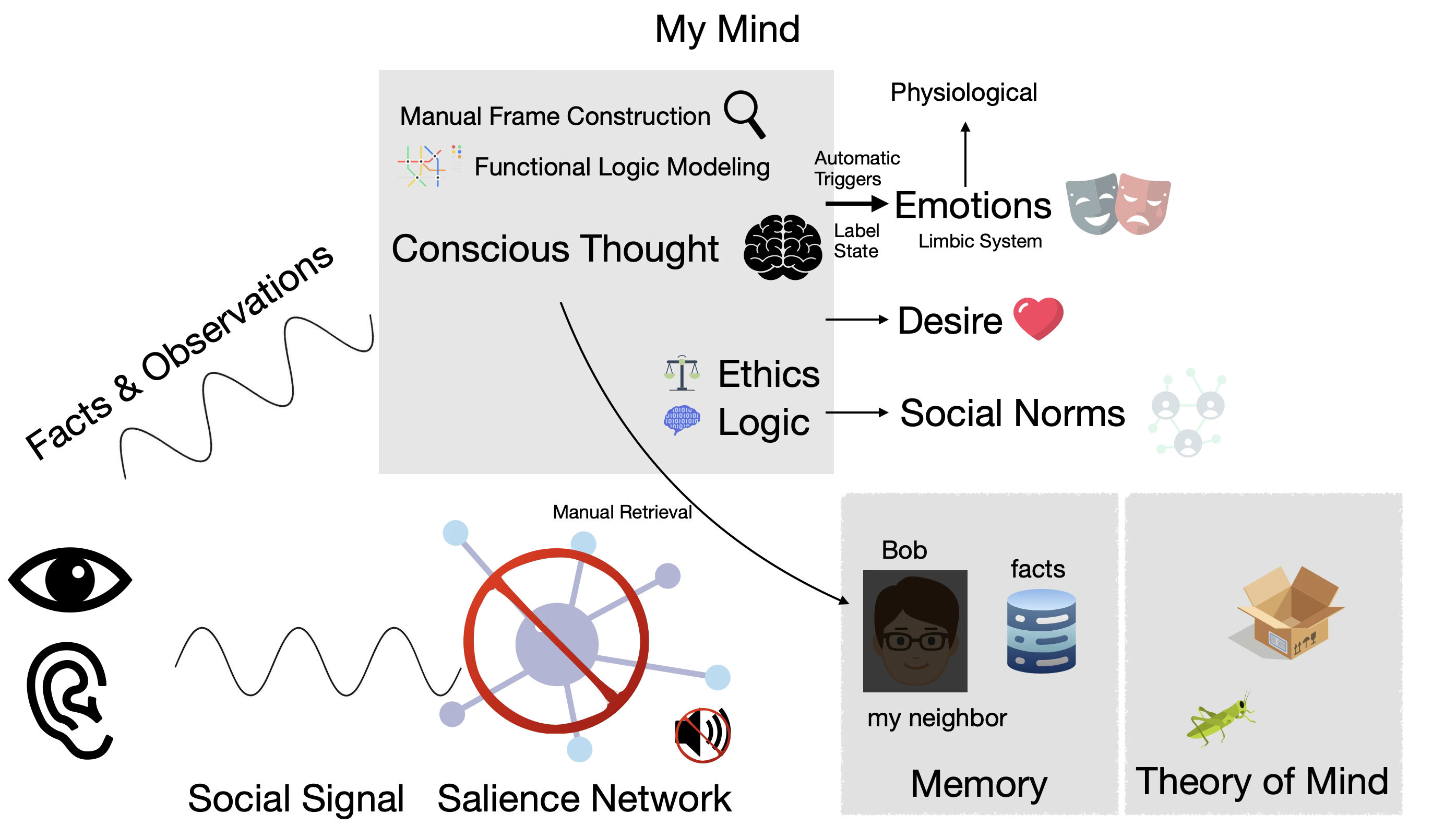
- The various senses provide the “social signal” to the salience network
- As far as I can tell, my senses are OK
- I can notice nonverbal cues of a high enough magnitude: crying, exaggerated facial expressions, laughing, yelling
- My salience network produces no output
- The salience network would provide signal to other systems with importance (salience) information – mine doesn’t
- It doesn’t feed into the limbic system (emotions) – I have no affective Empathy
- I am prosocial
- Have strong Ethics
- Employ Narrative Affective Resonance to understand emotional situations)
- It doesn’t feed Theory of Mind – I have no theory of mind
- I believe that it is either disabled or muted rather than just disconnected because other signals pass through here to provide the salience information for social interaction – I have none
- Failure Example is an example of a failure to assign salience
- Theory of Mind is a group of systems in the brain
- For most people this answers questions like: what is Bob thinking? How is Bob feeling?
- For NT people this is automatic – they don’t have to ask themselves these questions, they know it
- My theory of mind is empty or deactivated, see more details in Theory of Mind
- Mentally I model people as Black Boxes – I can observe inputs and outputs but I don’t know internal state or mechanisms
- Normally, lack of Theory of Mind might make it hard to fit in to society
- I have an alternate “operating system”
- For most interactions, I don’t even attempt to understand what people are thinking – Zero Lag
- For other interactions I use Manual Frame Construction and Functional Logic Modeling to build a logical model
- I can predict something like: if I want output Y then I need to supply input X
- This is very effortful and not often used – think about it like the prep work you might employ for a meeting with the CEO
- For people I know well, I have prebuilt logical models and I can employ coarse grained generic models for random people
- People are not represented in Theory of Mind, rather in my memory
- They have attached metadata
- They are not represented by a persistent simulation as they might be in Theory of Mind
- This is all processed with conscious thought
- The prosocial behavior that would come from social norms comes from Axiomatic Deontology and Ethics – I behave prosocially because I think it is logical and correct to do so
- This is normally low effort, zero lag, and potentially produces the same sort of interaction issues that autistic people experience: Say The Wrong Thing and Double Empathy
- I never attempted Masking because I never noticed I was different
- However, the part of the brain that might cause anxiety about social interaction is … the non-functional salience network
- I have no Shame or Embarrassment
- So I have no anxiety about social gaffes
- But do note that this is asymmetric – I experience no anxiety but people around me, especially my wife, do
- The salience network would normally flow into the limbic system (emotions)
- I do have Emotions but my experience is quite different from NT people
- I don’t have Alexithymia
- Emotions are more a label for mental and physiological state
- Example: I might feel a rush of adrenaline if I am angry. When the condition for being angry is gone the emotion is also go, though the adrenaline may remain. I experience this as “twitchy because of adrenaline” but NT people fell “I am still angry because of adrenaline”
- I am not angry, I am thinking angry thoughts
- Not pictured: the Amygdala (threat center of the brain) can bypass the conscious thoughts
- I am afraid of heights – I feel the fear even though I know logically it is irrational